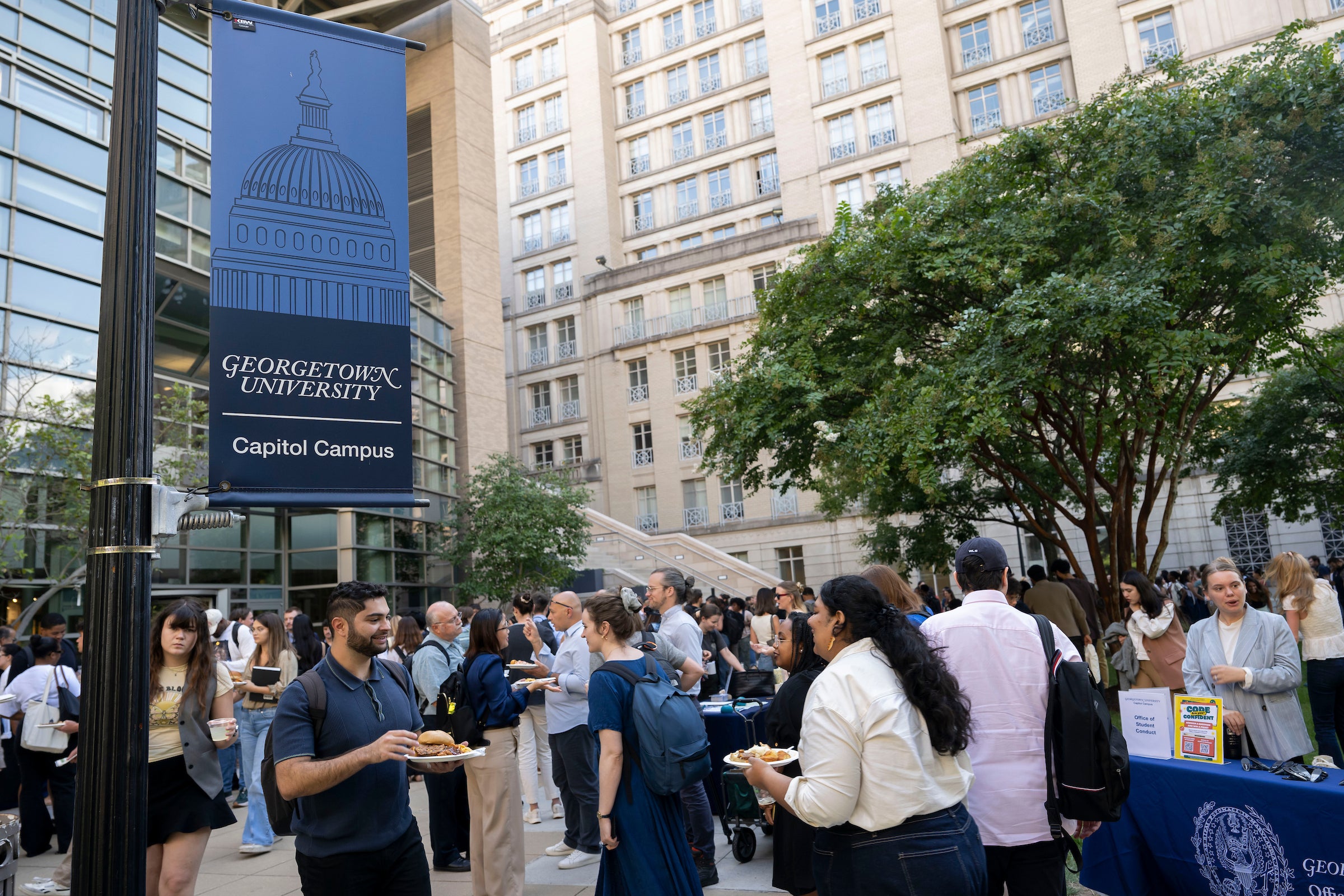
Georgetown’s Launchpad Program at the Capitol Campus Helps Liberal Arts Students Prepare for Careers
A new challenge-based career-development program, Georgetown Launchpad, will launch in the Fall 2026 semester within the Capitol Applied Learning Labs (CALL) at Georgetown University’s Capitol Campus.
The semester-long program will be piloted this fall through a partnership between the CALL, the College of Arts & Sciences, Cawley Career Education Center and the Red House, Georgetown’s hub for educational innovation. Launchpad is a distinct cohort pathway within the CALL ecosystem. It is designed to build upon and amplify CALL’s professional development focus with more concentrated skill development, challenge-based learning and close engagement with employers, for a smooth transition to lifelong learning after Georgetown.
The program features a signature course where students will collaborate with industry professionals and learn to effectively use AI systems to solve complex, real-world challenges.
Launchpad “is about helping students translate their liberal arts education into purpose, action and impact after graduation,” said Tad Howard, the associate director for strategic integration with the Red House. “It’s also about translation, helping students realize and then articulate the real capacities they’ve developed in this environment that translate to the workplace.”
Tackling Real-World Challenges
While Launchpad is being designed as a dynamic experience for seniors, students across all class years are welcome to apply for the Fall 2026 cohort. Those interested in participating should fill out the interest form and attend an information session.
Students apply using the CALL application, which is open until March 29. Late applications for Launchpad will be considered based on availability.
“I hope students who join this program will be able to enter their next step with a deeper sense of clarity and purpose, along with more precision preparation to achieve that purpose,” Howard said.
The centerpiece and anchor course for the Fall 2026 Launchpad cohort will be a new project-based, three-credit course, Wicked Problems: Learning to Plan and Decide in Human–AI Teams. The course is taught by Dewey Murdick, a professor of practice in the School of Foreign Service and senior fellow in the Academic Innovation Network and the Red House. A one-credit Launchpad Studio complements Wicked Problems with personalized coaching and mentoring, employer conversations and structured reflection.
Organizations invited to join the class may include financial institutions, consulting firms and public-interest nonprofit organizations, Murdick said. Throughout the course, students will team up with executives from participating companies and utilize customized AI tools to help define problems, evaluate options and plan responses to real-world wicked problems, which are complex challenges that are hard to define and lack simple solutions because they involve uncertainty, incomplete information and competing values.
Both the students and industry professionals will benefit from collaborating and gaining more knowledge of artificial intelligence, Murdick said.
“This is an environment to learn in,” he said. “It gives executives the opportunity to see emerging talent. …And students can have a lower stakes environment where they can get face time with senior people and work through problems together.”
Advancing Applied Liberal Arts
Launchpad pushes forward the notion of applied liberal arts, Howard said.
A major goal of the program is to affirm the value of a liberal arts education, while helping students recognize that the critical thinking and analytical reasoning skills they’ve gained during their time at Georgetown can be applied directly to their careers in a variety of professions.
Murdick said it is common for students to graduate without fully recognizing the skills they’ve learned. Launchpad is meant to uncover that more clearly.
“Students often have more skills than they realize,” Murdick said. “With Launchpad, we want to help them see how their education has built real capacity and how that capacity can be translated to have real-world impact.”