Pre-Health Advisors Guiding Hundreds of Students and Alumni Have a New Space in Poulton Hall
The new physical space will allow the advisors to expand on the work that they do serving approximately 900 undergraduates who study pre-health, dozens of postbaccalaureate students and more than a hundred alumni.
Pre-health students at Georgetown University have a new space to call their own.
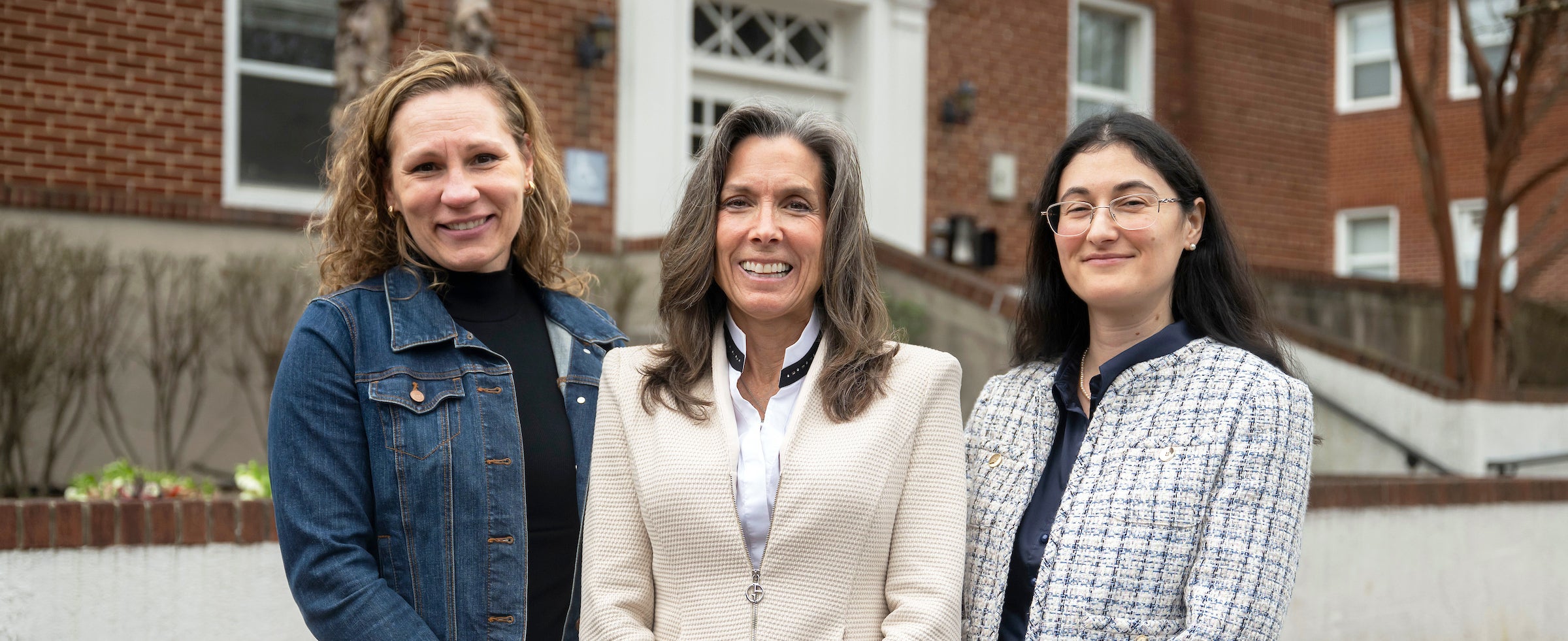
Located in Poulton Hall, across the street from White-Gravenor Hall, pre-health students can now visit the pre-health advisors in a dedicated space. Dr. Mary Beth Connell (M’89), an associate dean in the College of Arts & Sciences and director of the pre-health advising team, moved her office into the building this January, along with assistant directors, Jennifer Ericson and Lucy Cherner.
“I love the location,” Connell said. “It’s easy for students. …And I’ve always loved being in the middle of where their classes are.”
This move provides pre-health students with more opportunities to connect with their advisors and classmates. They can use the physical space to conduct video interviews for medical school, reserve rooms for meetings and study sessions and attend social events with guest speakers. It’ll also allow the advisors to expand on the work that they do.
The Pre-Health Advising Office, housed under the College, serves all pre-health students at the university preparing for careers in medicine, dentistry, veterinary medicine and other health professions. Connell, Ericson and Cherner advise approximately 900 undergraduates across the university who are preparing for health professions. The vast majority of pre-health students are pre-med, Connell said, and are in the College and the School of Health, with additional students in the McDonough School of Business and the School of Foreign Service. The advisors also support dozens of postbaccalaureate students and more than a hundred alumni.
“Students are accompanied on their four-year journey to figure out and discern what they want to do,” Connell said. “We make sure they are as prepared as they need to be.”
A Longitudinal Relationship
Anna Douglas (C’24) credits the pre-health advising team for guiding her on the path to medical school.
At Georgetown, Douglas majored in neurobiology and minored in fine arts, while also competing as a dressage rider. She was originally nervous about how she would fit into the pre-health community as someone with a “background that doesn’t immediately connect to medicine,” she said, but meeting with Connell and the advising team made Douglas feel at home.
“They were so nice, so understanding and so excited to hear about my story and the different things I was thinking about and curious about,” Douglas said.
She is currently deciding on which medical school to attend starting this fall.
“I have received more interviews and acceptances than I could have ever expected,” Douglas said. “I am now in the process of attending accepted students weekends at a number of schools and feel incredibly grateful to have a choice of several incredible schools.”
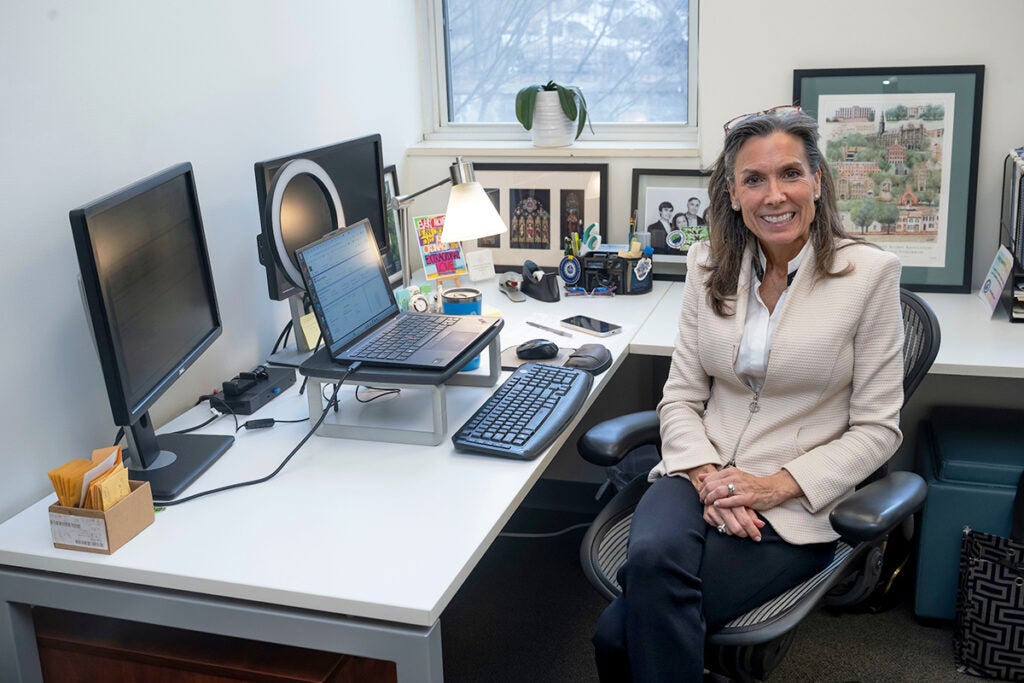
Dr. Mary Beth Connell (M’89) became the inaugural director of the pre-health advising team in 2019 and has seen the acceptance rate of Georgetown students into medical schools climb during her time. (Lisa Helfert/Georgetown University)
Throughout the medical school application process, which she began in the fall of 2024 while taking a gap year, Douglas turned to the advisors for help.
“I was really, really impressed and appreciative of the fact that I already had this longitudinal relationship with them, that I felt comfortable enough to meet with Dr. Connell and ask specific questions,” she said. “But also that there was constant information and workshops and seminars for everyone to go to.”
The advising begins by the time pre-health students arrive on campus.
Ishaan Kumar (C’24), a first-year medical student at Harvard Medical School, said that both his advising dean at the time and Connell had emailed him within his first two weeks at Georgetown. Over the next three and a half years — Kumar graduated a semester early with a neurobiology degree — he became close to the pre-health advisors, as they guided him through the application process.
“They’re the best,” he said. “They just really helped me figure out my path to medical school, because otherwise, I didn’t really know what I wanted to do. It was helpful to have them walk me through it.”
The advice they gave was personalized. Ericson sat down with Kumar and “made a step-by-step, month-by-month plan” for his schedule to fit in studying for the Medical College Admission Test (MCAT) as an undergraduate student, he said. And when he was ready to apply to medical school, Connell, who received her M.D. from Georgetown University School of Medicine in 1989, helped him prepare by conducting mock interviews.
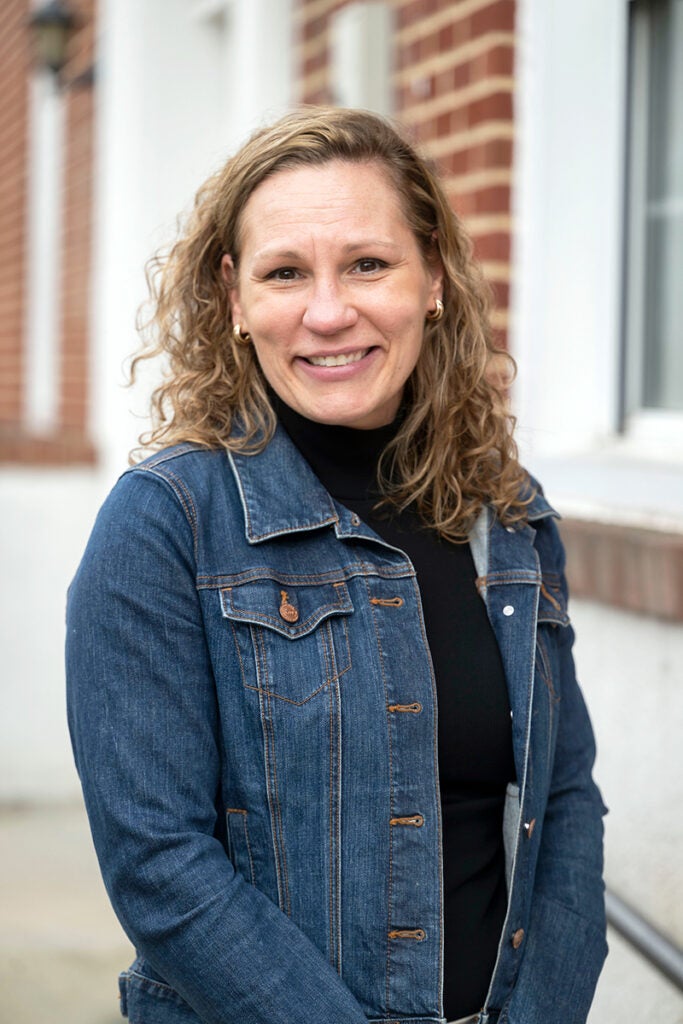
Jennifer Ericson, an assistant director of pre-health advising, joined Georgetown in 2014 as an advising dean in the School of Health and transitioned to the Pre-Health Advising Office in 2022. (Lisa Helfert/Georgetown University)
“I was applying to more research-oriented schools, so she tailored her mock interview questions,” Kumar said. She also put him in touch with at least two alumni of the schools where he interviewed.
In addition to personalized one-on-one advising, there are informational webinars and workshops that students can attend. Cherner, who coordinates Georgetown’s Post-Baccalaureate Pre-Medical Certificate Program, has built a large Canvas course full of resources for pre-med students and also those interested in pursuing education in other pre-health professions, like physician assistant programs and optometry school.
“We have a whole Canvas course available to us in order to learn all the things that prepare us to apply, whereas so many of my friends from other universities just had to use YouTube or pay advisors from outside their university exorbitant amounts of money for private tutoring and counseling,” Douglas said. “I feel really, really grateful for the amount of support I’ve gotten. The advisors genuinely care.”
Both Douglas and Kumar recommend that students reach out to the pre-health advising team as early as they can and to meet them in person. The more the advisors know about the students’ interests and motivations, the better they can assist them.
“They’re the kind of people who won’t try to put you into buckets, or say, ‘Everyone should do this,’” Kumar said. “They’ll find opportunities that align with your interests to help you have the kind of college experience you want, rather than trying to just fit a certain narrative that helps you get into med school.”
A Collaborative Effort
All students who express interest in pre-health can receive support from the Pre-Health Advising Office.
In addition to Connell, Ericson and Cherner, the College of Arts & Sciences and School of Health both have advising deans and faculty members who are knowledgeable about the pre-health admissions process and work collaboratively with the pre-health advisors.
“In my faculty advising role, I feel relatively comfortable giving students some basic advice, but when it comes to any sort of very specific types of questions, I really do rely heavily on the Pre-Health Advising Office,” said Ted Nelson, an associate professor in the School of Health and one of the 11 staff and faculty members that sits on the Pre-Health Recommendation Committee.
The committee, chaired by Connell, reviews students’ application material and sends their evaluations to schools.
Connell said the acceptance rate of Georgetown students into medical schools is “stellar” and has continued to climb since she began her role in 2019. She is also proud that the pre-health advising team does not “gatekeep” access to support. The advisors will help anyone interested in strengthening their applications.
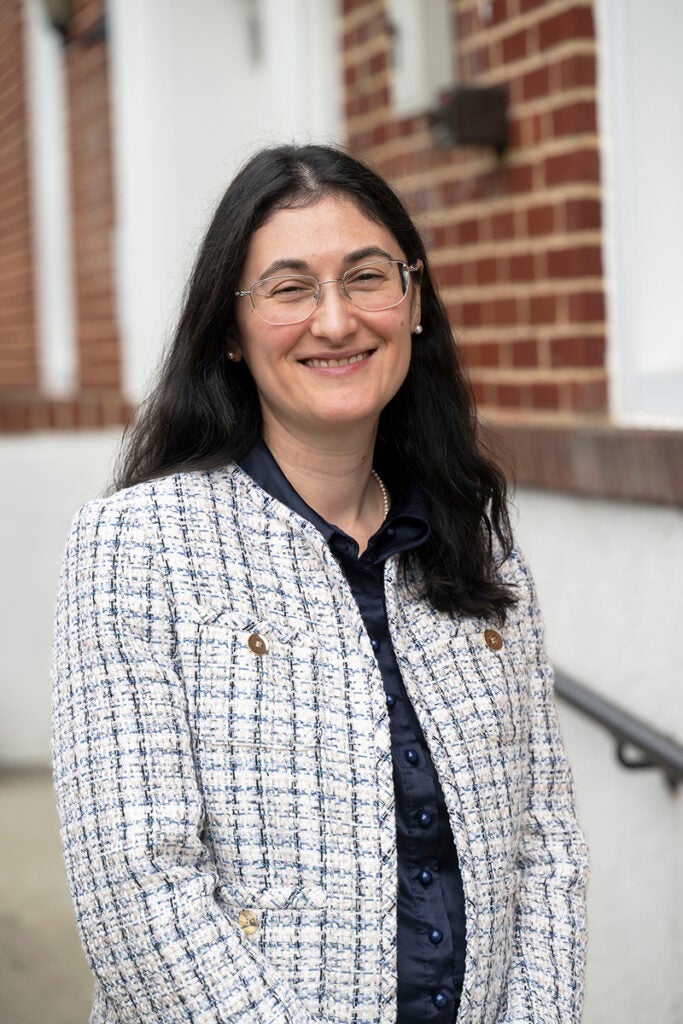
Lucy Cherner, an assistant director of pre-health advising, joined the team shortly after Connell and also coordinates Georgetown’s Post-Baccalaureate Pre-Medical Certificate Program. (Lisa Helfert/Georgetown University)
When students are applying for medical school, Connell prepares them on what she calls, “the big three” focuses: research, clinical experience and service.
“We help them with opportunities,” Connell said. “Research opportunities abound at Georgetown, and not just on the undergraduate campus, but the School of Medicine is right here. …We educate them about all the other wonderful sister and brother institutions we have here where they can find like-minded folks and go out to serve the community.”
Thom Chiarolanzio, director of advising and senior associate dean in the College, believes that Connell has strengthened the pre-health advising program in a comprehensive way.
“I consider us to be very lucky to have somebody of her own experience,” he said. “I’m really appreciative of her attention to providing more expansive opportunities for students that wasn’t always there.”
“She leverages her connections, and she builds new ones,” added Marlene Canlas, an associate dean in the College who is also on the Pre-Health Recommendation Committee. “That has really served our students well.”
Connell helped Eleanor Miskovsky (C’23), a third-year medical student at Columbia Vagelos College of Physicians and Surgeons, find opportunities to shadow surgeons and gain clinical experience while she was at Georgetown.
“It’s so competitive to find even unpaid, like volunteer positions, so it was huge that she helped connect me with people I could shadow and get some clinical experience with too,” said Miskovsky, who majored in biology of global health and minored in French.
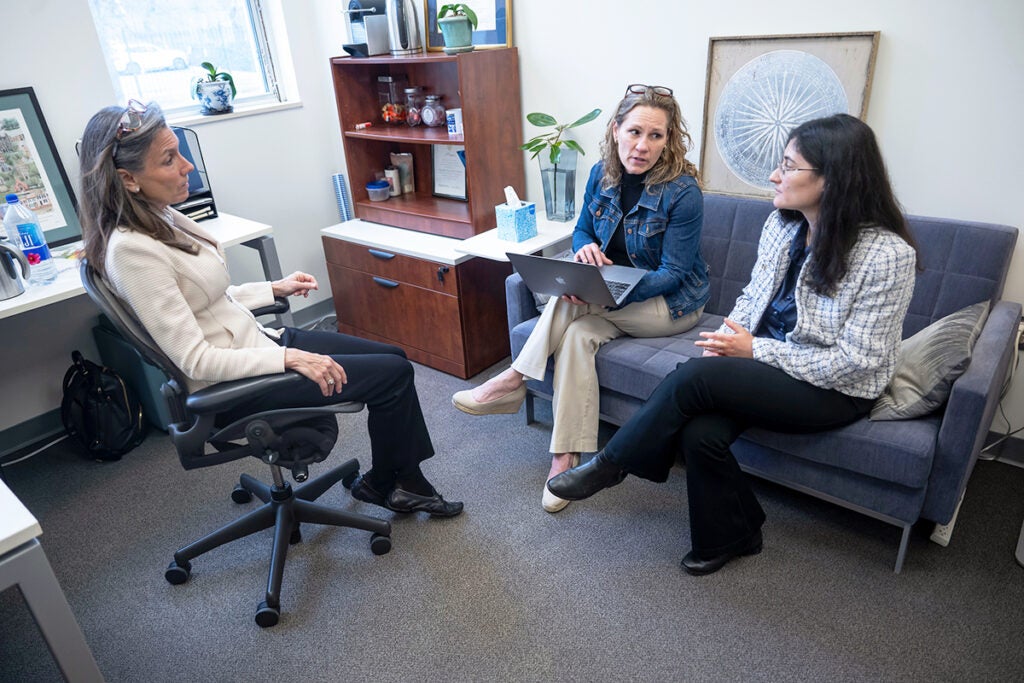
From left to right: Connell, Ericson and Cherner moved their offices into Poulton Hall, located right across the street from White-Gravenor Hall. The dedicated space will allow them to expand on their work serving all pre-health students. (Lisa Helfert/Georgetown University)
The Pre-Health Advising Office assisted Mahad Mohamed (H’22) in finding mentors. During his application cycle, he was paired with a first-year medical student at Georgetown University School of Medicine.
“My mentor was an amazing resource,” said Mohamed, who graduated with a health care management and policy degree from the School of Health. “He helped me with mock interviews and essays and things like that.”
He remembers meeting with Connell at least once every semester to check in and share updates. Even after graduation, he continued to meet with Connell and utilize the resources provided by the pre-health advising team. Mohamed is now a second-year student at the Johns Hopkins University School of Medicine.
“I help students during this journey, and in a way that gives me the same pride I had while accompanying my three kids to adulthood,” Connell said. “I have the most heartfelt thank you notes and emails from my students and it, you know, makes me cry. I’m here to help students. That’s why I do what I do.”
(All photos taken by Lisa Helfert for Georgetown University College of Arts & Sciences)