AI Pioneer De Kai Urges Humans to ‘Parent’ Artificial Intelligence Responsibly
There are hundreds of AIs in our devices, from social media platforms with sophisticated algorithms like Instagram and TikTok to apps such as Google and ChatGPT that use generative AI.
And each one is watching and observing our behaviors, said AI pioneer De Kai. In that way, he believes, AIs behave not like machines of the 20th century but more like “artificial children.” Similar with human children, people must parent their AI children responsibly, argues De Kai, whose surname is Wu but goes by his given name professionally.
“The question I’m asking is, how’s your parenting? Because these artificial kids for the last 20 years already have been by far the most massively powerful influencers in our societies,” De Kai said in an interview.
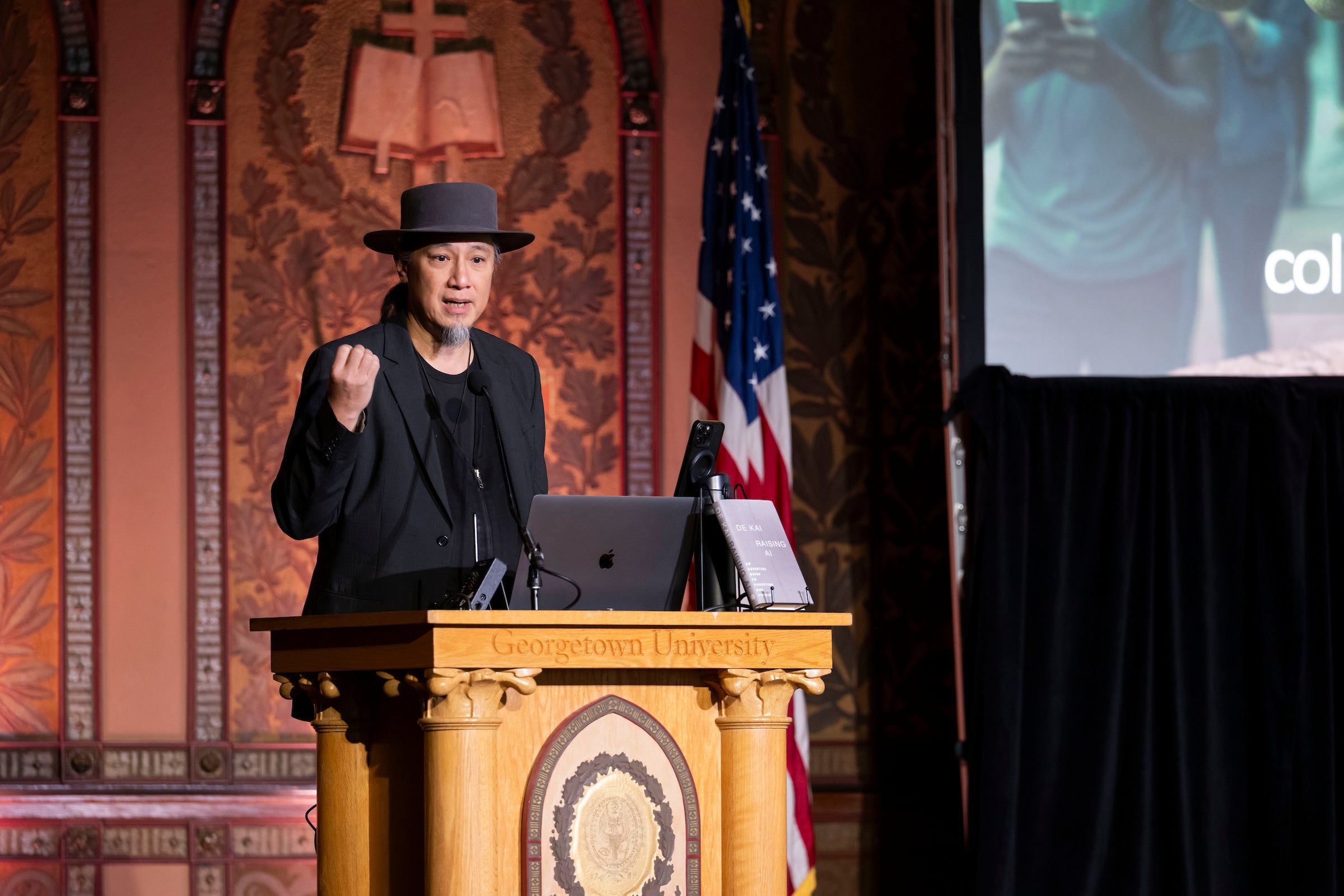
That is one of the main messages in his new book, Raising AI: An Essential Guide to Parenting Our Future, and something he reiterated in a recent talk at Gaston Hall as part of the “What Makes Us Human in the Age of AI” series co-hosted by the Georgetown Humanities Initiative and the Center for Digital Ethics.
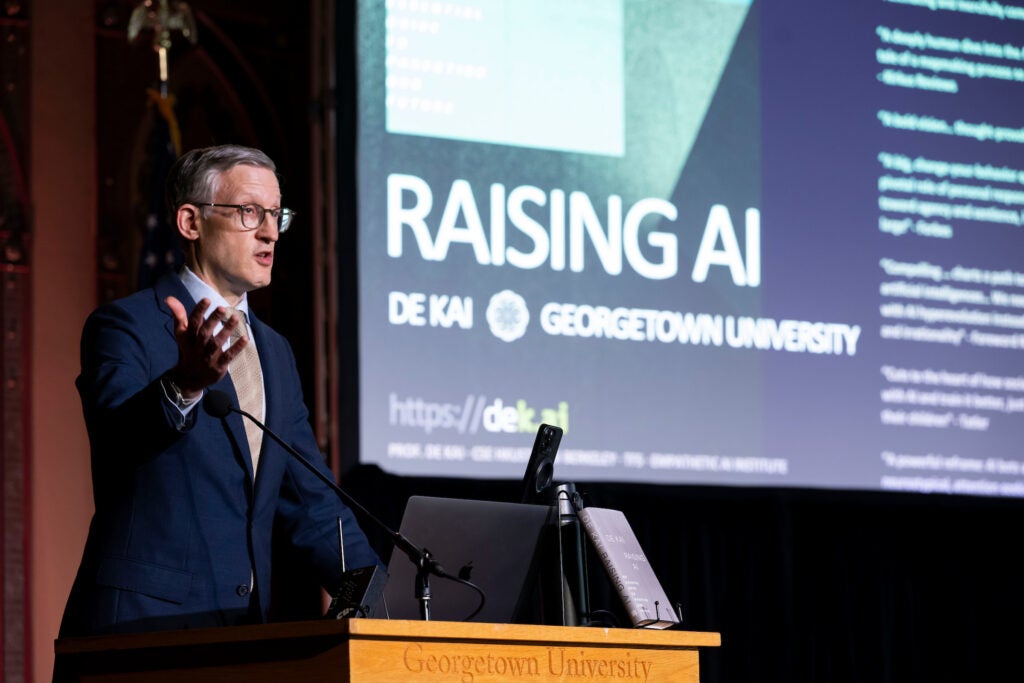
David Edelstein, the dean of the College of Arts & Sciences, helped introduce De Kai and highlighted the importance of the humanities in the age of AI. (Lisa Helfert)
Nicoletta Pireddu, the director of the Georgetown Humanities Initiative, introduced De Kai as “one of the most important voices about AI and the ethics of AI in the world.”
The event also featured remarks from David Edelstein, the dean of the College of Arts & Sciences, and a panel discussion with De Kai, Laura DeNardis, the director of the Center for Digital Ethics, and Edward Maloney, the executive director of the Center for New Designs in Learning and Scholarship (CNDLS).
“We tend to talk about ethics and AI in very general terms,” Pireddu said. “I think what makes De Kai’s book unique is its attention to specific elements that call for concrete responsibilities each of us must take on.”
‘We Are the Training Data’
De Kai has been working in AI research for decades.
He holds a joint appointment at the Hong Kong University of Science and Technology’s Department of Computer Science and Engineering and at the International Computer Science Institute in Berkeley, California.
The event at Georgetown came together after Katy Bohinc (C’07) saw an email last year from the office of Andrew Sobanet, a professor in the Department of French and Francophone Studies and then the interim dean of the College. The email mentioned Pireddu and the opening of a dedicated space for the Georgetown Humanities Initiative.
Bohinc, a mathematics and global and comparative literature major, was thrilled. Pireddu was her comparative literature advisor and Sobanet served as her thesis advisor during her time at Georgetown. She had just finished editing Raising AI – De Kai credits her as his “first editor” in the book – and suggested bringing De Kai to the Hilltop.
“I have an absolutely wonderful network of Georgetown in my life,” Bohinc said.
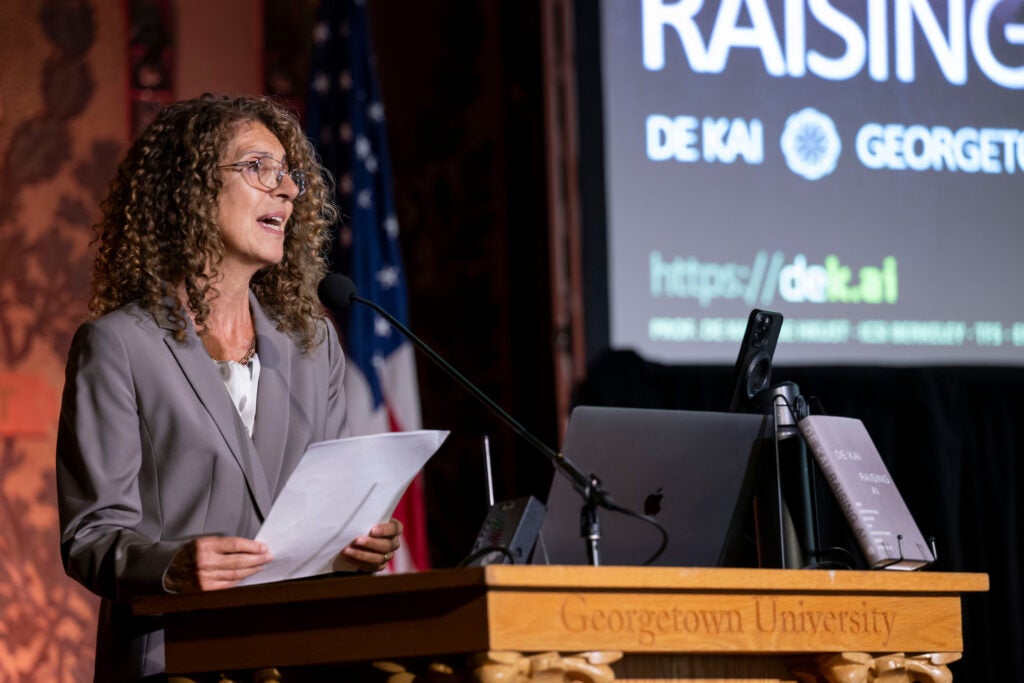
Nicoletta Pireddu, the director of the Georgetown Humanities Initiative, described De Kai as “one of the most important voices about AI and the ethics of AI in the world.” (Lisa Helfert)
She sat in the front row in Gaston Hall as De Kai spoke to a crowd of more than 200 people that included Georgetown faculty, staff, students and community members. A group of more than 30 students, along with their law and government teacher, Monte Bourjaily, from Thomas Jefferson High School for Science and Technology also attended.
In the talk, De Kai said he believes that the public discourse around AI lends itself to asking the wrong questions. AIs are not toasters, steam engines, carburetors or electric fans – they are embedded in our social fabric. Guardrails and regulations alone aren’t going to save us, he said.
“We are the training data,” De Kai said during his presentation. “Whatever I continue to do with my colleagues on the regulatory side, whatever I continue to do with my colleagues at tech companies on guardrails, it doesn’t change the fact that we’re the parental role models. Those of you who work in AI or machine learning will understand there’s only a few things we really control. We control the training data.”
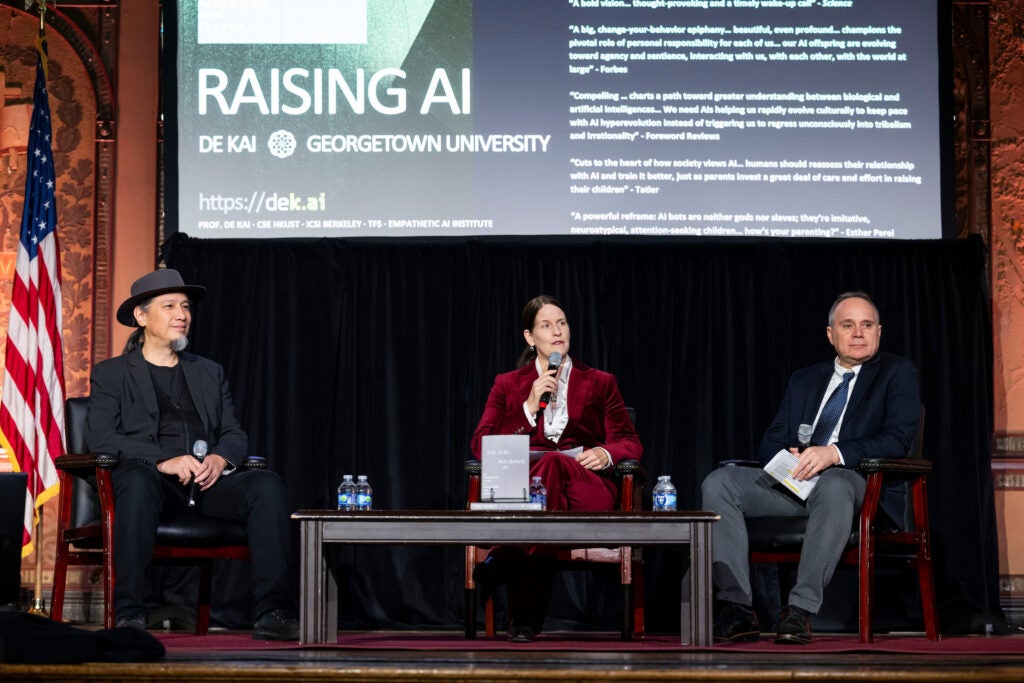
From left to right: De Kai, Laura DeNardis, the director of the Center for Digital Ethics, and Edward Maloney, the executive director of the Center for New Designs in Learning and Scholarship (CNDLS). (Lisa Helfert)
AIs decide what pops up on our screens – and perhaps even more importantly, what we don’t see – something De Kai describes as “algorithmic censorship.” That is connected to a phenomenon De Kai calls “neginformation,” which he defines as “misleading facts that manipulate you not through deception, but through what’s left unsaid.”
The potential consequences of that are dire, De Kai warns.
“When we don’t know something about other groups, about other perspectives, another unconscious bias is that we fear what we don’t know,” he said. “And fear tends to slide into anger and hatred, and that slides into demonization, which slides into dehumanization.”
Responsible Parenting
De Kai wants his book to be a call to action.
“We are the last generation of humans that gets to parent AIs. All the future generations of AIs are going to be parented primarily by AIs in the labs,” he said during his presentation. “We have one last shot at getting this right.”
Being a responsible parent means being mindful of what is being consumed and how you interact with it online.
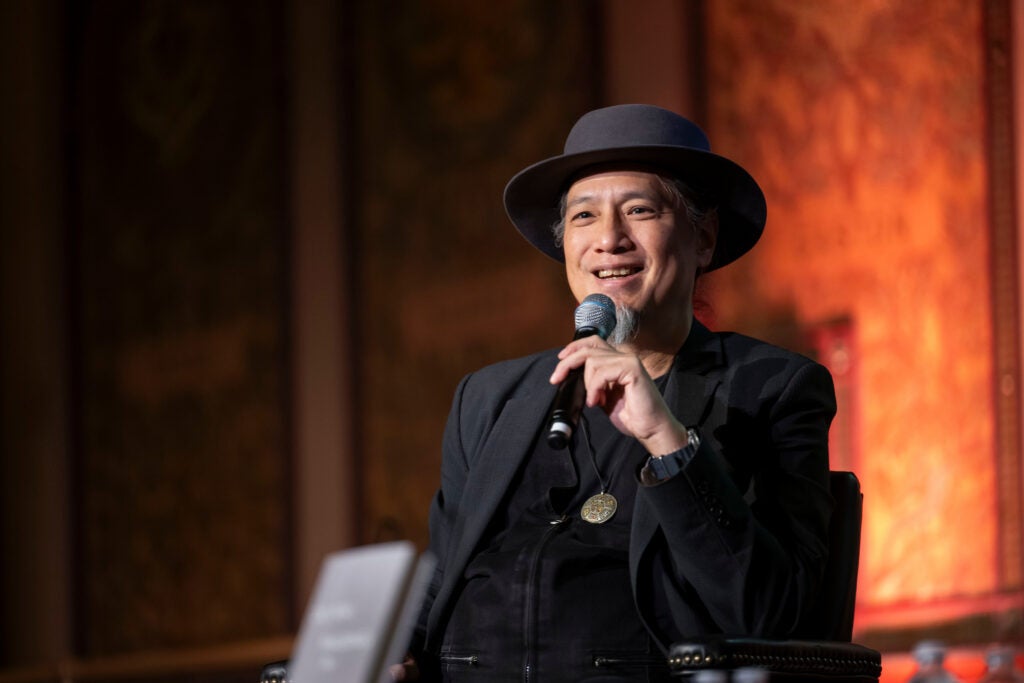
De Kai holds a joint appointment at the Hong Kong University of Science and Technology’s Department of Computer Science and Engineering and at the International Computer Science Institute in Berkeley, California. (Lisa Helfert)
In his book, De Kai shares recommendations on how to better raise our AIs.
“Teach your AIs to look for more diverse opinions,” he writes. “Break the echo chambers. Click more on stories framed in contrasting perspectives, on stories explaining other cultures. Try to re-orientate your perspective – especially when the technologists and policymakers still haven’t gotten it right. Teach your AIs to be polite and respectful. ‘Like’ or ‘Share’ reasoned, fact-based, respectful discussions – not insults, offensive wording or trolling.”
AI has the potential to be the most transformative tool invented to address the destructive power of biases, De Kai said, but major changes need to be made. We can all play a part.
“We have only survived today because parents do their best,” he said.
(Photos by Lisa Helfert for Georgetown University)