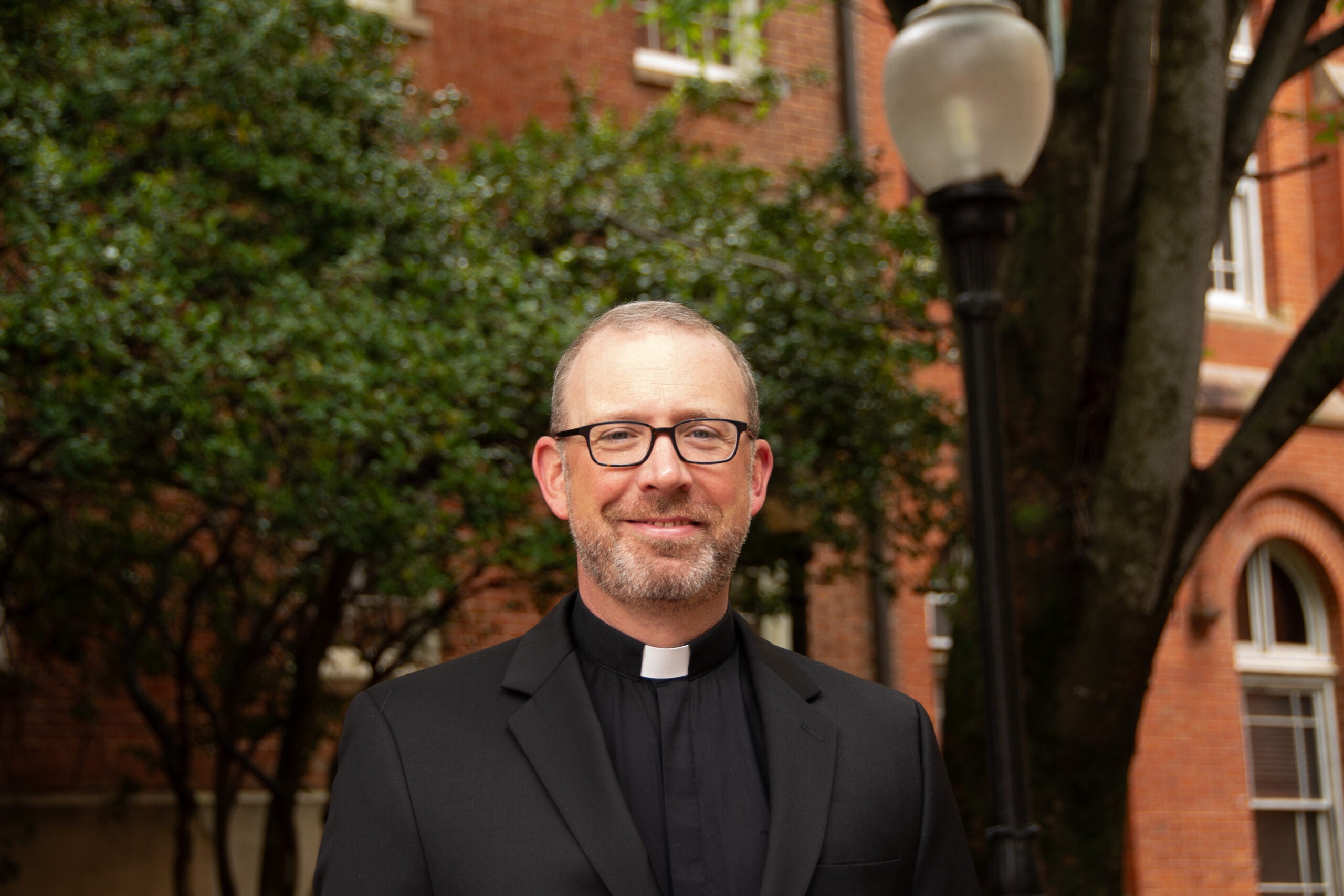
Expert Advice: The 3 Stages of Decision-Making With Fr. Peter Folan, S.J.
Each day, we make an almost countless number of decisions, most of which resemble picking the outcome of a coin toss — this or that outfit, sandwich or coffee order — more than choosing exactly one from among many potentially life-changing options — this or that spouse, career or home. Still, every decision, no matter the degree of its apparent significance, entails facing a field of possibilities and cutting off some number of them in order to pursue only a few, or maybe even only one, of them.
And that cutting off — the Latin word caedere, the root of “decision,” means “to cut” — can be hard.
When I face a decision, I try to approach it in three stages, and during each, I pose to myself a series of questions and challenges to help me proceed as soundly as possible. Like the rest of us, I can make poor decisions; I can skip stages, questions and challenges, either intentionally or unwittingly; and I can be dissatisfied with the outcome of a decision, even when I make a “good” decision, that is, one that adheres to the following process.
Stage One: The Conditions
No decision appears out of thin air. The circumstances of our lives and our worlds converge, and at some point out come the scissors to start cutting. I find that attending to three conditions underlying a decision is especially worthwhile.
How do I want to spend the time I have to make this decision? You may be the sort to want decisions on and off the table as quickly as possible, or the sort who waits until the very last moment to make a decision. Most of the time, you probably join me in being somewhere in the middle.
Whatever amount of time you have or want to take to make a decision, consider a balance between training your thoughts directly on it, and, in a sense, forgetting about it. Sometimes, time away from a decision is the best preparation for making it.
Fr. Peter Folan, S.J.
What is important to me? This is a question of values, only some of which will come into play in a given decision. Choosing between a cappuccino and a macchiato prioritizes the value of taste and pays no mind to the value of what one thinks it means to live a good life. Choosing between career paths should do the opposite. The most complex decisions we make will touch on a variety of our values. We do well to identify those values and weigh them, not with the goal of producing a ranked list, but in order to discover what is of great, and even greatest, importance to us.
What are my options? You own only so many shirts, and you know only so many people who could be a potential spouse or friend. The options before you in almost any decision are limited, and it is advantageous to identify as many of them as is reasonably possible. No, you cannot meet every person in the world before locking arms with one, but you can look at every shirt in your closet. When you are making a decision, devote time to unearthing the options before you, including options that might be hidden at first. Even though you are told to choose between x and y, perhaps there is a z yet to be revealed or created.
Stage Two: The Making
Once the conditions become clear — and, note, they can shift throughout the decision-making process — I move from asking questions to presenting myself with some challenges. Two of them are vital.
Have some conversations. I try to find the Goldilocks zone between the extremes of crowd-sourcing my decisions (everyone but me has a say) and making them in total isolation (no one but me has a say). The sorts of voices I need to hear to empower me to make decisions in my life, especially major decisions, are varied: friends, family, mentors, wisdom figures and experts are just a handful of them. The two voices that I always strain hardest to hear are my own and God’s. Neither comes to me in an auditory event, but both, if I give them time, well up in unmistakably clear ways.
Execute a decision. I can articulate this challenge even more briefly: cut! Many people find choosing a way forward, and as a result, leaving any number of ways behind, the single most challenging aspect of making a decision. They have good reason to think this way, especially when a decision is of a “one way” nature, that is, I cannot undo it without great cost, time or effort. When I come to the moment of execution, I try to remind myself that I have taken seriously the conditions surrounding and listened carefully during the conversations informing my decision. And then I cut, sometimes nervously.
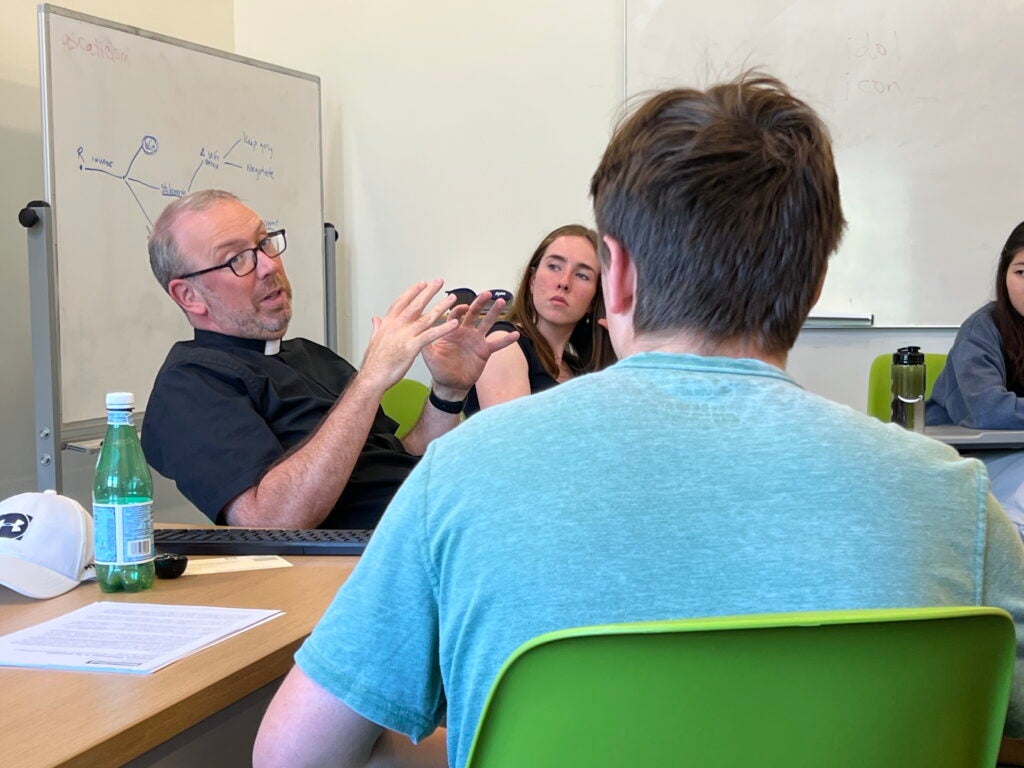
Fr. Peter Folan, S.J. is teaching the first-year Ignatius Seminar, How to Make a Decision, this semester.
Stage Three: The Aftermath
All done, right? If we are talking about deciding between a turkey or tuna sandwich, yes, but for the more consequential decisions, no. A challenge and a question remain.
Live into the decision. Once I make a decision, especially an important one, I try to put it behind me and follow out its implications without immediately second-guessing myself. If my decision is to run a marathon, then I need to start training for those 26.2 grueling miles. Muscle soreness after the first few practice runs does not mean I decided poorly. If my decision is to become a physician, then I need to start studying my natural sciences. Earning a C on an organic chemistry exam does not mean I made a mistake. The fruits of an executed decision often require our work and our patience to mature.
Do I want to reconsider my decision? There are, of course, decisions whose hoped-for fruits will not blossom, no matter how much work, no matter how much patience you devote to living into them. At some point, you might have to reconsider a decision, even a “one way” decision, and return to the beginning of this process. When is the time to do that? Identifying that moment is more art than science, but there is a guiding question I have for myself when I suspect that I am approaching that moment: Is my decision integrating the various parts of me to help me become someone of depth and meaning, or is it disintegrating those parts and making me superficial and shallow? If I am walking the path of disintegration, it is time to find another path.
Fine Tune Your Decision-Making
“Measure twice, cut once.”
This maxim of tailors and carpenters ought to be the mantra of our decision making too. Measuring carefully, that is, following a process of decision making like the one I have articulated here, does not guarantee that each of our cuts, each of our decisions, will have perfect results. No process can do that. These three stages, though, reveal the component parts of decision making and allow you to fine-tune them so that you make the decisions of your day, of your life, with greater awareness and purpose.
Fr. Peter Folan, S.J. is an assistant professor in the Department of Theology and Religious Studies.