Environmental Historian Dagomar Degroot Looks to the Past to Navigate the Future of Climate Change
For Degroot, the value of history lies in its ability to inform what comes next. Environmental history, in that sense, is about the future that is still being shaped.
In a quiet office in the Department of History, the past is anything but distant for Dagomar Degroot, a professor of environmental history. History is a guide to understanding what lies ahead and helps find potential solutions for one of the world’s most pressing and urgent challenges: climate change.
That challenge, in his view, is a question of survival, equity and resilience.
“The world has warmed by about one and a half degrees Celsius since the late 19th century,” he said, noting that at this threshold, “certain things start to break down, like the coral reefs, globally.”
The question of why has become central to his work and reveals a key insight: climate change does not produce uniform outcomes. Some communities suffer, while others adapt or even thrive, depending on social and economic conditions.
In his research, Degroot, who is an expert on climate change, space exploration and existential risk, does not approach the past in isolation.
“I’m a very unusual historian in that my research into the past is shaped by my perception of what matters now and in the future,” he said.
Responses to Climate Change
Growing up in a small town near Niagara Falls in Canada where “there are more cows than people,” Degroot said he was fascinated with anything that could take him far away.
That curiosity became a way of expanding beyond the limits of place. At first it took the form of science — astronomy, weather systems, the atmosphere — but eventually found a home in history. Today, as an associate professor of environmental history at Georgetown University College of Arts & Sciences, Degroot’s work sits at the intersection of climate, society, space and time.
He was recently honored with the College’s Stevens Faculty Excellence Award for excellent research, effective mentoring of student research and innovation in a social sciences field.
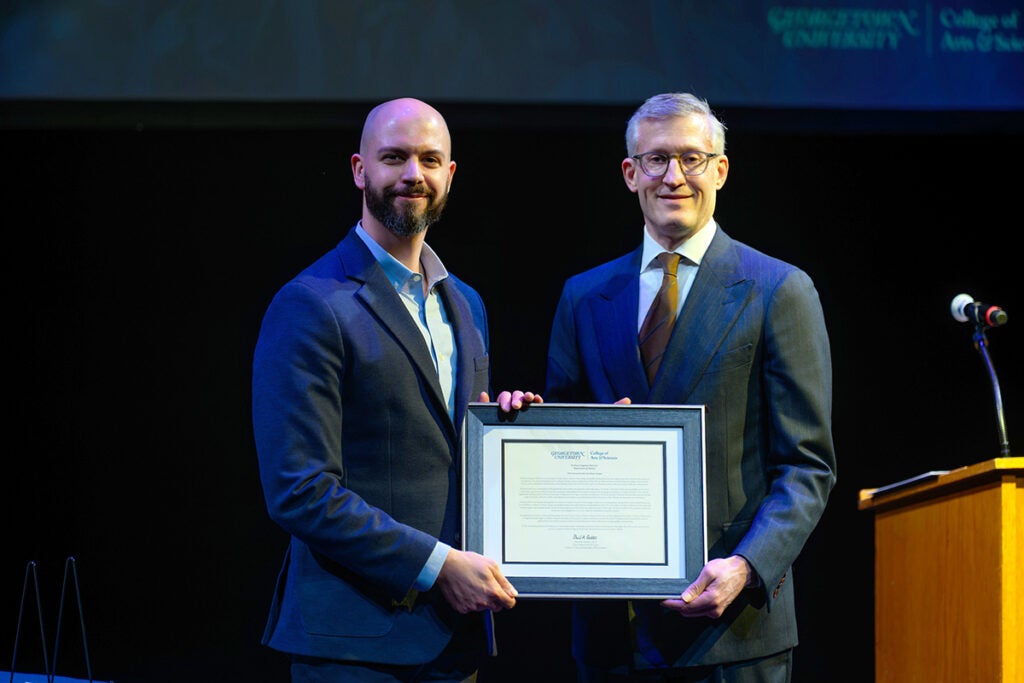
Dagomar Degroot, left, poses with David Edelstein, dean of the College of Arts & Sciences, after receiving the College’s 2026 Stevens Faculty Excellence Award. (Photo by Rafael Suanes)
Degroot discovered his interest in environmental history when he was studying for his master’s degree at McMaster University in Hamilton, Ontario.
“I had this idea that I could find out how the climate changed even before the rise of greenhouse gas emissions and industrialization,” Degroot said. “That I could perhaps discover how different populations responded to changes in the climate, and use their responses to try to figure out where we might be headed in the future.”
His doctoral research at York University in Toronto focused on the Little Ice Age, a period of natural climatic cooling between the 13th and 19th centuries. Degroot studied the Dutch Republic, a society that “seemed to prosper and grow as the climate cooled,” he said.
“Many people suffered, but at a fundamental level, their society got stronger,” Degroot said. “It grew, it prospered.”
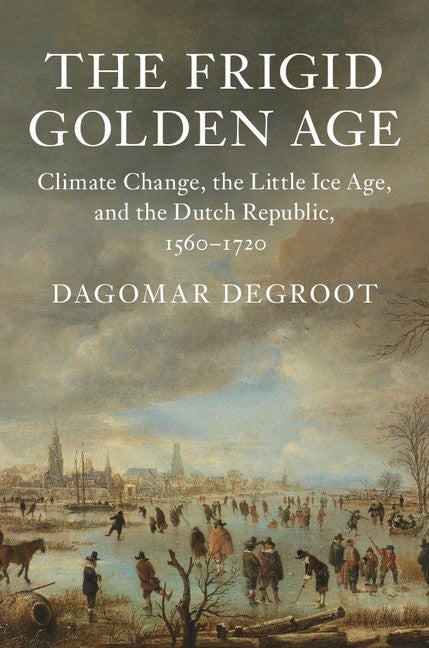
Degroot’s first book was published in 2018 by Cambridge University Press.
That research ultimately led to his first book, The Frigid Golden Age: Climate Change, Crisis, and Opportunity in the Early Modern Dutch Republic, published in 2018. In the book, Degroot argues that being more connected to the rest of the world could help a society be more resilient in the face of climate change.
“The Dutch prospered not because their republic was rich but because much of its wealth derived from activities that benefited from climate change,” Degroot wrote in a 2018 Washington Post article. “Today, we can learn from the republic by strengthening social safety nets, by investing in technologies that exploit or reduce climate change and, more broadly, by thinking proactively about how we will adapt to the warmer planet of our future.
Degroot believes that the more you mitigate climate change, by reducing greenhouse gas emissions, the less you have to adapt. “The less you mitigate, the more you have to adapt, until you can’t adapt,” he said. “You can think of mitigation as being significantly more important than adaptation — but adaptation still matters, and history might be able to teach us how to adapt.”
To Degroot, history offers a clear lesson: inequality can weaken resilience. Communities marked by inequality are more vulnerable to environmental shocks while more equitable societies are better equipped to respond. That’s partly because it’s poor people who are often most at risk of flooding, for example, or high food prices caused by extreme weather.
“A society that thrives as climate changes probably can’t have extremely high levels of socioeconomic inequality,” Degroot said. “I think that it can make a society brittle in many different ways.”
Existential Risks
Degroot’s research now extends beyond Earth.
In his new book, Ripples on the Cosmic Ocean: An Environmental History of Our Place in the Solar System, he explores how space research has revealed risks that shape life on this planet.
One example begins with dust storms on Mars. Scientists studying these storms discovered that atmospheric particles could cool a planet, which is an insight that eventually contributed to the theory of nuclear winter.
In another case, early space missions raised fears that dangerous microbes could travel between Earth and other worlds, imperilling environments on a vast scale. Yet, in spite of these concerns, “the actual systems that were developed to avoid contamination were full of problems, some of which were understood at the time, and some that escaped detection” Degroot said.
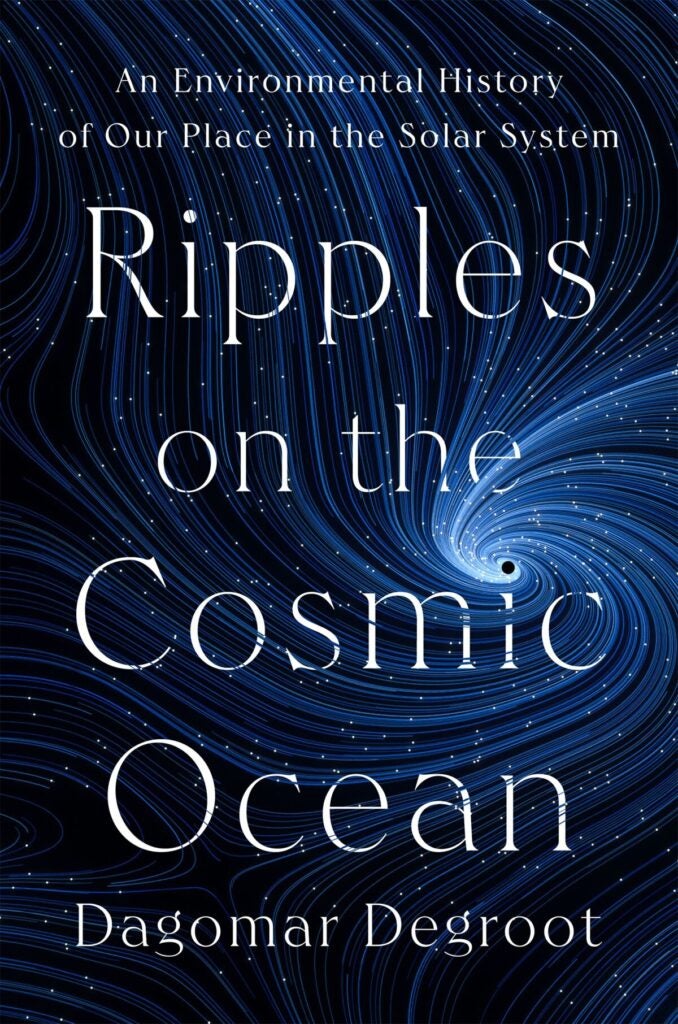
Degroot’s latest book was published in 2025 by Harvard University Press.
His research on space allowed him to identify a recurring pattern: intense pressure and competition between countries has led to existential risks throughout history, risks that threaten the survival of humanity.
During the Space Race between the United States and the Soviet Union, for example, both countries fought for the court of public opinion.
“Faced with this kind of constant competitive pressure, people prioritized known risks to missions or astronauts over unknown risks to planetary environments,” Degroot said.
It reminds him of the modern competition between corporations and world powers over artificial intelligence.
“History shows us how dangerous that kind of competition can be when it’s applied to areas that can create existential risks,” Degroot said. “I think a policy solution there is to try to reduce that competition as much as possible.”
The Joy of Discovery
Despite the weight of his research subject matters, Degroot finds joy in discovery.
The idea of having a thought about any aspect of the past, present or future that nobody else has had before is really thrilling.
Dagomar Degroot, professor of environmental history
At Georgetown, that excitement carries into the classroom, where he encourages students to think differently about history. He also explores new ways of storytelling, including digital projects that bring climate history to broader audiences.
Degroot is the writer, narrator and producer of “The Climate Chronicles,” a multimedia project on the history and future of climate change. The series draws on research in archaeology, history, climatology and geology to explain how climate change has influenced humanity. With dramatic storytelling, it targets the widest-possible audience.
For Degroot, part of the value of history lies in its ability to inform what comes next. Environmental history, in that sense, is about the future that is still being shaped.
“We’ve got 300,000 years of human history,” he said. “And I think this deep legacy of our ancestors is so under-realized as a way of helping us to understand where we might be headed in the future. The world today is, of course, very different from the world of the past, but people, I think, inherently are kind of still the same. My goal is to write histories that can help us understand how to avoid risks, how to thrive in spite of them, or even because of them going forwards.”