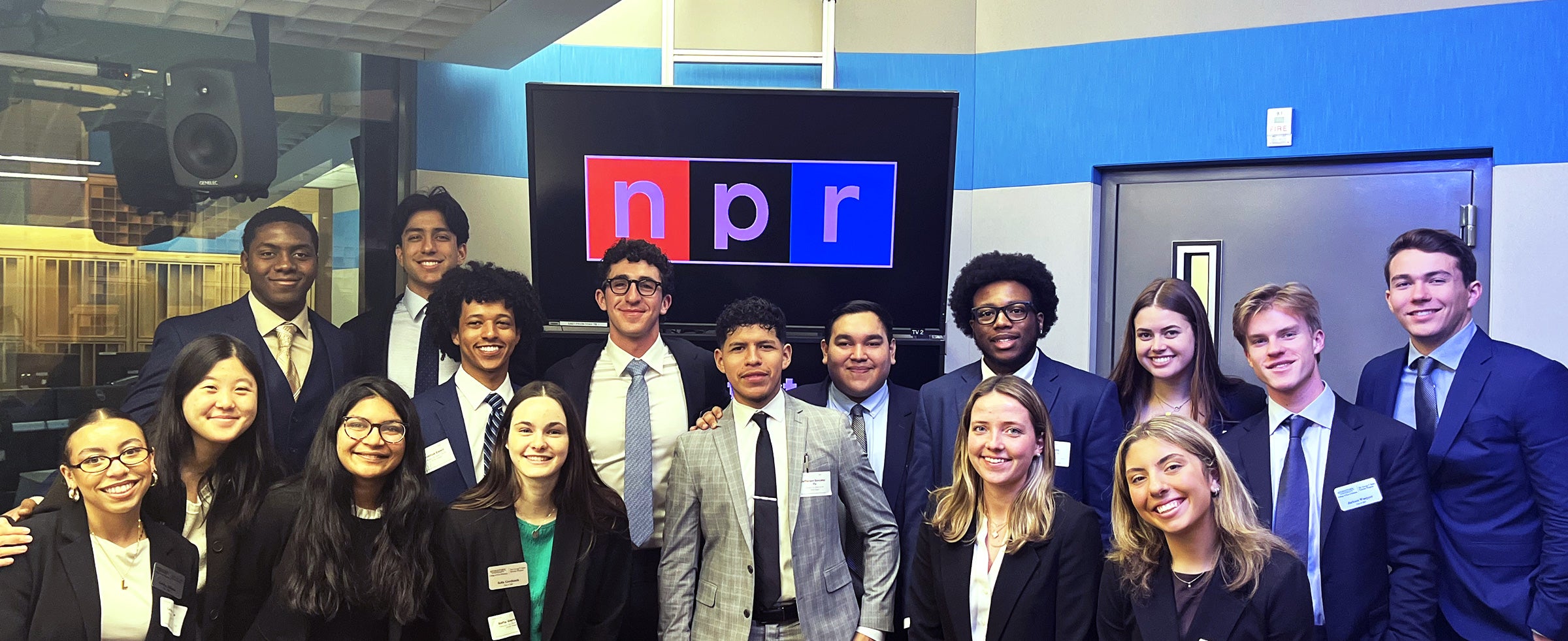
Baker Scholars Program’s DC Day Helps Shape and Inspire Career Paths
Each year, students in the Baker Scholars Program spend a full day visiting businesses in the DC area and learning from local industry and social impact leaders.
By sunset on a chilly and overcast Friday evening in late February, the students in the George F. Baker Scholars Program had walked more than 10,000 steps and gained hours worth of knowledge. They spent the day touring businesses in the DC area and engaging with local industry and social impact leaders for their annual DC Day trip.
This year, the students — 16 of the 19 total in the program — visited Graham Holdings Company, where CEO Tim O’Shaughnessy (B’04) shared stories about his business career; NPR, where students heard from arts and culture writers and editors and NPR Music producers; José Andrés Group, where chefs and operations leaders demonstrated their inspirations at the test kitchen; and Lafayette Square, where founder and CEO of the private credit firm, Damien Dwin (B’97), gave an impassioned speech about “leaving the system better than you found it.”
For lunch, students heard from Kathleen McCabe (C’94), a partner in the strategic advisory group at PJT Partners and former Baker trustee, who emphasized the importance of a liberal arts degree in the business world.
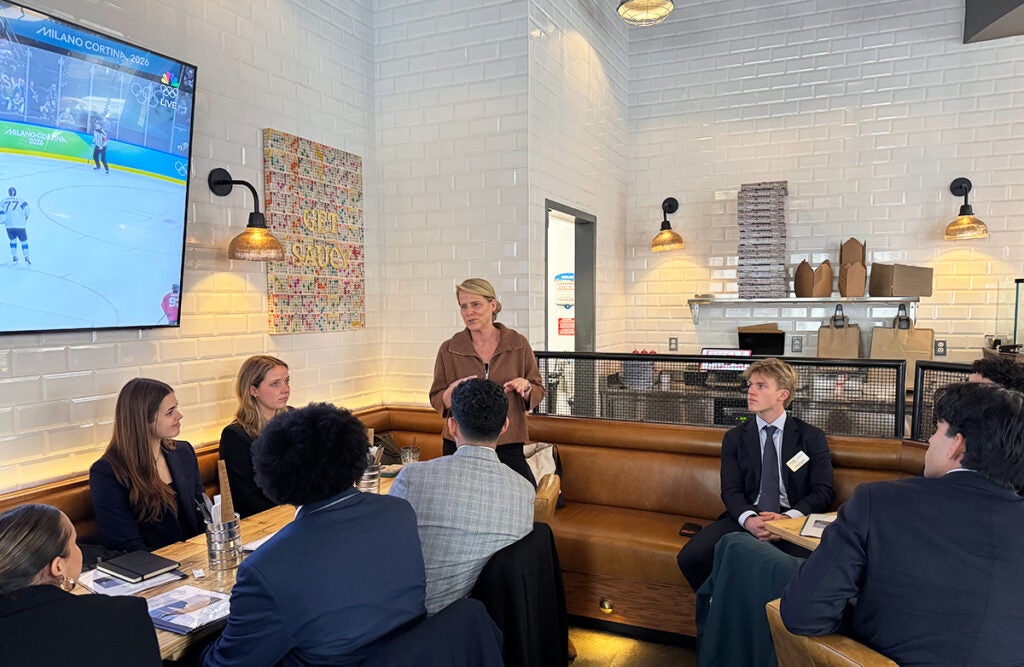
Former Baker trustee Kathleen McCabe (C’94), standing, talks to Baker Scholars students during DC Day.
These visits can serve as networking opportunities. But, more importantly, they can help shape career paths and interests. DC Day is the third of these trips that students in the Baker Scholars Program take each year, following a trip to New York City earlier in the spring semester and a visit to a rotating city each fall.
“DC Day, as well as the other trips that Baker Scholars undertake, expose the students to a wide variety of business opportunities as well as different locations,” said Stefan Zimmers (C’92, G’97, G’07), the decanal representative to the program. “This is an incredibly valuable process not necessarily for the short-term but has an impact long-term in particular as students make transitions in their careers. Many of these meetings also contain really important life advice that is relevant and applicable at any time.”
A Bird’s Eye View
The Baker Scholars Program consists of undergraduate students in the College of Arts & Sciences who are interested in business and have a commitment to service, Zimmers said. Selection for the program takes place in the spring of a student’s sophomore year.
“Being a Baker is to be a Baker for life,” said Kaitlin Martin (C’26), a political economy major who is minoring in Spanish and business studies. “You come into this program trying to learn about yourself and different industries, but also to give back to your community and future students within the program.”
During events like the DC Day trip, Baker Scholars students gain exclusive access to business executives and leaders. These individuals can provide a “bird’s eye view” on the path they took to the top of their industries, said Josh Dawit (C’26), who is majoring in government and minoring in sociology.
“In my experience, when talking to people that are much further into their career, they’re a lot more candid about failures and setbacks that they’ve had because they’re not like recent grads that are still trying to put up that image of perfection for their next employer,” Dawit said. “Seeing those people talk very candidly about those things and still be in the positions that they are is not only reassuring but also very tangibly helpful.”
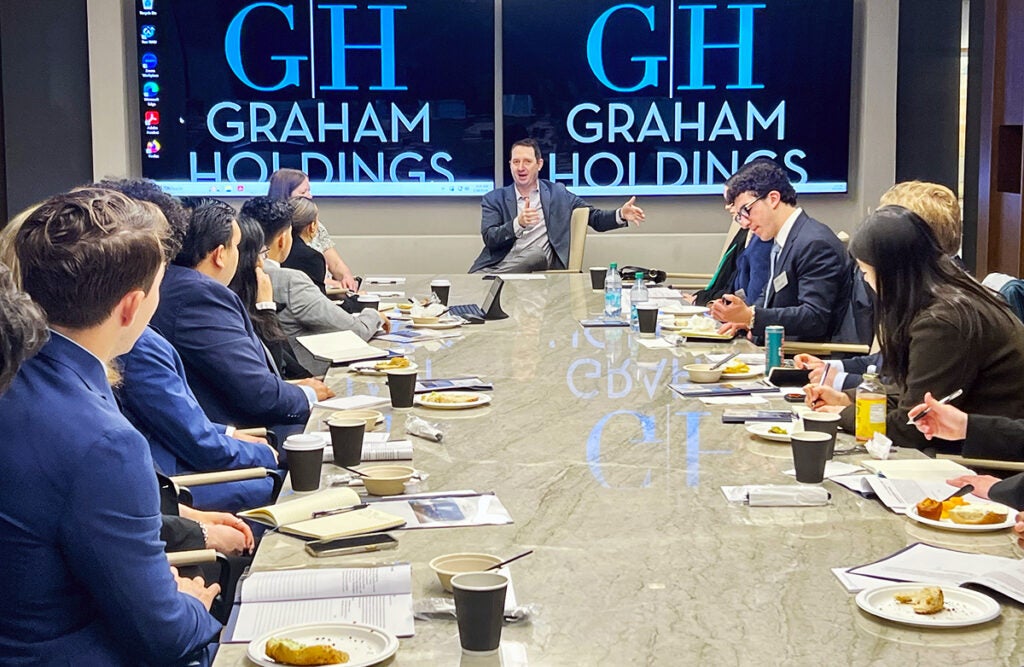
DC Day started off with a conversation with Graham Holdings Company CEO Tim O’Shaughnessy (B’04), pictured in center.
At the visit to Graham Holdings Company, O’Shaughnessy shared stories from his time as a product manager at America Online — “AOL at the time was like Google,” he said — and as the co-founder and CEO of LivingSocial, a local e-commerce company that, at its peak, was valued at multiple billions of dollars and had thousands of employees.
He joined Graham Holdings Company in 2014 and was named president and CEO in 2015. The holding company’s portfolio includes Kaplan, Inc., a global leader in educational services; Framebridge, a custom framing service company; Slate, a daily online magazine; and Clyde’s Restaurant Group, the owner and operator of The Tombs.
“There are a lot of different ways to be successful,” O’Shaughnessy told the students.
Charlie Berger (C’27), a political economy major who is minoring in philosophy, said he was inspired by the meeting and learning more about the historical legacy of Graham Holdings.
“That was amazingly informative for me,” he said. “The relationships that they are looking to build with their portfolio are not ones of menacing dominance … but are more like part of a family. I think having that really long-term approach to investing is what a lot of great investors say is most important.”
Follow Your Passions
Everything about music interests Sofia Gershanik (C’27).
She is passionate about singing, songwriting, musical theater and the intersection of business and music. At Georgetown, she is an American musical cultures major with a Spanish and psychology double minor. After graduation, Gershanik wants to work with musical artists.
The visit to NPR felt tailored for her and reinforced in her mind the importance of liberal arts skills.
“It really just makes me see how important connection is, and that’s something that I focus on a lot in music,” Gershanik said. “Music is not only about expression but human connection and being able to speak or sing or resonate with somebody else in some way.”
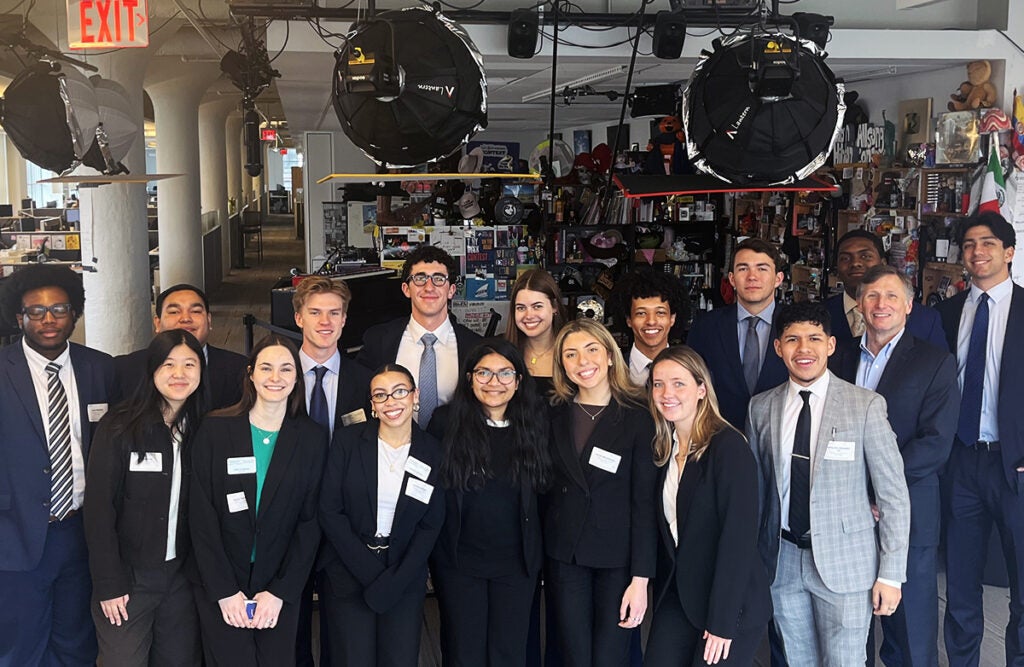
As part of the tour of NPR headquarters, students stopped by the desk where Tiny Desk concerts are filmed.
As part of the tour of the broadcasting organization’s headquarters, students got to see where Tiny Desk concerts are filmed. After the tour, students heard from Bob Mondello, an arts critic; Ciera Crawford, the chief culture editor on the Culture Desk; Mitra I. Arthur, a producer for NPR Music; Valentina Rodríguez Sánchez, an audio engineer; and Josh Newell, the technical director for NPR Music.
For Gershanik, the biggest takeaway was the joy and care that each person brought to their role.
“Passion is a really big thing,” she said. “I think a lot of times, when talking to business professionals in any industry, you get the sense of like, ‘This is the job they do.’ This is how they do it, and then they go home and they do what they like. But at NPR … you bring your passion to your work. They can’t do their work without feeling excited about it.”
‘New Ways and New Ideas’
All of the fondest memories for Berger, a junior in the Baker Scholars Program, revolves around food and conversations with people. His “true dream job” would be to one day start a restaurant group, he said.
Visiting José Andrés Group reaffirmed those interests.
“It was important for me to go there and see what is arguably one of the most successful restaurant groups,” Berger said.
During the visit at José Andrés Group’s corporate office, students lined up in front of the test kitchen and heard from Hector Contreras, the former research and development chef, Tammy Saunders, the research and development pastry chef and Alan Grublauskas, the director of operations for José Andrés Group in DC.
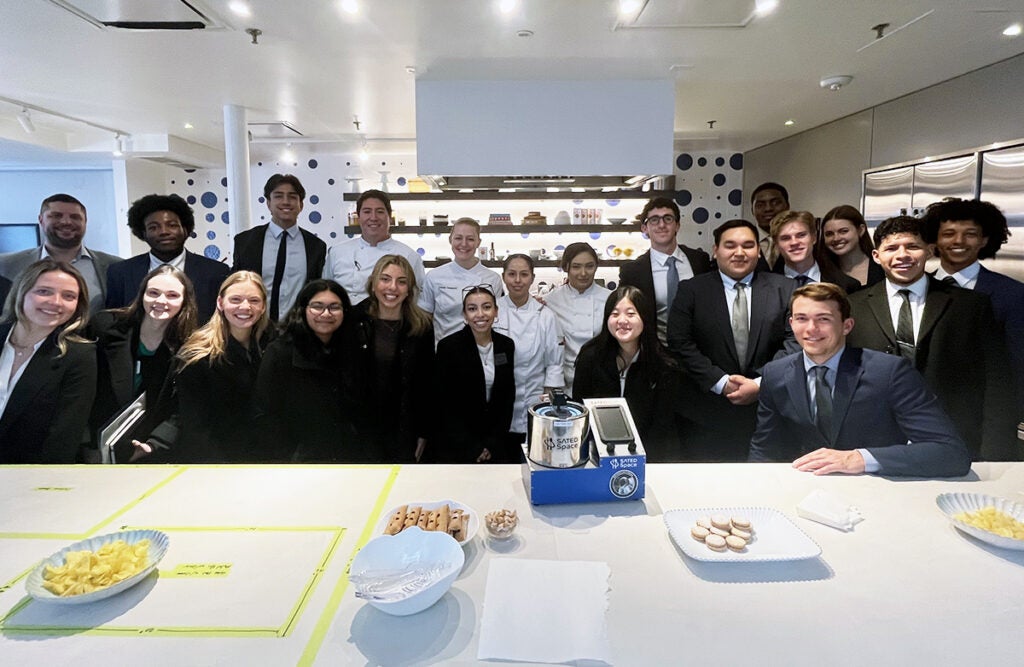
Research and development chefs at José Andrés Group treated the students to some of their culinary creations.
The R&D team explained how they come up with different culinary concepts and served the students several samples, including a “Philly cheesesteak” air bread, one of the signature items at The Bazaar by José Andrés: a puffy pita filled with creamy white cheddar espuma foam and topped with onion jam and wagyu tenderloin. The R&D team also talked about the future of cooking and eating in space.
“We’re finding new ways and new ideas,” Saunders said.
Like Berger, Arnoldo Sandoval Garcia (C’26) found the conversation about the restaurant business and the constant need for reinvention to be illuminating. He has experience working with Rogers & Sons Produce Inc., a produce distribution company in the San Antonio Wholesale Produce Market, and recently accepted a job as a production supervisor for Ready Foods, a family-owned food manufacturer based in Colorado.
“It’s a very low chance that a person actually goes to visit your restaurant twice,” said Sandoval Garcia, an American studies major. “If they visit your restaurant three or four times, you have a client for life. So, how do you create those experiences for your clients to keep on coming back to your restaurant?”
The conversation was helpful even for those, like Gershanik, who aren’t interested in entering the food and restaurant business.
“If I need to apply any of those skills to a future career, whether that be in music or not, I can now work on developing them,” she said. “I have the context to learn from.”
Anything Is Possible
Dwin, the CEO of Lafayette Square, a private credit firm lending capital to growing middle market companies in working-class places, began his speech to the students with a declaration: “What you do with your money and power is your choice.”
He implored the students to have an agenda, while adding that it’s okay if that evolves. Spend time understanding economic systems, and then leave them better than you found it, Dwin encouraged.
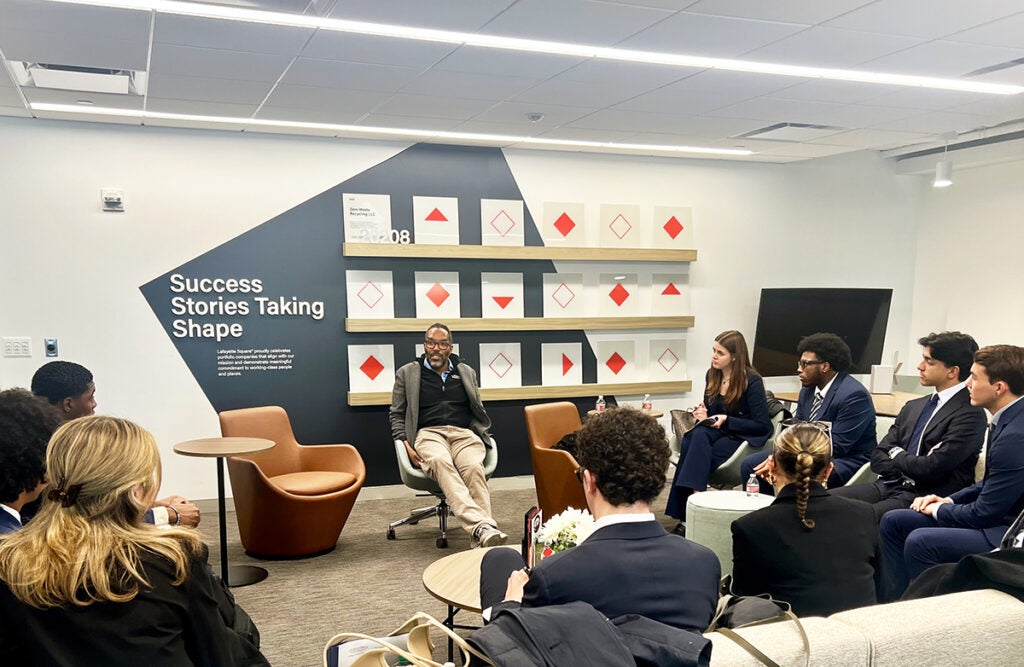
Lafayette Square CEO Damien Dwin (B’97), center, gave an impassioned speech about “leaving the system better than you found it.”
Dwin, who began his career as a trader with Goldman Sachs in New York and London, believes that working-class people and places are often ignored by private credit. Lafayette Square aims to support 100,000 working-class jobs, invest 50% of capital and curate benefits for 50% of its portfolio companies by 2030.
“I’ve never felt more alive than in the presence of ethical human beings,” he said.
Dwin’s speech left an impact on TJ Johnson (C’27), an economics major and junior in the Baker Scholars Program, crystallizing his belief that studying liberal arts is important to becoming a strong business leader.
“I think that going to these visits really shows that anything is possible,” Johnson said. “You can really follow your passions in a very unstructured way, especially during our time being young, and make a very major impact by just following your heart.”