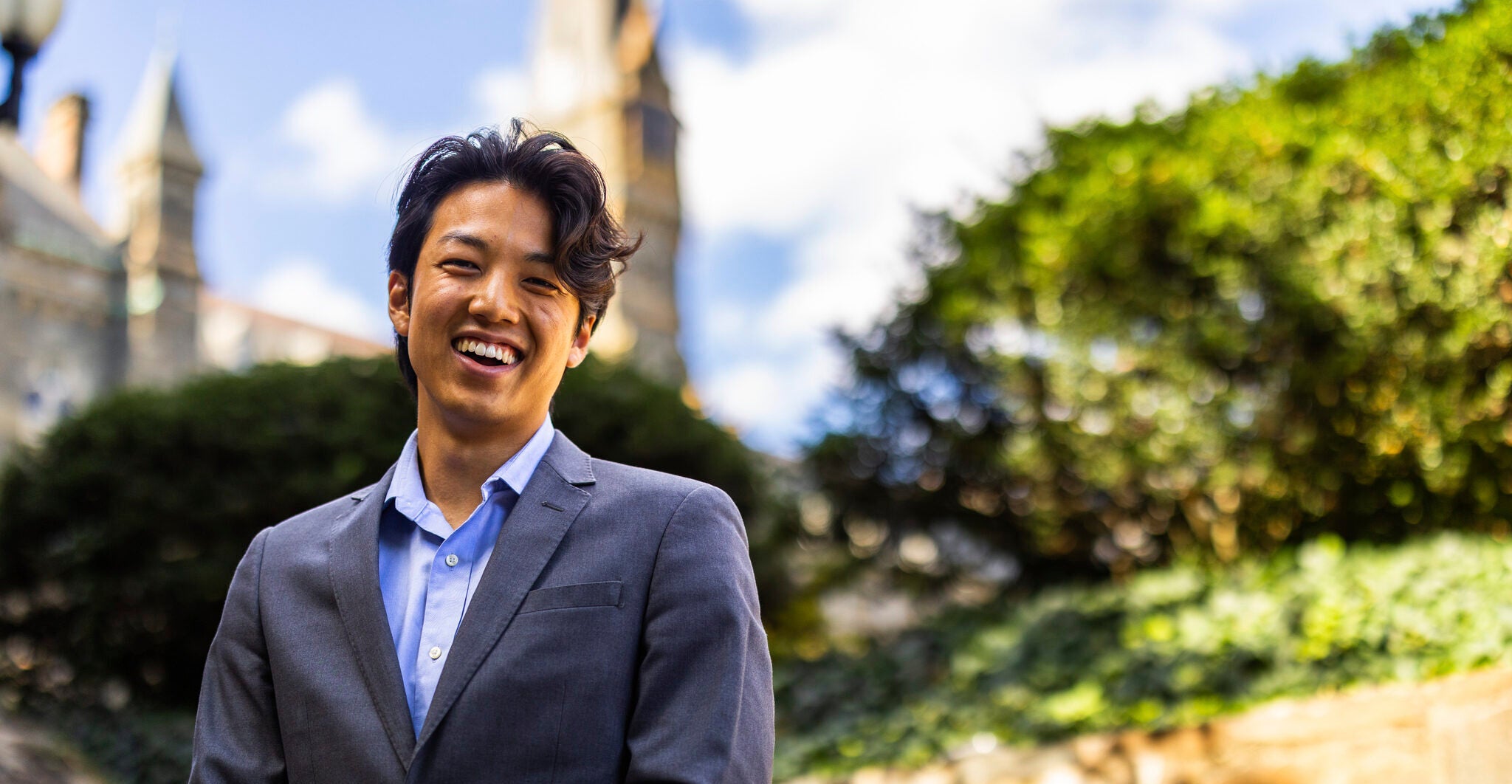
This Senior’s Political Passions Led to a Path Devoted to Immigrants’ and Workers’ Rights
Andy Feng (C’26) remembers his passion for politics started early in life.
As a middle schooler, instead of playing video games or sports after school, Feng would be at home, eagerly awaiting the 5 p.m. broadcast of CBC News. His dad also had a cable subscription to all of the American national news channels. Feng, born and raised in a suburb of Toronto, would watch news on politics — particularly from the United States — any chance he could. In high school, he wrote papers on the Cuban Missile Crisis and other historic U.S. political events.
“I had the bug of loving American politics and American news,” Feng said. “I thought about politics in a very analytical way very early on about why people believe the things they believe.”
That passion eventually led him to the U.S. and Georgetown University, and Feng will graduate this May with a degree in government from the College of Arts & Sciences. During his four years on campus, Feng has gained experience in immigration policy and organized labor. He plans to attend law school in the fall to become an immigration or labor lawyer. A Rhodes Scholarship finalist, Feng hopes to advise on the future of immigration law from the legal perspective.
“I want to do appellate litigation for a plaintiff’s law firm,” Feng said. “I don’t think I can have a long career in law without addressing working-class issues.”
Immigration Policy Reform
Feng’s interests in immigration policy and labor are rooted in his personal history.
In 1999, Feng’s parents left China with his older brother to immigrate to Canada. The move provided new opportunities for the family, but Feng’s parents left a part of themselves behind in China, he said.
His mom was a kindergarten teacher, and his dad was an aerospace engineer. The extra education and re-certification required in Canada made it difficult for them to continue their old careers, Feng said. Instead, they took clerical jobs at a local bank.
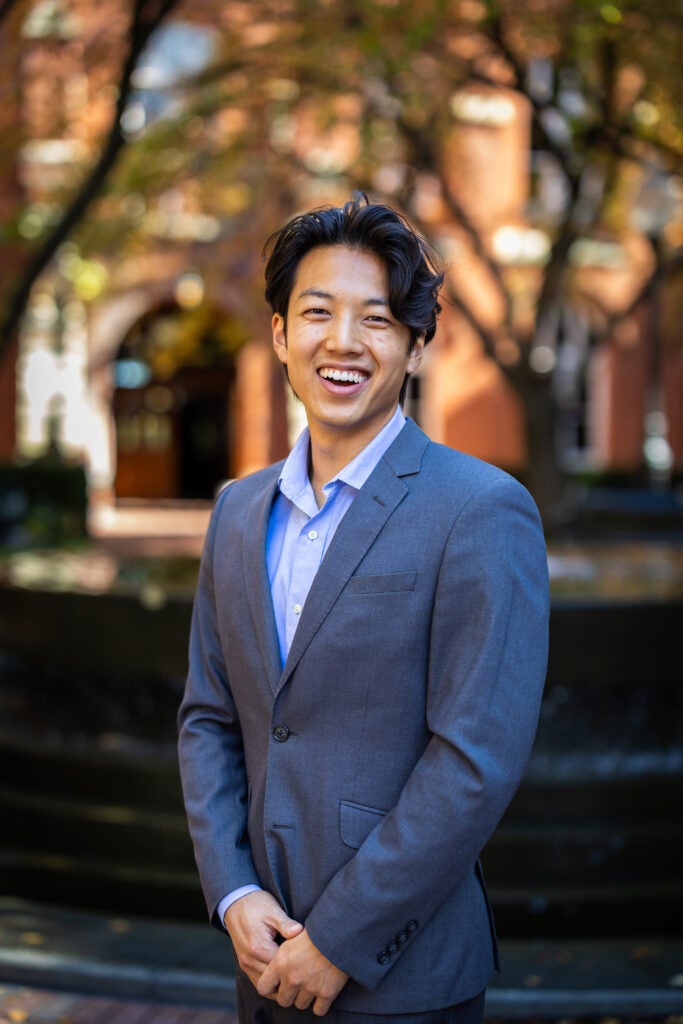
Andy Feng (C’26) will graduate this May with a degree in government from the College of Arts & Sciences.
“I can never give my parents their old careers back,” Feng wrote in his Rhodes Scholarship application. “However, I can still give back to Canada by making it easier for the next generation of skilled immigrants to economically integrate. My parents’ career sacrifices have pushed me to imagine a Canadian immigration system in which Persian doctors, Ukrainian scientists and Burmese care workers can easily continue these careers as Canadians — contributing to our nation in the ways they know best.”
“Economic immigration is much more than just a way to supply Canada’s labor market,” he added. “A moral immigration structure must first grant newcomers their innate humanity and basic social rights.”
Feng wrote his senior thesis on what he calls the critical juncture for economic immigration reform in Canada, the U.S. and the United Kingdom from 2008 to 2014. His key takeaway is that while the three countries originally revolved around different immigration systems, all of them converged toward an American two-step model for immigration. In that system, immigrants may be selected for temporary work by U.S. employers and then potentially transition to a non-guaranteed permanent residence.
“Only a small percentage of all those who apply can get it,” Feng said. “If you don’t get it, you should, as logic, leave and end your stay in the countries. But the implication of my thesis is that many people don’t. That is driving some of the immigration issues we see as hot-button topics today.”
One of the goals for his thesis was to set the groundwork of how countries got to their current immigration systems before exploring possible solutions. Among the questions that Feng asks are:
- Can there be an economic immigration system that minimizes precarity for those living life within it?
- How can we make a system that protects the ability of immigrant workers to be safe and have a voice at their workplace, without fear of immigration action initiated by their employer?
- How can we see these goals as top priorities alongside national growth and economic success? Is it possible?
“It’s an extremely privileged thing that I get to say the system worked for me,” Feng said. “I wish that were the case for more people.”
Standing Up for Workers
Feng’s commitment to workers’ rights has been shaped by his liberal arts education.
At Georgetown, Feng took The First Amendment class as a first-year student with Joseph Hartman (G’15), the Walter I. Giles Associate Professor of the Practice in Constitutional Law in the Department of Government. The course, he said, changed his life.
“It was a seminar,” Feng said. “It had no grades, no tests, and the only thing you would do is write a 25, 30-page paper at the end of class. …That really solidified me in the government space, because I thought if I could do stuff like this every semester, that’d be super cool.”
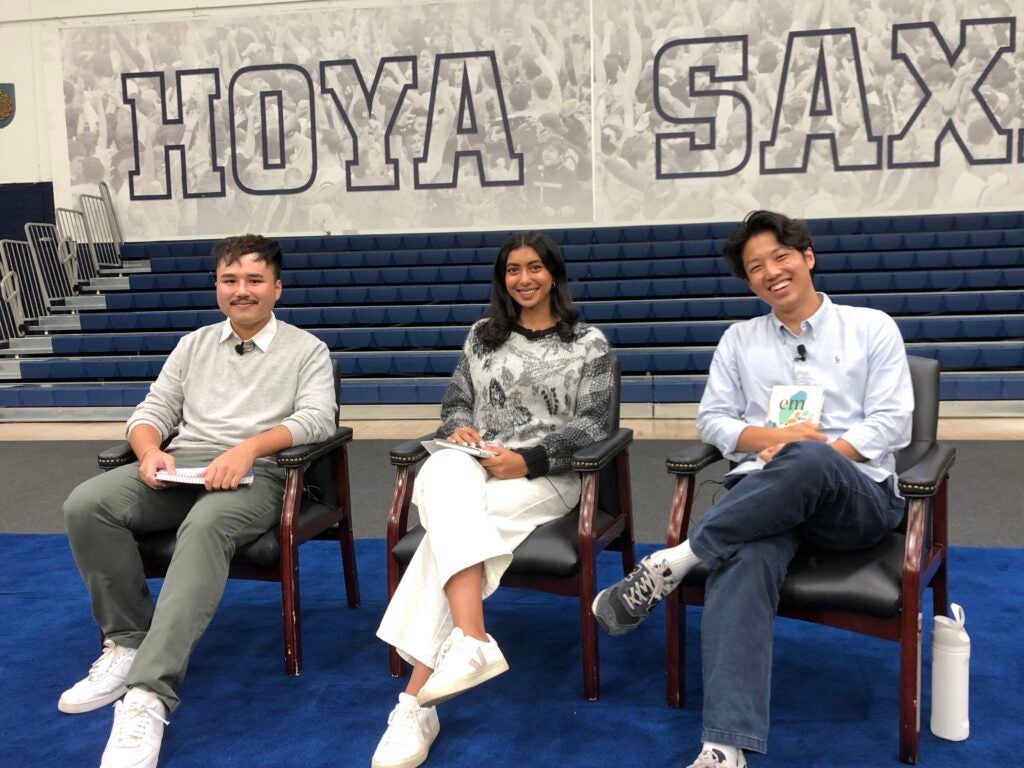
Feng, right, with co-hosts, Nate Ha (G’26), left, and Aria Nimmagadda (C’26), center, at the 2025 Marino Family International Writers’ Academic Workshop, where they discussed the book, Em by Kim Thúy. (Courtesy of Andy Feng)
Feng made an immediate impression on his professor.
“From the outset Andy had an amazing talent for thoughtful consideration of — and understanding of — complex concepts, an innate intellectual curiosity and a very good sense of what he wanted to do after college, even as an incoming first year,” Hartman said. “Andy has always kept his focus on his long-term goals — specifically to work in support of organized labor, and both his academic work and his professional experience has been geared toward that goal.”
Feng also enjoyed Elements of Political Theory with Mark Fisher, an assistant professor of government, and U.S. Working Lives with Joseph McCartin, a professor in the Department of History and co-director of the Kalmanovitz Initiative for Labor and the Working Poor. Feng’s interest in reading and writing led him to the Lannan Fellows Program, where he’s written scripts, fiction stories and poems.
“I have intersected a lot with just the government degree,” Feng said. “I love the idea that there is such a broad network of folks. …It’s really nice to have the College just because of the diversity and breadth of all this.”
Fisher sees in Feng a “clear sense of seriousness to his boundless curiosity.”
“Andy exemplifies that purpose-driven pragmatism that makes our students so much fun to teach,” he said.
McCartin agrees, calling Feng, “one of the most curious students I’ve ever taught.”
“Andy embodies the idea that learning should sharpen one’s understanding of the world and preparing one to help make it more just and inclusive,” McCartin said.
On campus, Feng has served on the College Academic Council, which he called one of his top experiences at Georgetown. Feng was also the philanthropy chair and board member at large for Students of Georgetown Inc., commonly known as The Corp, a student-run nonprofit and charitable organization at Georgetown.
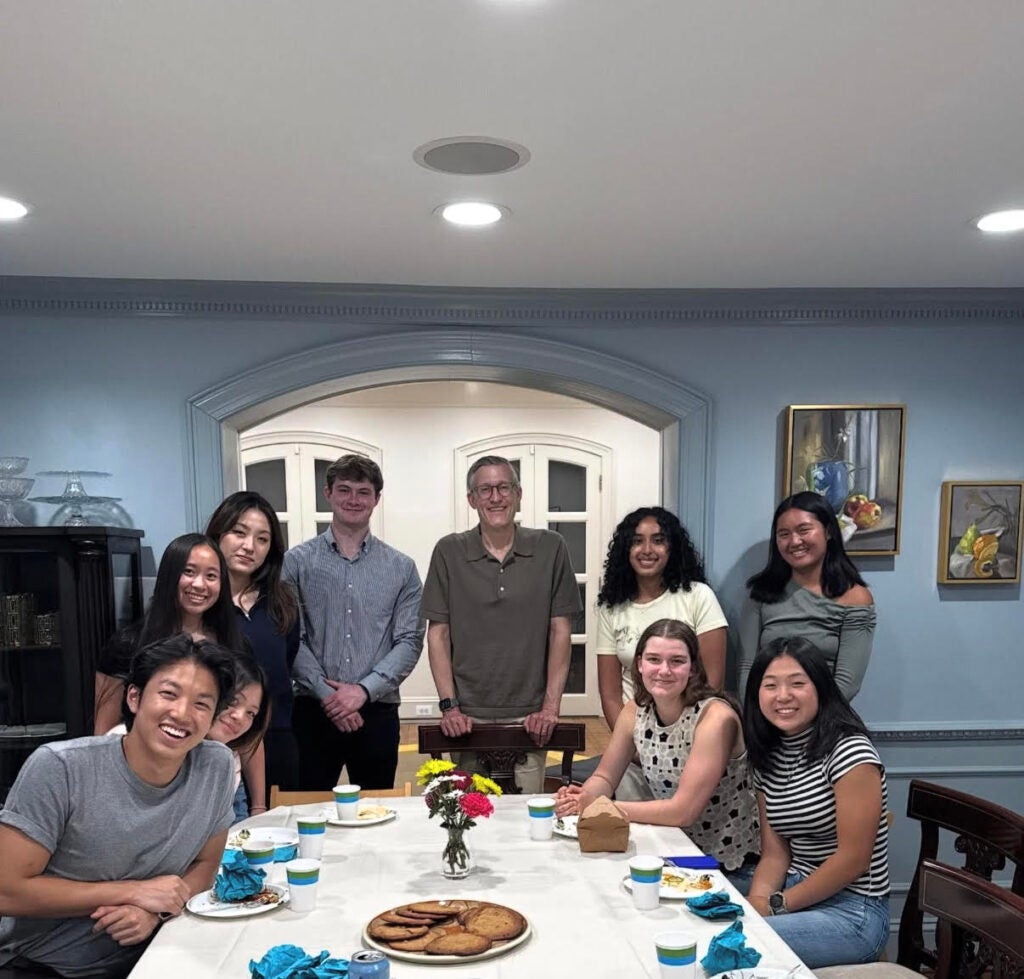
Feng, bottom left, and members of the College Academic Council at the residence David Edelstein, center, dean of the College of Arts & Sciences. (Courtesy of Andy Feng)
Off campus, Feng worked for the American Federation of Labor and Congress of Industrial Organizations (AFL-CIO) as a political and field mobilization fellow. There, he advised national political directors on the messaging strategy for the 2024 elections and constructed national worker support programs.
“We’re in a time of great skepticism surrounding the purpose and value of higher education, and Georgetown is so well positioned to offer answers to those skeptics,” Hartman said. “In some sense, our students are our answer — and Andy is a perfect example of this. He works hard, tempers healthy ambition with grace, humility and altruism. I have no doubt he’ll have a significant impact when he leaves the Hilltop.”
People for Others
The word discernment comes to mind when Feng reflects on his Georgetown education. That means having the ability to think about things in an analytical manner, he said.
“I think that’s my pitch for Georgetown, the sense that you’re just going to have to interact with things in a humanistic perspective that deals with a lot and that can’t be just boiled down into one thing,” Feng said.
Being in DC, with its proximity to the federal government and all of its moving parts, has taught him to look at how decisions and policy directly impact people. It also reminds him that there will be challenges in any path, but that at the end of the day, whatever career path Feng takes, it will be about service to others.
“There is no way in which you come to Georgetown and you leave and think you’re not going to do anything for a community of people,” he said.
Four Years of Memories
Feng has accumulated a lot of memories and favorites during his four years at Georgetown — from taking classes on script writing to attending a cappella concerts on campus. Here he shares some of his favorites from the Hilltop:
Favorite spot on campus: In the summer, Copley Lawn, and in the winter, Midnight Mug or Uncommon Grounds or one of the coffee shops.
Favorite class that you didn’t expect you’d enjoy: Medicine and the Muse: Writing Through Change with Aminatta Forna, the director of the Lannan Center. It totally opened a whole new third eye for different things that are fictional but can be applied to real life. A second one is Script Writing with John Glavin. I loved it especially from the perspective of talking about cultural issues through scripts.
Favorite local restaurant and order: Pho 75. No. 1. Large. All the fixings.
Favorite event you’ve attended at Georgetown: A capella singing festivals. Spring Sing. Cherry Tree Massacre. DCAF. Those three. I haven’t missed one. I don’t sing either. They’re amazing.
Favorite Georgetown tradition: The comfiest hoodie in your closet has to be a Georgetown one because you’re going to have to wear it to the airport and the airplane. That’s just how it goes. It feels strange wearing a non-branded thing nowadays.
(Top photo by Josh Rodriguez)