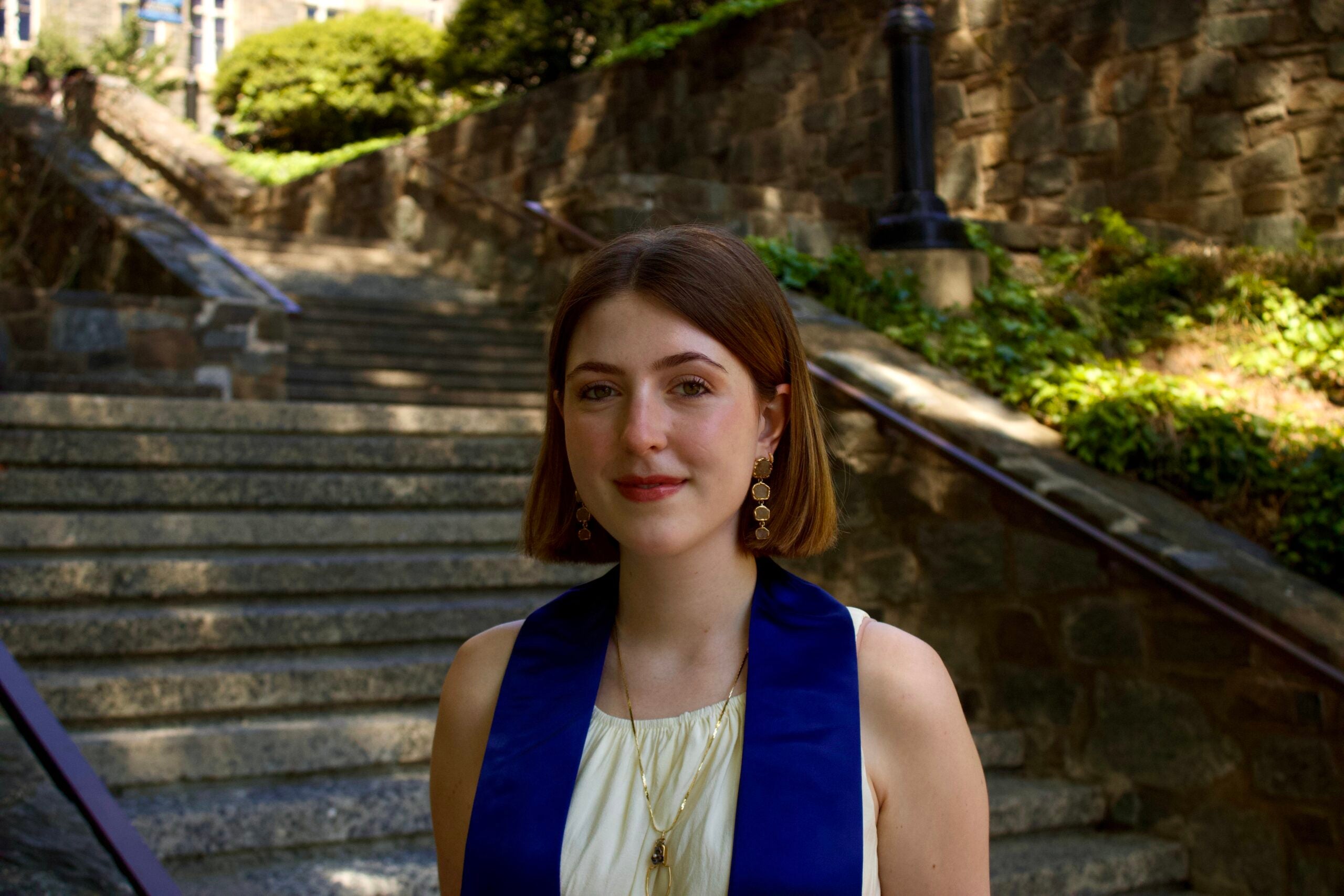
For This Senior, Nature Is Essential to Urban Planning and Sustainability
A sense of place has always played an important role for Justine Brandes (C’26).
After spending her first year at Occidental College in Los Angeles, Brandes transferred to Georgetown University, a place she believed she was meant to be. Born and raised in DC, Brandes felt like she belonged in the city and at Georgetown.
“I felt like I was a part of the community, and so that’s what really locked it in,” she said. “I really feel people look out for each other in this city in a way that is different than any other place I’ve been, and you feel that just walking down the streets here. I missed that a lot.”
Brandes will graduate this May from the College of Arts & Sciences with an interdisciplinary studies major focused on urban sustainability. In her three years on the Hilltop, Brandes has been studying the theoretical frameworks of place and the process of urban places.
After graduation, she plans to backpack along the Appalachian Trail in Maine before moving to New York City in the fall to work in urban planning or urban design. One day, she hopes to own her own design firm.
“Cities are really complex, and there are a lot of things that are planned in cities, and there are a lot of things that happen spontaneously,” Brandes said. “And I think both things can be so beautiful.”
An Interdisciplinary Approach
Brandes arrived at Georgetown as a government major, but she knew even then that she wanted to study cities and the environment.
She noticed that many classes explored those areas of study, just not within a single major. That’s when she discovered the College’s interdisciplinary studies major, where students can design their own academic programs around research questions. The major has existed in the College for almost 50 years.
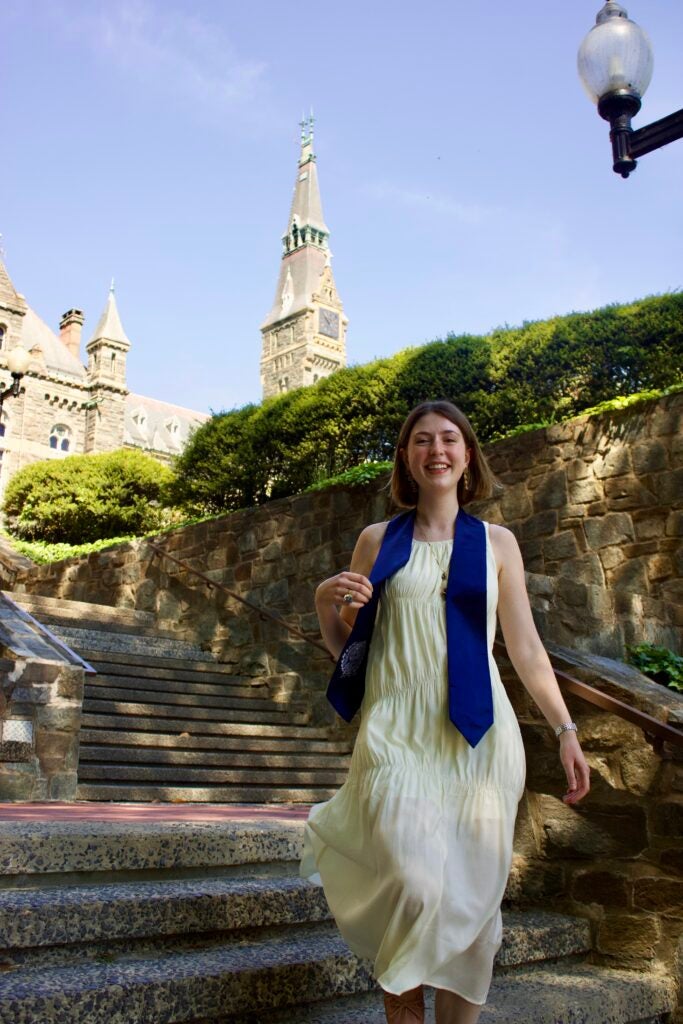
Justine Brandes (C’26) will graduate this May from the College of Arts & Sciences with an interdisciplinary studies major focused on urban sustainability. (Photo by Maria Sophia Dyer, C’26)
“It was an opportunity where I really took a chance to go out on my own and do something bold,” Brandes said. “And it was such a good decision.”
She made a list of potential classes she would want to take, and each one, she said, was “super intentional.”
“My first impression of Justine was that she was a remarkably curious and composed student,” said Bernie Cook (C’90, G’91), an associate dean in the College and the director of the interdisciplinary studies major. “Justine is unhurried in her consideration of questions, directions and opportunities.”
Brandes said one of the most important courses she took was Urban Inequality with Carla Shedd, an associate professor in the Department of Sociology. In that seminar, Brandes read works from writers like W.E.B. Du Bois and about theoretical approaches in urban cities like Chicago, Philadelphia, New York City and Washington, DC.
“I was most impressed by her enthusiasm for the course content, engagement with the readings, active participation in class and her generosity with her colleagues,” Shedd said. “It was truly gratifying to be a part of Justine’s academic journey.”
Other courses Brandes took included Water with Mark Giordano, a professor of geography and the vice dean for undergraduate affairs in the School of Foreign Service, and Urban Ecology with Ali Whitmer, the associate vice president for strategic initiatives in the Office of the Provost and an adjunct professor in the Department of Biology.
“Making your own way in an interdisciplinary studies major takes vision and passion, and Justine has both,” Whitmer said.
Brandes was also part of the Global Cities Scholars Program, which introduced her to a community centered around urban studies. Another experience Brandes cherished on the Hilltop was serving as a board member for the student-run Georgetown University Farmers’ Market that features more than 15 vendors.
“Being able to see everyone gather in one space on Wednesdays and see the entire community come together gave me so much purpose as a Georgetown student,” she said.
A Connection to Place
Brandes had been thinking about her senior thesis ever since her sophomore year.
It started with a curiosity about what makes a sense of place. She asked herself: What makes DC so different from L.A.? What makes L.A. so different from Berlin? It goes back, Brandes explained, to the Latin term, genius loci, which means “spirit of a place.”
“This has really been a labor of love,” she said.
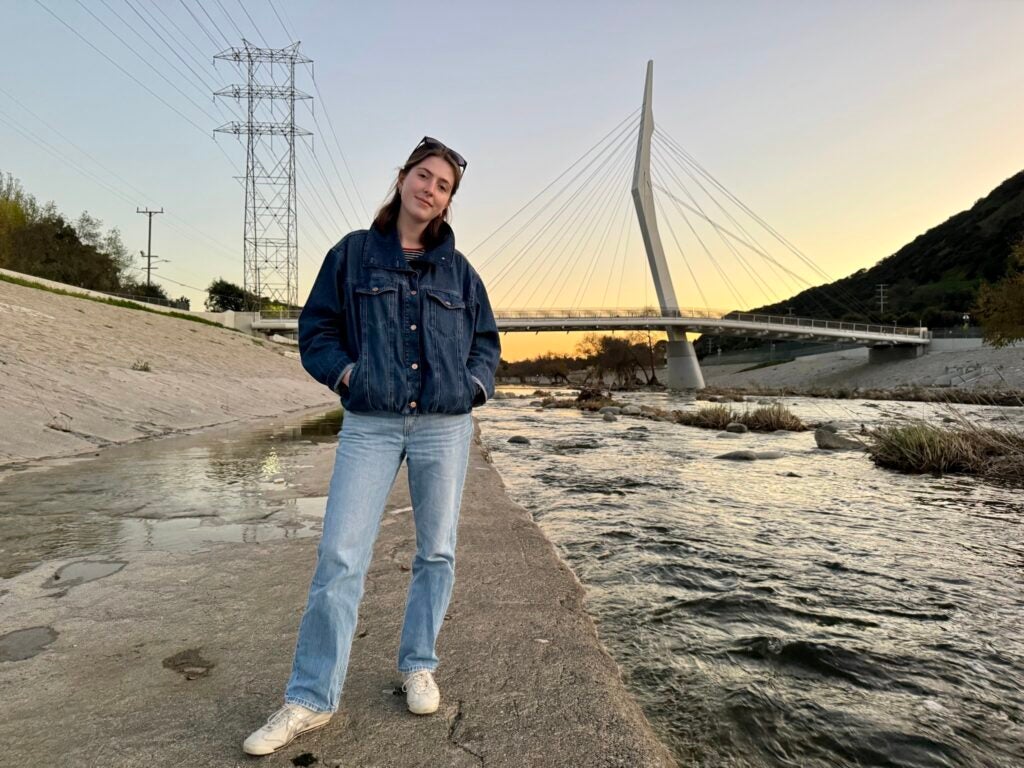
Brandes visited the Los Angeles River as part of a field research trip for her senior thesis in January 2026. (Courtesy of Justine Brandes)
She eventually focused her thesis, “Searching for a Lost River: Remaking the River That Made L.A.,” on the Los Angeles River, a 51-mile river in L.A. that is nearly completely encased in concrete, and a plan by the late architect Frank Gehry and his team to design a public space near the Rio Hondo confluence in South Gate, California.
“The Los Angeles River is mostly seen as a movie backdrop, rather than a really important ecological asset to the city,” Brandes said. “That topic really fired me up.”
Brandes visited the site in January and returned with an understanding that the proposed design plan for a cultural center and platform parks by Gehry’s team has been polarizing.
“What my thesis gets down to is belonging and connection to place and how that is 100% tied to the natural environment,” Brandes said. “And you cannot ignore the natural environment.”
Ultimately, her thesis argues that the platform parks that would be built on the top of the river would create a sense of placelessness for residents along the river, Brandes said, because it conceals the river, rather than re-naturalizing it. Brandes also argues that because Gehry is an architect and not an urbanist or community planner, he approached the river as a design opportunity rather than an ecological system, prioritizing bold structures over restoration.
“You have to engage with local communities in which you intend to design for,” she said. “When local communities feel ignored, it ends up not being good for anyone.”
Everything Is Nature
Brandes’ sense of place is rooted in the outdoors.
Around the age of 10, her parents took her to the Grand Canyon National Park. In addition to the awe of seeing the natural wonder, they hiked and backpacked the 24-mile rim-to-rim trail.
“I think that was my first experience of seeing nature in a way that really humbled me and made me feel small,” Brandes said. “And since then, it just took off.”
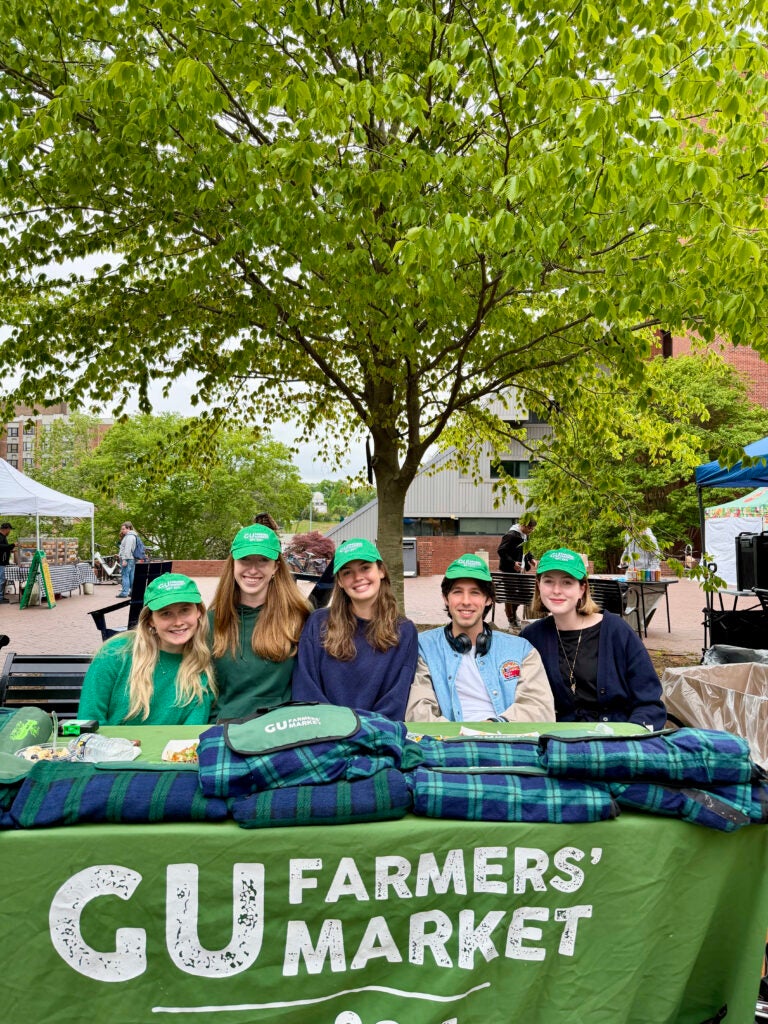
Brandes, farthest to right, alongside the Georgetown University Farmers’ Market board. (Courtesy of Justine Brandes)
She went on an Outward Bound rafting trip, which eventually led to a 30-day backpacking trip during high school in the Teton Range in Wyoming with NOLS, a nonprofit outdoor education school. Navigating with only a compass and map on that trip solidified Brandes’ commitment to the environment.
“I decided for the rest of my life, this is going to be something I fight for,” she said.
And while she has a deep commitment to the environment, Brandes has always loved cities and the human connections found in them. Her academic interests were bolstered by study abroad experiences in Bilbao, Spain and Copenhagen, Denmark.
“I think Bilbao helped me start thinking about urban processes and urban change,” Brandes said. “Copenhagen really opened my eyes to sophisticated design and architecture.”
In DC, she often visits Rock Creek Park. Part of her academic growth, Brandes said, is the realization that nature is all around us.
“I think a lot of times we think when we’re in a city that we aren’t in nature, and nature is something that you can distinctly step into, but in reality, there’s no difference,” she said. “Everything is nature all the time.”
As she prepares to leave Georgetown, Brandes said that her liberal arts education has inspired a commitment to service and helping others. It’s also taught her to always push the status quo.
“As a community, we push each other,” Brandes said. “We’re not afraid to disagree with each other in the classroom, and I think that’s really beautiful. I’ll always take that with me for the rest of my life. No matter what situation I’m in, I will take a step back and really think: How can I push this situation? How can I grow while supporting others? How can we grow together as a community?”
Reflecting on the Hilltop
For the past three years, Brandes has made the most of her time at Georgetown. Here are some of her favorites around campus and the city she calls home:
Favorite spot on campus: Healy Lawn. Way back on that one bench between the John Carroll statue and Lauinger Library. You can look up at the tower. I think I’ve spent the most time reflecting there. I have the most memories there.
Favorite class that you didn’t expect you’d enjoy: I took Acting I this semester with Professor April Brassard. It was totally out of my comfort zone, but super impactful. Amazing class. I would have never taken that if it hadn’t come on my radar.
Favorite local restaurant and order: Teaism in Dupont Circle. I would get the spicy glass noodles with a green tea lassi and one of the cookies for dessert.
Favorite Georgetown tradition: Not walking on the seal outside of Healy is really funny. They always say once you get here, don’t step on it, or you’re not going to graduate. I don’t know if I believe in it, but I’m not gonna test it.
Favorite thing to do off campus: Just walk to Dupont Circle and sit in the circle. I love doing that. I think it really connects me to DC beyond Georgetown. I really just enjoy sitting there on a nice day.
(Top photo by Maria Sophia Dyer)