Examining Hurricane Katrina’s Environmental Justice Legacy, 20 Years Later
The U.S. Army Corps of Engineers pumped the last remaining floodwaters from the city of New Orleans on Oct. 11, 2005, 43 days after Hurricane Katrina first made landfall on August 25. The storm had catastrophic effects for the city of New Orleans. Floodwaters breached levees, leaving the city 80% underwater and thousands of people without homes. The hurricane cut the city’s population roughly in half.
The past two decades of recovery have brought sweeping changes to New Orleans, as rising prices and unequal recovery have extended the effects of the flood.
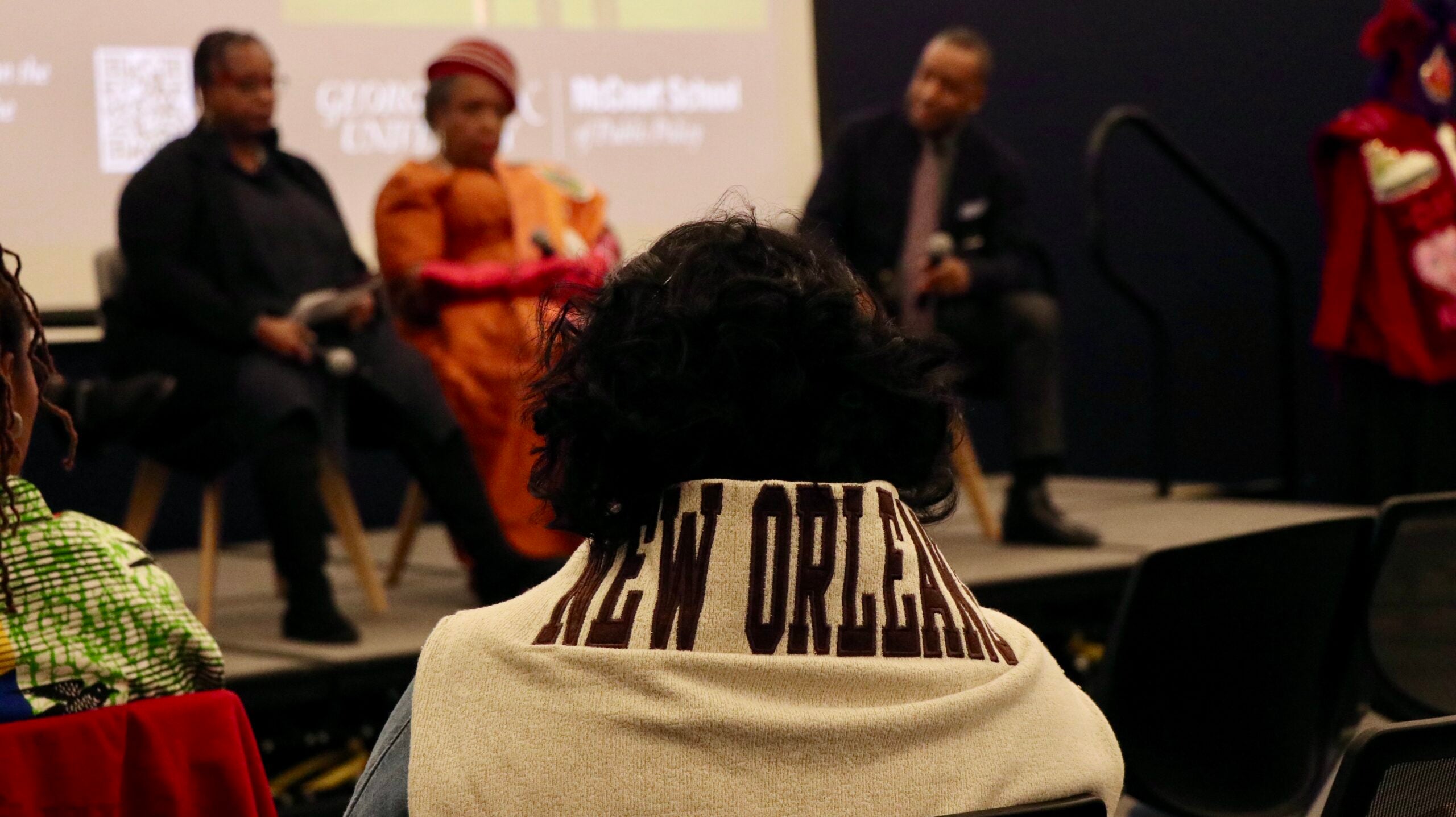
This October, 20 years later, Georgetown University hosted the Katrina@20 Symposium, sponsored by the Earth Commons and Georgetown Humanities Initiative. The event reflected on the legacy of the disaster from an interdisciplinary perspective and through the lens of environmental justice.
The symposium focused on how “the residents of New Orleans and their partners … are working with imagination and creativity and brilliance to address and create conditions for justice at a community level,” said Bernie Cook, an associate dean in the College of Arts & Sciences and founding director of the Film and Media Studies Program.
Preserving Community and Culture
The symposium was the second of its kind. In 2015, Georgetown’s Film and Media Studies Program held the Katrina@10 Symposium, which featured panels, film screenings and a musical performance that explored the impacts of Hurricane Katrina on memory, culture and social justice in New Orleans.
The symposium this year began with a screening of Guardians of the Flame, a film about preserving community and culture in the aftermath of Katrina, held at both the Hilltop and Capitol campuses.
The program continued later in the week with two panels, split up by a musical performance by Donald Harrison Jr., a 2022 NEA Jazz Master and Grammy-nominated saxophonist from New Orleans, in the McNeir Auditorium.

Donald Harrison Jr., a Grammy-nominated saxophonist from New Orleans, performed in the McNeir Auditorium during the Katrina@20 Symposium.
The first panel, The Wild, Wild Creation: New Orleans Living Culture as Recovery and Resistance, was led by Cook and featured Harrison, Cherice Harrison-Nelson, an artist, educator and Queen Reesie of the Guardians of the Flame, and Anita Gonzalez, a professor in the Department of Black Studies.
The panelists discussed New Orleans as the heart of Caribbean and American culture, the intersection of Black performance and protest, the difficulties of sustaining a living culture during displacement — especially for Black, working-class New Orleanians — and the impacts of environmental injustice and racism.
“Katrina happened, but it didn’t happen to everyone in the same ways,” Cook said during the panel.
Harrison spoke about the historic importance of Congo Square, a place in the city where enslaved people would congregate on Sundays that is now famous for its jazz music.
“One of the things about Congo Square was to keep the music alive so that you could have some kind of connection,” Harrison said. “It’s an ancestral place.”

From left: Anita Gonzalez, a professor in the Department of Black Studies, and Cherice Harrison-Nelson, an artist, educator and Maroon Queen, talked about the importance of New Orleans culture and traditions.
The second panel, New Orleans Community-Based Innovation and Alternative Visions for the Future, was led by Yuki Kato, an associate professor in the Department of Sociology and author of Gardens of Hope: Cultivating Food and the Future in a Post-Disaster City. It featured Jenga Mwendo, founder of the Backyard Gardeners Network, Shana M. griffin, a sociologist, artist and activist, and Nyree Ramsey, the executive director of the Ujamaa Economic Development Corporation.
The discussion covered the challenges and opportunities in community organizing and re-building during the 20 years since Katrina. The panelists also spoke about barriers faced by Black communities in New Orleans, as well as their achievements. Successes have included Mwendo’s Backyard Gardeners Network, which has worked to strengthen the 9th Ward of New Orleans, the Claiborne Corridor Cultural Innovation District, which received a grant from the U.S. Economic Development Administration in 2017 and the Jane Place Neighborhood Sustainability Initiative, the first community land trust in New Orleans which was founded by griffin.
“Inequality is spatialized within a built environment,” said griffin. “We see it all the time, but it doesn’t always resonate. So social and economic inequality, we can see it within a built environment. So if it’s structurally or architecturally designed, it can be structurally and architecturally undesigned.”
A Necessary Reflection
For many undergraduate students, Hurricane Katrina happened a lifetime ago — or even before they were born.
The Katrina@20 Symposium served to remind the Georgetown community of the lasting impacts of the disaster that are still felt today.

Sociology professor Yuki Kato, left, led a panel about community organizing in New Orleans. Jenga Mwendo, founder of the Backyard Gardeners Network, is to her right.
The city of New Orleans has helped shape America and is crucial in the connection between the United States, the Caribbean and Central and Latin America. Katrina and its aftermath revealed how catastrophes often have unequal impacts on Americans, as working class and Black residents of New Orleans were unevenly impacted during and after the disaster.
Continuing the discussion of Katrina is key to remembering these lessons.
“It’s still extremely important for America and the world, but for Americans especially to understand what happened, what it revealed, how its effects were unevenly felt, how poor people, working-class Black folks and others, had a much more difficult time recovering,” Cook said.
Photos by Nate Findlay (C’27) and Francesca Scovino (C’27).