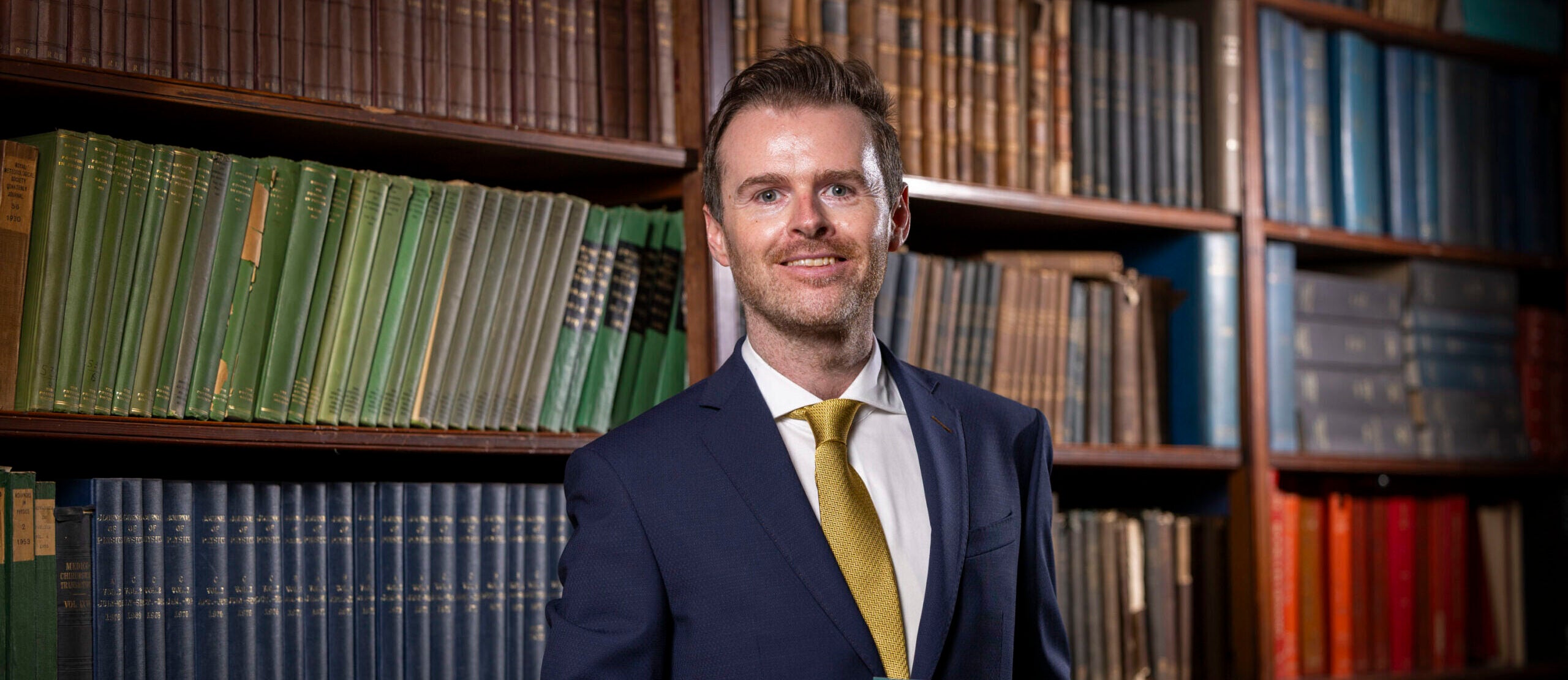
Global Irish Studies Professor Wins Research Prize for Book on Irish History
Darragh Gannon, an assistant teaching professor of Irish history and the associate director of Global Irish Studies in the College of Arts & Sciences, was born into a world of Irish history.
He is a native of Monaghan, a town on the border of Ireland and Northern Ireland, and his father was a high school history teacher in Ireland. Books about Irish history surrounded Gannon at home.
“There was an element of cultural immersion in the subject,” he said.
Gannon is passionate about communicating Irish history to audiences at Georgetown and beyond, and last month, he was awarded the 2025 NUI Irish Historical Research Prize (Special Recognition Prize) for his 2023 book, Conflict, Diaspora, and Empire: Irish Nationalism in Britain, 1912-1922.
“The highest form of recognition really is that of your academic peers,” Gannon said. “To receive this award for me personally represents a form of career recognition by the Irish academy.”
Gannon’s book suggests that the actions, activities and attitudes of Irish nationalists in Britain were essential to the creation of the modern Irish state, he said, and it has contributed to recent national discourse in Ireland.
“We are proud to see Professor Gannon’s work recognized with the NUI Irish Historical Research Prize,” said Fr. David J. Collins, S.J., a professor and chair in the Department of History. “This award is particularly meaningful because it validates the global approach to history that we champion here at Georgetown. Professor Gannon’s scholarship — specifically his monograph, Conflict, Diaspora, and Empire — does not just recount events; it reimagines them across borders.”
Irish Nationalism in Britain
The book and Gannon’s research findings grew out of his Ph.D. thesis at Maynooth University and involved extensive archival research across Ireland, the United Kingdom and the United States.
Traditionally, Ganon said, the actions of Irish nationalists in mainland Britain were characterized as a “sideshow” to the revolutionary events that took place on the island between 1912 and 1922. But the book suggests that Irish nationalism in Britain was integral to contemporary Irish and British assessments of the Irish Revolution. It also shows that the role of Irish immigrants was invaluable to the creation of the Irish state, Gannon said.
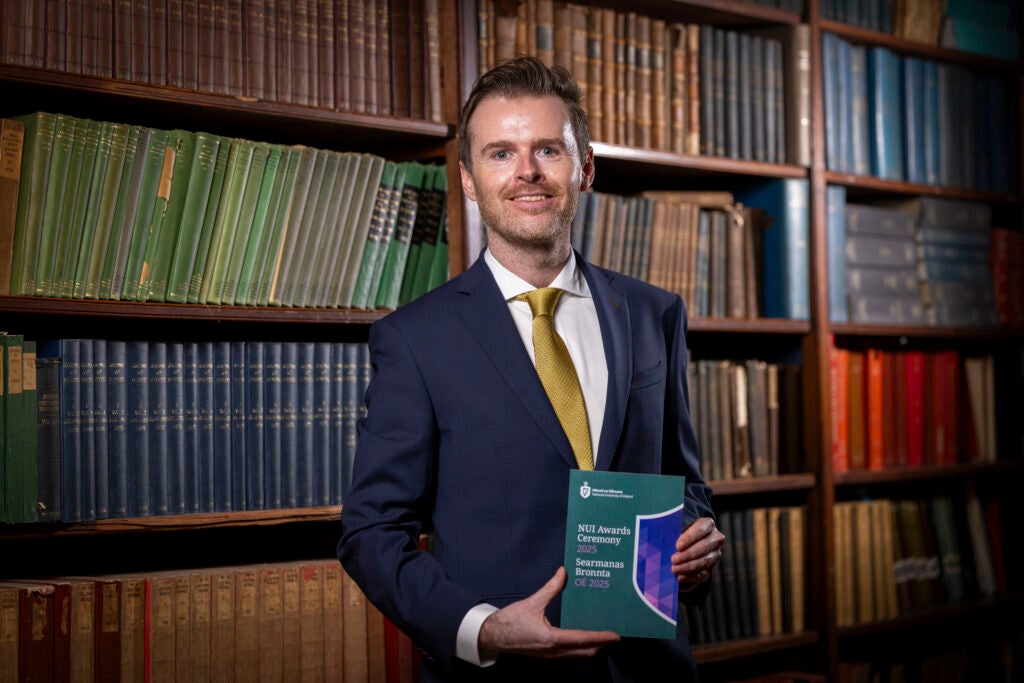
“The highest form of recognition really is that of your academic peers,” Darragh Gannon said. (Courtesy of the National University of Ireland)
The book and Gannon’s arguments have earned considerable media attention and commentary in Ireland and led to national debate. Publications and news organizations like The Irish Times, The Irish Independent and RTÉ, Ireland’s national broadcaster, have reviewed the book.
“This thoroughly researched, well written and insightful study addresses a significant gap in our knowledge of Irish Nationalism in Britain during the Revolutionary period and makes a convincing case for a need to reframe how we look at Irish Nationalism and the Revolutionary period in Ireland,” the NUI Awards selection panel wrote. “Professor Gannon is the first to place Irish Nationalism in Britain, which until now was regarded as marginal, more centrally within the wider context [of] the Irish Revolution.”
The selection panel also praised Gannon for “presenting a convincing argument that Home Rule activists, Sinn Féin supporters and IRA activists, operating in Britain had greater significance in shaping the Revolution back in Ireland than has hitherto been recognized.”
Maintaining peace on the island of Ireland requires embracing both British and Irish heritage, Gannon said, and the book attests to the importance of the shared past, shared future narrative through empirical research.
Georgetown’s Irish History
When Gannon received a Fulbright Irish Scholar Award in 2022, he chose to come to Georgetown because of the Global Irish Studies program and the comparative and transnational focus of the history department.
“I think the incredible breadth of research interests in the Department of History really set Georgetown apart from every other institution in my mind,” Gannon said.
Collins, the chair of the history department, believes that Gannon’s book, with themes of migration, empire and transnational identity, mirrors the wider ethos of the department, where scholarly analysis that crosses geographic and thematic boundaries is encouraged.
The fact that a book focused on the Irish diaspora in Britain has received such high accolades demonstrates that the historical community values the kind of expansive, interconnected research that defines Georgetown’s history department.
Fr. David J. Collins, S.J., a professor and chair in the Department of History
Gannon said he feels at home at Georgetown, and considers the NUI award an international endorsement of the value of Irish history at the university. Gannon noted that both Georgetown University founder John Carroll and president Fr. Parick F. Healy, S.J. were of Irish descent.
“I’m really passionate about promoting Georgetown’s historic Irish heritage, and positioning Georgetown’s Global Irish Studies as the premier Irish studies program in the world,” Gannon said. “I consider this award a significant milestone towards those aims.”