A Student-Made Website Explores the Future of a Warming World
The conventional classroom can be a space for civil discourse, rigorous analysis and problem-solving.
Existential Risk, a course taught by Dagomar Degroot, an associate professor of environmental history, challenged Georgetown students to apply these principles to the past, present and future — all at once.
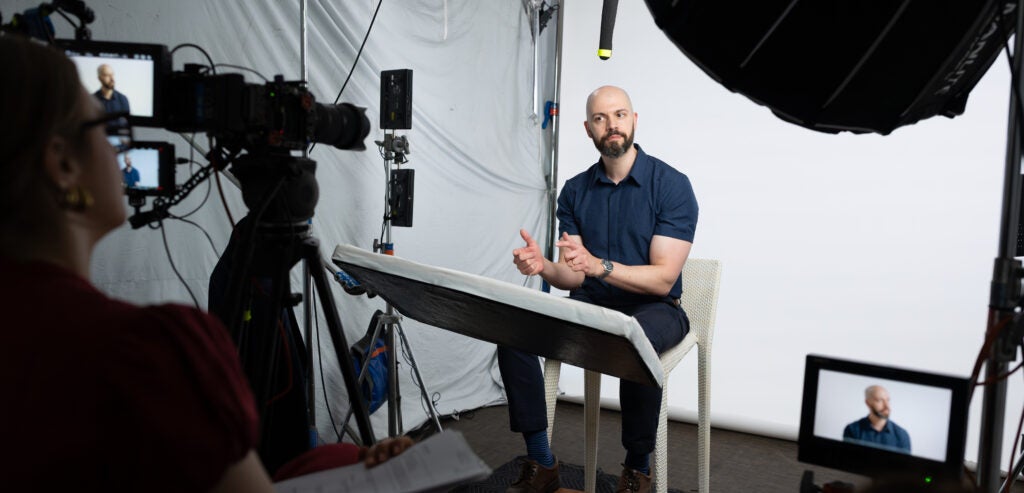
Dagomar Degroot recently won the 2026 Dan David Prize, which recognizes outstanding contributions to the study of the human past. (Courtesy of the Dan David Foundation)
That resulted in After2C, an interactive website on how history students of the future might write about the climate changes of the coming century, Degroot said.
“Our students are growing up in a world that is being transformed by global warming,” he said. “The world is on course to warm by more than 2 degrees Celsius, relative to its average temperature in the late 19th century. After2C explores what could happen next.”
For Degroot, the project shows how the future — not just of humanity, but of the Earth — could be shaped by today’s students. And it serves as a model for projects in the classroom that can help students create better futures for themselves.
“We built something together that can hopefully make a tangible difference,” he said.
Existential Risk
As an environmental historian, Degroot knows that people often conceive of climate change in abstract terms, but storytelling can encourage them to imagine how it could actually influence their lives and futures.
Degroot modeled his Existential Risk course after a 1967 MIT course he learned about while writing his new book, Ripples on the Cosmic Ocean: An Environmental History of Our Place in the Solar System. In the MIT course, graduate students were tasked with developing a plan to deflect an Earth-bound asteroid using existing technology. In laying the groundwork for modern planetary defense, “Project Icarus” confronted one possible existential risk.
In his course, Degroot strove to familiarize students with a greater variety of threats to humanity’s long-term potential, but also to spur them to think critically about mitigating them.
After investigating artificial intelligence, biodiversity loss, nuclear war, extraterrestrial invasion and biosecurity, Degroot’s students voted to concentrate the second half of the semester on global warming and geoengineering, the purposeful editing of Earth’s climate system to slow or stop climate change.
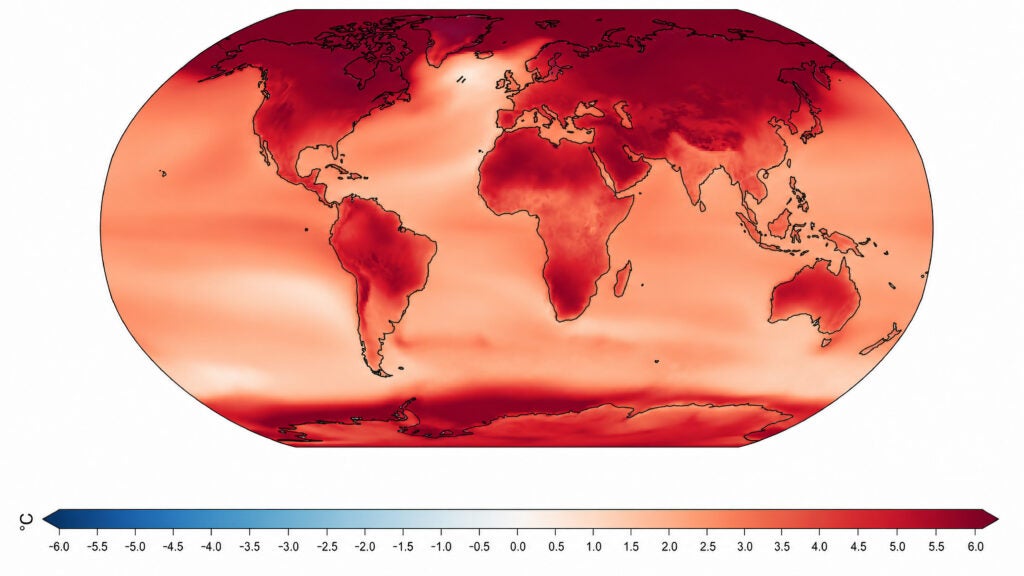
A map showing a simulation of regional temperature changes on an Earth that has warmed by 4 degrees Celsius, relative to its average temperature in the late 19th century. It is a modified version of an image obtainable from the IPCC WGI Interactive Atlas.
The course helped teach students like John Henry Lotz-McMillen (C’26), who graduated with a Bachelor of Science in biology in May, about the complexity of global decision-making.
“Existential risk is about what is going on psychologically for leaders who have to make rapid decisions about serious risks,” he said.
The focus on using lessons from the past to respond to today’s challenges mattered to Katherine Chow (SFS’28).
“No one with the ability to enact change is actually doing anything about it [climate change],” she said. “What will happen if we do too little too late? I want to do something about that.”
Building a Better Future
Influenced by AI 2027, an influential website that forecasts alternative futures linked to the growth of AI, the students decided to create a website as their final project.
As they planned the site, Degroot and students collaborated as partners. Degroot proposed devising multiple timelines representing different climate futures, while students suggested incorporating the perspectives of future history students reflecting on the past.
Together, the students drafted and revised four possible timelines, each based on a different degree of warming by the year 2100. During the summer of 2026, Degroot fleshed out the students’ timelines into cohesive narratives, sourced and created visualizations and compiled them into After2C, a website that asks, “If the Earth continues to warm, what happens next?”
For Lotz-McMillen, such storytelling lent greater solemnity to in-class conversations as well as his personal ecology and environmental sustainability research. “Could my research be repurposed for something destructive?” he wondered.
Ultimately, Degroot hopes the project will help more people understand what the future could look like if greenhouse gas emissions remain high, or if geoengineering efforts fail. He also hopes it will help them see that they can be part of creating a bright future for humanity — and for Earth.
It already has for Georgetown students.
“Even if I don’t know what I can do … things like this make me think that I can do something,” Chow said. “My actions today can influence people 100-plus years in the future.”