Students Share New Research on Clara Barton for the National Park Service
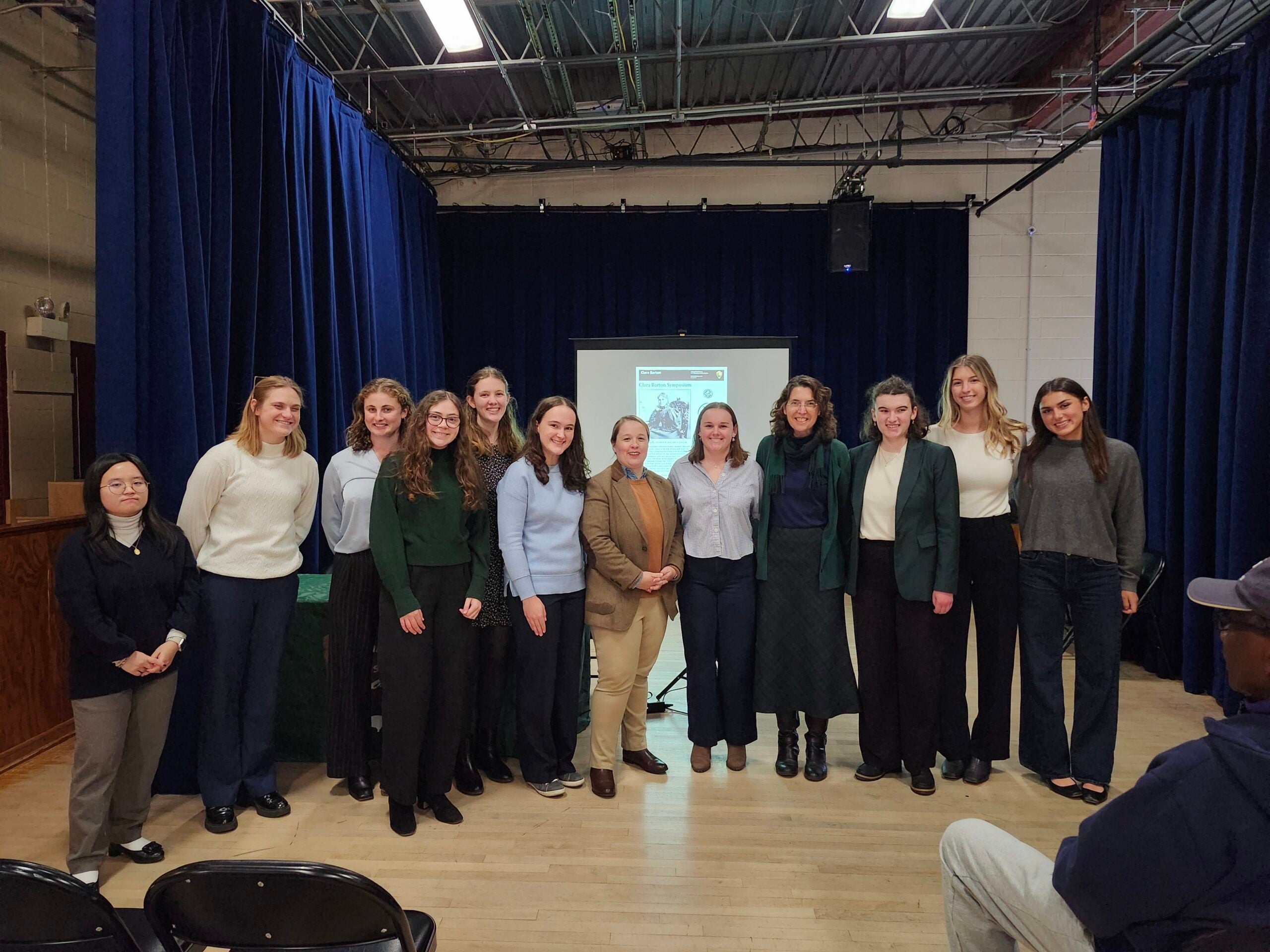
At a public symposium hosted by the National Park Service (NPS) at Glen Echo Park last month, 11 Georgetown University College of Arts & Sciences students shared original historic research on Clara Barton, a Civil War medical care provider and pioneer of emergency medicine who founded the American Red Cross, as part of a seminar led by history professor Chandra Manning.
The event highlighted the results of a semester-long research partnership between Georgetown and the Clara Barton National Historic Site and featured four panels of student researchers whose work will support public interpretation of Barton’s life and legacy.
Kevin Patti, a park ranger and site manager for the Clara Barton National Historic Site, told the crowd gathered at the symposium that Barton’s story remains urgent and relevant.
“Clara Barton died 113 years ago, and yet we still have a great deal we can learn from her life and her service,” he said.
He praised the Georgetown students, who also served as volunteer researchers with the NPS, for producing work that will strengthen interpretation at the site as it prepares for a major renovation.
“The work they have done in a Clara Barton-focused class this semester will be used by the National Park Service to educate people and connect people to the Clara Barton National Historic Site — online, on social media and in other ways at the site,” Patti said.
A Mutually Beneficially Collaboration
Manning, a Civil War historian and professor in the Department of History at the College of Arts & Sciences, designed and taught the history seminar, Hands on DC History: Researching Clara Barton for the NPS.
She explained that the collaboration emerged when she learned that NPS staff wished they had the time and resources to look more closely into specific questions about Barton, who Manning describes in her course syllabus as “one of the most significant Americans in the 19th century.”
I know from past experience that Georgetown students are very good researchers. And a lot of them really like to do work that is going to make an impact outside of the campus gates.
Chandra Manning, professor of history
Barton’s home and the national headquarters of the American Red Cross are both located in the DC area, and students spent the fall reading Barton’s diaries, deciphering 19th-century handwriting together, visiting local historical sites and collaboratively analyzing and discussing archival discoveries.
“Every single one of them has learned something new,” Manning said. “And now that knowledge is being used by the Park Service.”
A Humanitarian and Reformer
The first panel examined how Barton’s upbringing, values and early professional experiences shaped her later humanitarian work, offering new perspectives that will inform how the National Park Service interprets Barton’s life for the public.
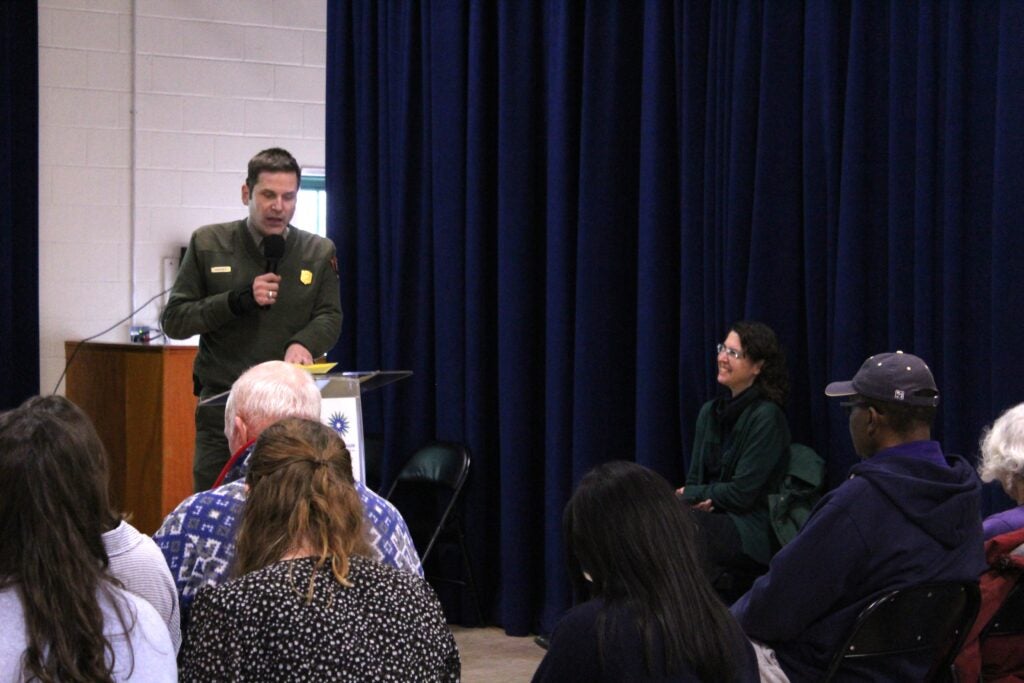
Kevin Patti, a park ranger and site manager for the Clara Barton National Historic Site, praised the Georgetown students for their research. (Photo by Adrianna Guerrero)
Carleigh Heckel (C’27) found that Barton’s views differed from evangelicals inspired by the Second Great Awakening. She held equally deeply felt moral views, but they sprang from Universalism, not evangelicalism. Barton was raised in a Universalist household, Heckel explained, but “most of the evidence we have shows she isn’t especially religious” in the way that mainstream evangelicals were.
Fallon Wolfley (C’28) explored Barton’s poetry and how it helped her forge meaningful relationships during the Civil War. Barton exchanged poems with soldiers and reformers, using poetry to connect with others during the Civil War, and later, to illuminate her own experience.
“Is Barton necessarily a good poet? … I’m not convinced,” Wolfley said. “But what’s more important is the story her poetry tells about emotions, connection and grief.”
Dahlia Lozier (C’28) focused on Barton’s short but revealing tenure as superintendent of the Massachusetts Reformatory for Women.
Lozier argued that Barton’s emphasis on kindness, dignity and politeness subtly challenged prevailing reform models that sought to reshape incarcerated women according to rigid ideals of domestic femininity. Barton’s approach, Lozier suggested, foreshadowed later critiques of punitive reform systems.
A Public Health Pioneer
Barton was a public health pioneer who helped shape early approaches to mental health, emergency response and first aid education by extending care beyond hospitals and military settings to ordinary civilians.
Lily Marino (C’28) examined Barton’s lifelong struggles with melancholy through a modern psychological lens while emphasizing that any diagnosis would be speculative. By tracing patterns in Barton’s diaries, Marino argued that recognizing these episodes “puts in relief how much harder she had to push to do the spectacular things she did.”
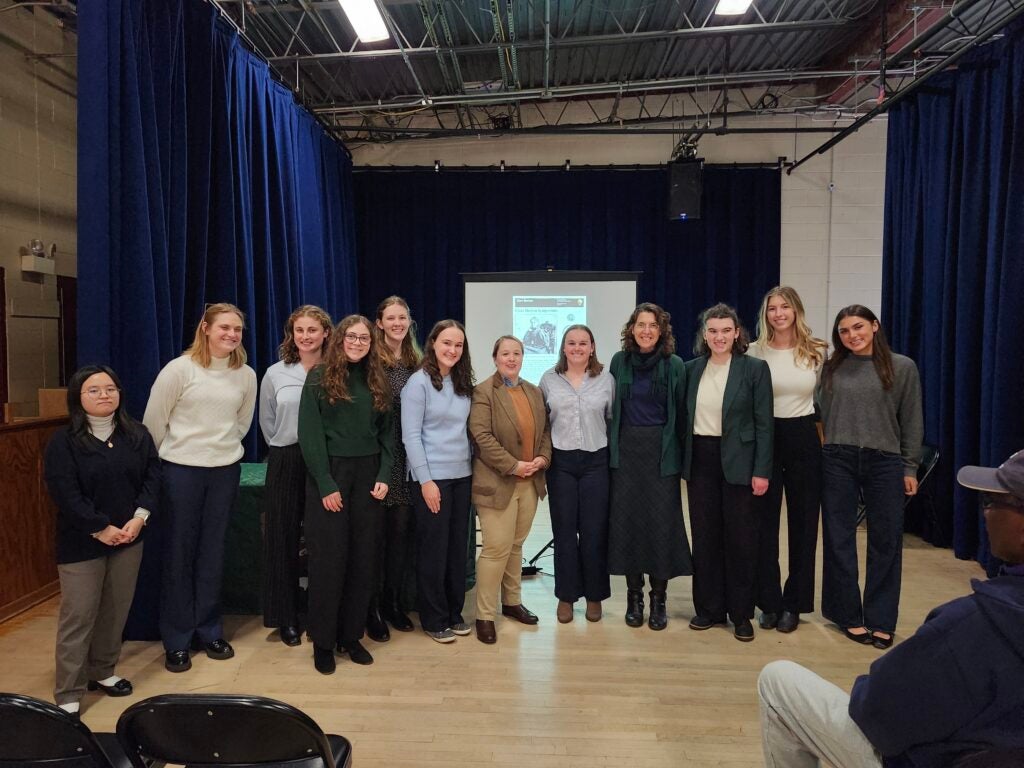
Last month, 11 Georgetown students shared original historic research on Clara Barton in a public symposium as part of a seminar led by history professor Chandra Manning, fourth from the right. (Photo courtesy of Chandra Manning)
Olivia Matlaga (C’28) highlighted Barton’s establishment of the National First Aid Association of America in her early 80s. Matlaga’s project, Barton in a Box, creates an educational kit accompanied by online instructions and informational pamphlets linking early first-aid tools with modern ones.
Barton’s efforts, Matlaga explained, “spread the ability to render aid to the hands of ordinary people … without waiting for the approval of larger institutions.”
Caroline Thomas (C’27) traced Barton’s evolution as an emergency-response leader, from delivering supplies after the 1861 Baltimore Riot to improvising battlefield care during the Civil War. Thomas argued that Barton’s work anticipated the development of disaster and emergency medicine long before the field was formally recognized.
Responding to Natural Disasters
Barton shaped the way that people responded to major natural disasters by systematizing relief efforts, preparing in advance for emergencies and developing recovery models that were later applied across the country.
Sophia Grossman (C’27) analyzed the 1889 Johnstown Flood, shifting attention from heroic relief narratives to the social dynamics of recovery. Grossman showed how class shaped access to housing and resources during reconstruction, revealing how post-disaster recovery could reinforce existing inequalities.
Sylvia Jordan, a second-year Ph.D. in history candidate, focused her research on the 1888 Mount Vernon, Illinois tornado and found it was “the organization’s fifth largest domestic relief campaign” during Barton’s tenure and foundational for later responses in Johnstown, the Sea Islands and Galveston, Texas.
The Mount Vernon project, Jordan said, shows that “we cannot base everything we know about the early American Red Cross off just three major disasters.”
Patti also singled out Jordan’s work, noting that it highlights “an aspect of Miss Barton’s work that has not been highlighted as it will be now because of Sylvia’s work.”
A Women’s Rights Advocate
Barton’s legacy includes expanding opportunities for women in public leadership and humanitarian work.
Marie Kim (C’27) analyzed how Barton strategically navigated 19th-century gender norms, using domestic spaces and the performance of proper womanhood to gain authority in male-dominated political and humanitarian spheres.
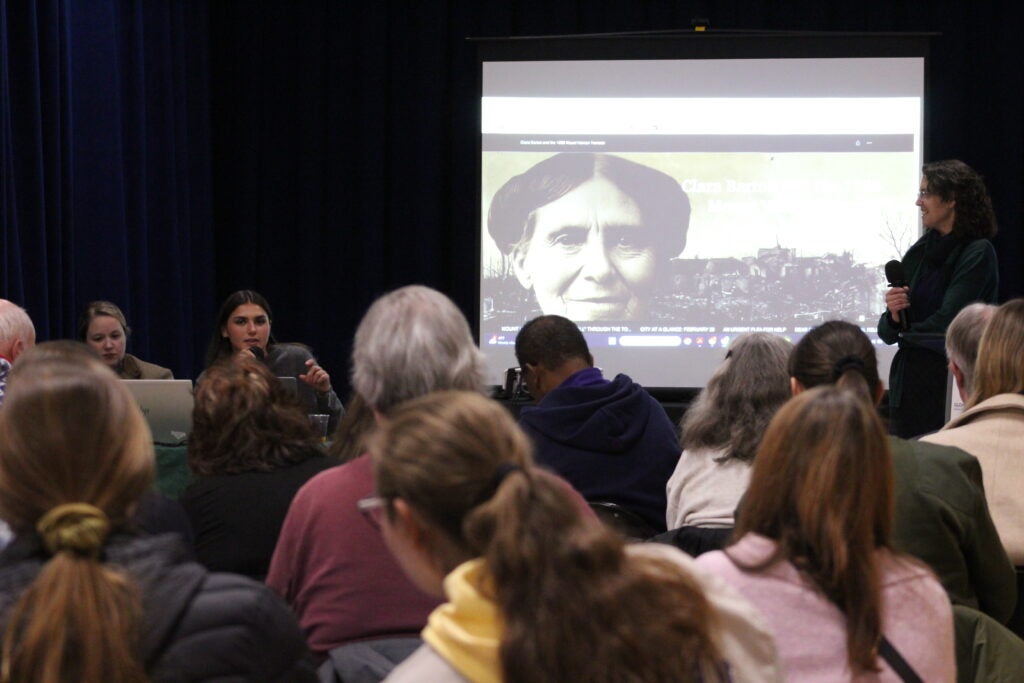
Sophia Grossman (C’27) presented her research at a public symposium at the Clara Barton National Historic Site. (Photo by Adrianna Guerrero)
Maggie Stephens (C’28) studied Barton’s participation in international Red Cross conferences spanning the late 19th century. Barton fiercely defended the integrity of the Red Cross symbol and used conference speeches to highlight American relief innovations. Media coverage praised her as a female delegate operating on equal footing with international leaders.
Emma Vonder Haar (C’28) mapped how Barton is commemorated across the United States and abroad — from schools and roads to a Worcester Red Sox mascot named “Clara.” Public memory, she argued, reveals what communities choose to value.
“What do you see of yourself in Clara Barton’s triumphs, tragedies, or ordinary moments?” she asked.
Patti closed the event by thanking the students for “the wonderful program,” adding, “I know that your work will serve the park very well in the future.”