Davis Performing Arts Center Celebrates 20 Years With Speculative Historical Fiction
The Davis Performing Arts Center briefly became a boxing ring on a Friday evening earlier this year.
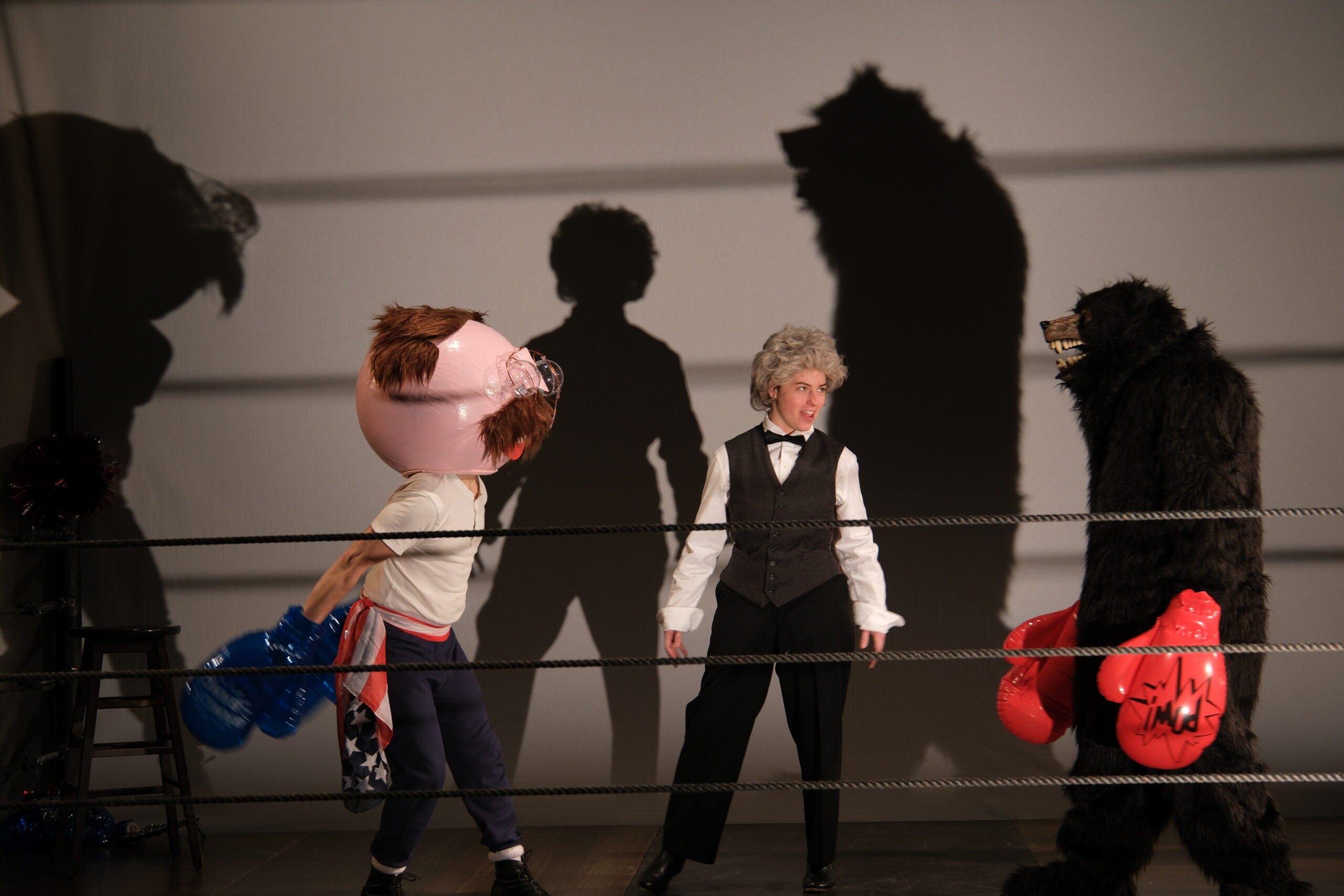
At 6:30 p.m., the event began with an introduction of “BULLY! Theodore Roosevelt, ‘A Locomotive in Human Pants’ vs. JONATHAN EDWARDS, His Pet Black Bear.” At 7:00 p.m., the historical fantasy and political spectacle performance began. By 7:20 p.m., Roosevelt had fought his bear. A ten-minute Q&A followed, closing a reflective night that combined humor and theater.
The original performance marked the 20th anniversary of the Davis Performing Arts Center. But rather than simply celebrating two decades of performances, the evening examined the building and its unique history through a boxing performance and exhibition.
Co-curators Van Tran Nguyen, an assistant professor in the Department of Performing Arts, and Natalie Fleming, an educator and curator based in New York, emphasized that the center’s story stretches much further back than 20 years.
“The Davis Center has always been a space of performance,” Tran Nguyen said. “It’s always been a space where Georgetown has been looking to create bodies in certain ways and put them on display.”
The Building’s Origin
The anniversary became an opportunity not just to commemorate, but to investigate.
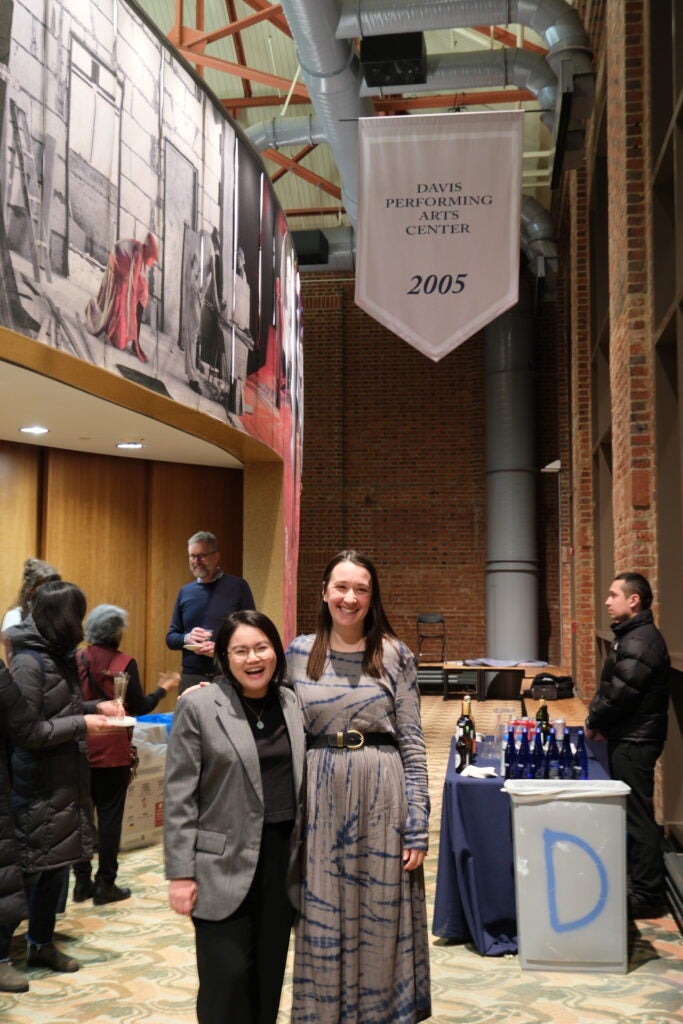
Professor Van Tran Nguyen, left, and Natalie Fleming, right, are frequent collaborators. Fleming is an educator and curator who lives in New York.
“We were specifically interested in the building itself,” Fleming said. “If you’re going to do a celebration of the building, what is this building about?”
That question led Tran Nguyen and Fleming, who are frequent collaborators, into Georgetown’s archives, where they found historic photographs. Many of those images, the curators discovered, documented basketball teams or building renovations. The curators wondered how they could “activate the space and the images,” as Fleming put it.
The answer lay in the building’s origin.
The Davis Performing Arts Center originally began as a gymnasium. When Ryan Gymnasium opened in 1906, “this idea was about creating a well-rounded and healthy student body made up of Georgetown’s male student population,” Fleming said. The university would not become fully coed until long after the building ceased serving as a gym.
That discovery revealed what Fleming called “the connection between a performing arts center and a gymnasium: both were about performing bodies.” The functions may have changed, but the space has always shaped and displayed bodies.
“As you travel around the exhibition’s panels displaying photographs from this building’s history, you will also see passages from texts written by students, professors and reporters describing the space as a body or part of a body,” Fleming said. “We were very interested in bringing to the surface not only how the space functioned for the display of the university community over time, but also how the building itself was conceptualized through the metaphor of a performing body.”
Masculinity as Performance
The Roosevelt thread emerged through Maurice Joyce, Georgetown’s first Director of Physical Education.
Joyce had a background in circus performance and was one of Roosevelt’s boxing coaches. At the time, Roosevelt himself delivered an impromptu commencement speech for the university where he talked about the importance of cultivating healthy bodies through exercise and sport.
From that history came a creative leap.
Tran Nguyen and Fleming invited artist Tara Mateik to respond to the archive they had uncovered about Ryan Gymnasium. Working together, they imagined a fantasy boxing match. Mateik brought that idea to life by staging Roosevelt in a theatrical bout against his own bear.
Yes, Roosevelt had a pet bear. He rescued it as a cub and kept it for a time before eventually parting with it.
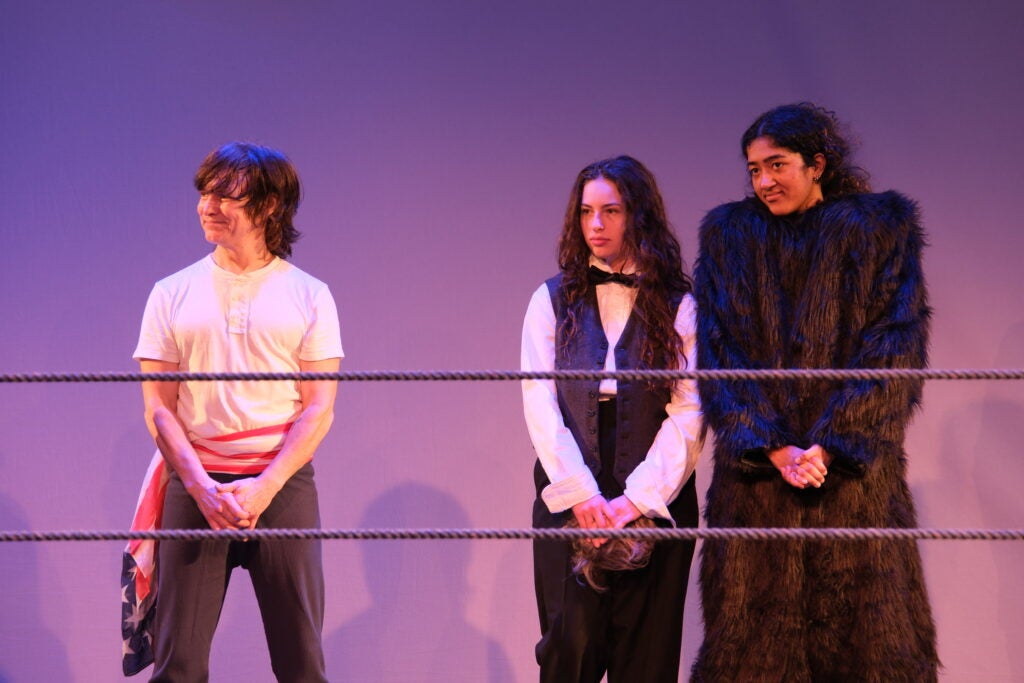
From left to right: Arist Tara Mateik as “Teddy Roosevelt”, Amelia Scott (C’26) as “Professor Joyce” and Kanmani Duraikkannan (C’26) as “Jonathan Edwards, the Bear.”
In performance, that historical detail became a spectacle. The bear sharpened the evening’s central theme: masculinity as performance.
The original gymnasium cultivated strength as an institutional ideal. It aimed to produce a disciplined male body representing national vigor. The theater, opened 20 years ago, also seeks to cultivate well-rounded students, but a different kind.
By placing Roosevelt in the ring, Mateik rendered that masculinity theatrical. His exaggerated gestures and bravado made visible what had always been implicit: strength itself is staged.
The performance also invited reflection on Georgetown’s shift from an all-male institution to a coed university, and on how gender is performed in the gym and in the theater. The building has changed functions, but it has consistently been a site where bodies are formed, displayed and interpreted.
Performing Body Through the Arts
The broader exhibition, “Gym Time,” reinforces this idea. Sixty-nine archival panels line the Davis Center lobby, tracing how the building has been imagined over time.
The structure was described in a Georgetown Record article as a “nerve center” during its administrative period. During basketball games, the students came together to watch basketball and the athleticism of movement. Today, it is a performing body through the arts.
“The building itself has always been thought of as a body,” Fleming said.
The boxing performance did not replace that history. It layered it. For 20 minutes, the gymnasium resurfaced inside the theater. Roosevelt’s rhetoric about cultivating strong men echoed in a contemporary moment still preoccupied with health, strength and national identity.
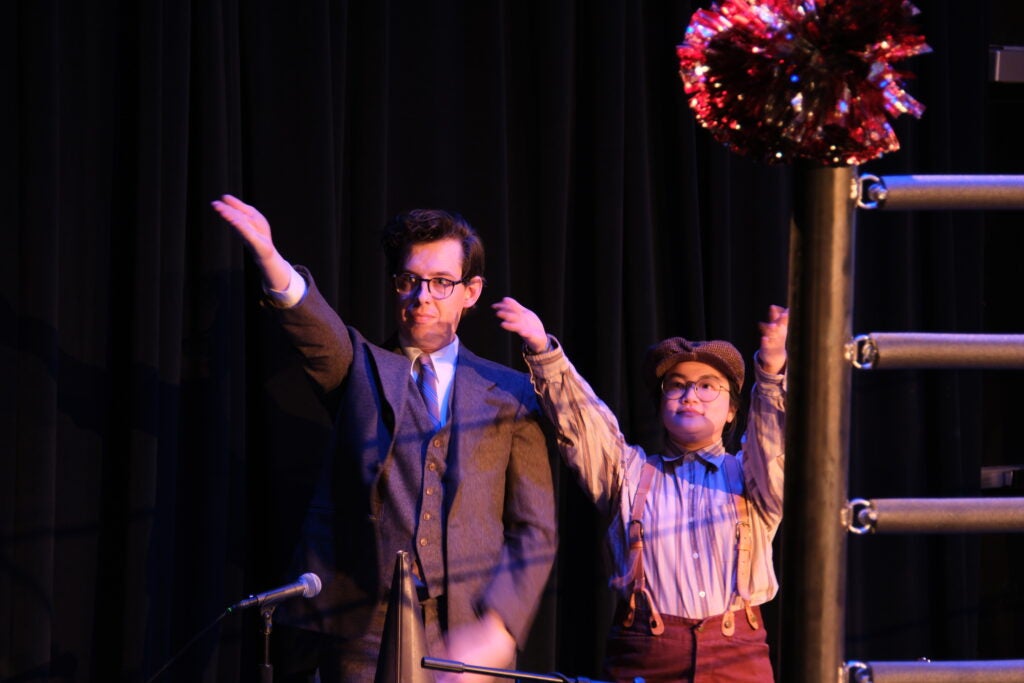
William Hart, left, an administrator in the Department of Performing Arts, played the narrator, and Professor Van Tan Nguyen, right, was the Foley artist for the performance.
After the final bell, a brief Q&A allowed the audience to unpack the archival research, the choice of the bear and the building’s transformation. By 7:30 p.m., the boxing ring was gone. But the purpose of the building remained. The center has always been about performing bodies.
All photos by Jinlin Liu (C’28) for Georgetown University College of Arts & Sciences.