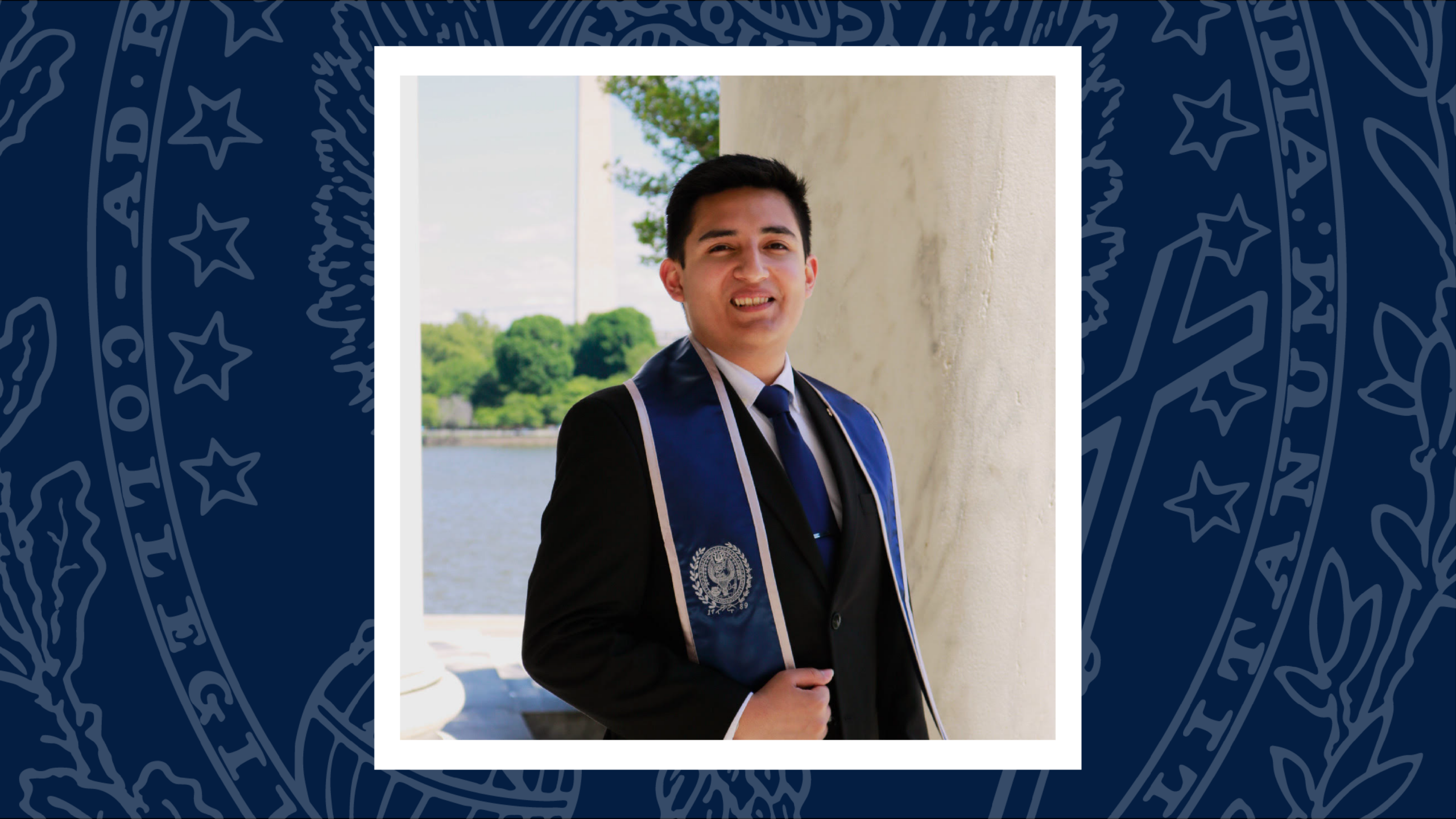
Curiosity for How Things Work Led Senior to Computer Science and Neurobiology
Whenever someone asks Emilio Cazares Borbon (C’26) why he is double majoring in computer science and neurobiology, he has a simple answer for them. Because he’s interested in both.
“I always had a curiosity for how things work,” Cazares Borbon said. “I’ve felt a deep connection with science. It just makes sense to me and scratches that itch in my mind of learning how things work.”
He will graduate this May from the College of Arts & Sciences with degrees in computer science and neurobiology and plans to work as a software developer in his hometown of Tucson, Arizona. Cazares Borbon’s work as a research assistant in the DeMarco Advanced Research Neurorehabilitation (DARN) Lab with Andrew DeMarco, an assistant professor of rehabilitation medicine at Georgetown University Medical Center, has also influenced his career interests.
“I would love to do software development for researchers to help people do research,” Cazares Borbon said.
His contributions to the DARN Lab were multifaceted and important, DeMarco said.
“Emilio is an impressive trainee,” he said. “He quickly understands complicated concepts and systems, both technical and conceptual. He is quiet but also does not shy away from asking clarifying questions. His independence, dependability and willingness to work hard cannot be overstated.”
‘Intellectual Courage’
Cazares Borbon attended a Catholic, Lasallian college preparatory high school in Tucson that was part of the national Cristo Rey Network. His first introduction to Georgetown University was through the Summer College Immersion Program (SCIP), a three-week college prep program for rising high school seniors from select schools, including those in the Cristo Rey Network.
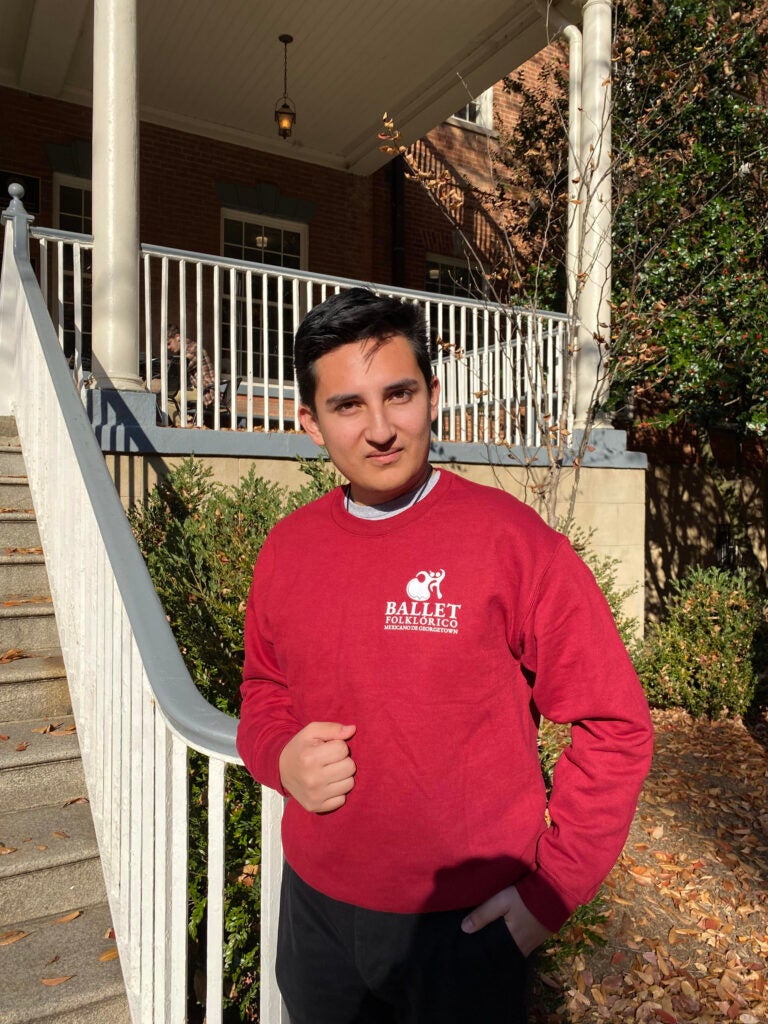
Emilio Cazares Borbon (C’26) will graduate from the College of Arts & Sciences with degrees in computer science and neurobiology and plans to work as a software developer in his hometown of Tucson, Arizona. (Photo by Andrea Esquivel, C’26)
It became a catalyst of Cazares Borbon’s interest in Georgetown.
“I felt connected and welcomed even online,” he said. “I thought, if I feel this way online, imagine how it is in person.”
When he arrived on the Hilltop, Cazares Borbon immediately remarked on how green the campus was. Seeing Healy Hall reminded him of Hogwarts from Harry Potter.
In high school, his main extracurricular activity was robotics. He discovered computer science by programming the team’s robots for FIRST Tech Challenge.
Originally, Cazares Borbon figured he would major in computer science with a biology minor at Georgetown. But after attending a lecture about neurons, he decided he wanted to learn more about how the brain works. That led him to the neurobiology major.
“I would describe Emilio as optimistically bold,” said Stephon Hamell, an assistant dean in the College of Arts & Sciences. “I am always impressed by his genuine thoughtfulness and intellectual courage. I have known Emilio as someone always willing to venture into unfamiliar territory while consistently finding the constructive lesson in every outcome. …Our most enthusiastic conversations occur when he shares the connections he observes in the world between all his interests.”
Mark Maloof, a professor of computer science, sees a “quiet confidence” in Cazares Borbon. “He is quite mature and measured,” Maloof said. “He is pursuing two rigorous courses of study, computer science and neurobiology, and I do not remember ever seeing him panicked or stressed because of what must be an arduous workload.”
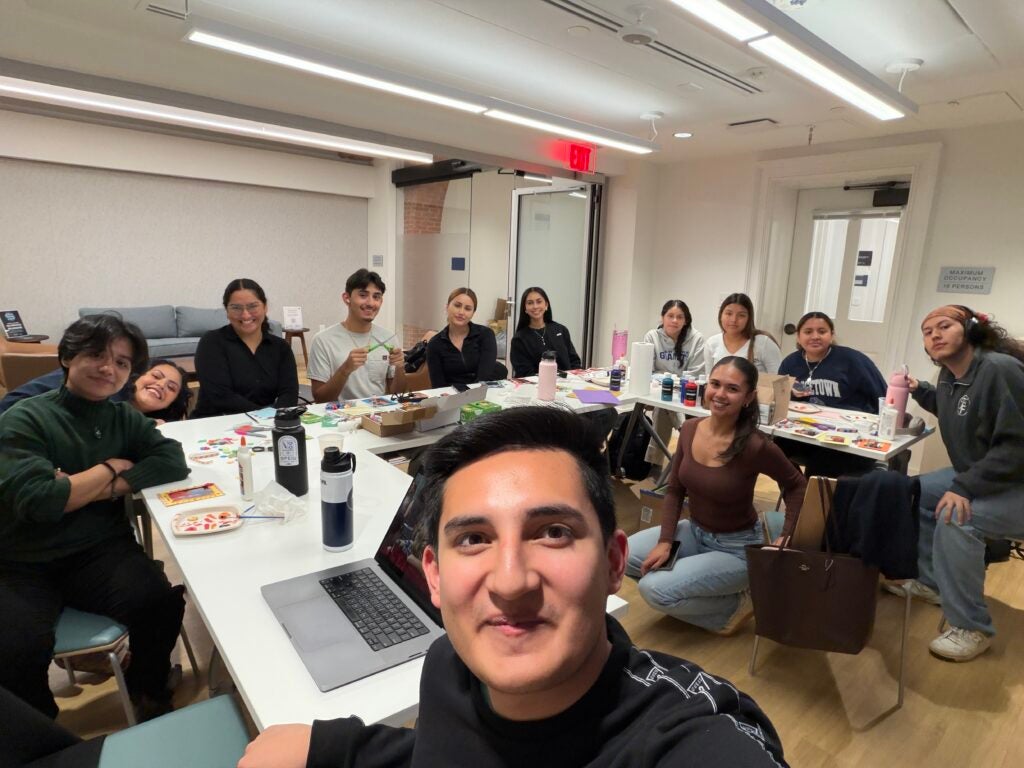
Cazares Borbon takes a selfie at Movimiento Estudiantil Chicano de Aztlán (MEChA)’s arts and crafts event in preparation for Día de los Muertos. He’s pictured with the MEChA board and club members and members from Campus Ministry staff. (Courtesy of Emilio Cazares Borbon)
Cazares Borbon is also a part of the Georgetown Scholars Program (GSP), which supports first-generation and low-income students, and the Community Scholars Program (CSP), a decades-old program where first-generation students begin their Georgetown experience with a five-week summer program. Additionally, Cazares Borbon received support from the Regents STEM Scholars Program (RSSP), which is designed to expand opportunities for students from traditionally underserved communities pursuing studies in the sciences.
“Having a smaller experience of college before college fully started helped me grow as a person,” he said.
Trying New Things
Cazares Borbon enjoys trying new things.
Besides his classwork, he was involved in several organizations on campus.
He danced and handled operations for Ballet Folklórico Mexicano de Georgetown (BFMG), a student-run dance ensemble dedicated to sharing traditional Mexican dance and culture. For the Catholic Ministry, he sang in the choir, was an altar server and helped with Spanish Masses. This year, Cazares Borbon was the president of the Mexican advocacy club Movimiento Estudiantil Chicano de Aztlán (MEChA) at Georgetown.
His friend even convinced him to become a volunteer tax preparer for Hoya Taxa, where Cazares Borbon has served on the board as president and treasurer, helping the organization grow to more than 200 volunteers.
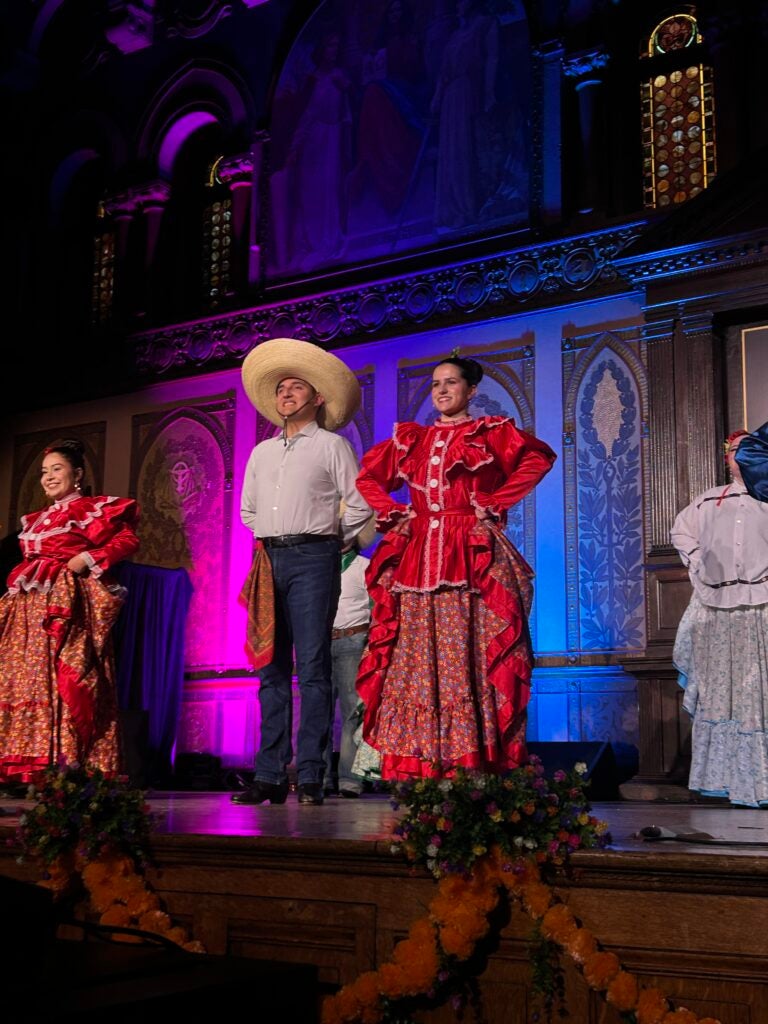
Cazares Borbon, center, danced for Ballet Folklórico Mexicano de Georgetown (BFMG), a student-run dance ensemble dedicated to sharing traditional Mexican dance and culture. He’s pictured with Daniela Guadana Huizar (C’26), left, and Morgan Richards (SFS’28), right. (Photo by Valeria Gastelum)
When asked what he would share with his younger self, Cazares Borbon said, “trying new things really doesn’t hurt me.” That’s one of the main lessons he’s learned from his Georgetown education.
“Try new things out without worrying if you’re going to fail or not, because you’re probably going to succeed,” he said. “And then find friends that push you to do new things, because, sure, you can do new things on your own, but doing them with friends is so much better.”
Making Memories
Coming to DC from the Southwest meant new experiences for Cazares Borbon. Here are some of his favorites during his time on the Hilltop:
Favorite spot on campus: The table next to the chemistry labs on the second floor of Regents Hall. Because that floor is the coldest floor in Regents and also the table has a good view of the Regents patio. That’s where I study before an exam.
Favorite class that you didn’t expect to love: The Dynamic Brain in Biology with Professor Isaac Cervantes Sandoval and Professor Haiyan He. They really taught me how to actually read research papers. In previous classes, we’ve read a lot of papers. We sometimes analyze the figures, but in the Dynamic Brain, we had to actually know what the researchers were talking about and what methods they used. This really opened my eyes that not everything researchers produce is good. You have to identify how you can make things better.
Favorite local restaurant and order: Recently my friends and I discovered actual good Mexican food at Tortas Y Tacos La Chiquita. It’s a 24-hour Mexican restaurant, and we go there at all kinds of hours of the day. It’s located in Arlington. We get the chicken nachos.
Favorite event that you’ve attended: One of my favorite events at Georgetown would be the Día de los Muertos celebration this past fall, because it landed on a Sunday and we had a bilingual mass followed by the reception, which had the biggest attendance I’ve ever seen of any event in Georgetown. More than 300 people attended.
Favorite memory or moment on campus: My favorite memory on campus was my first snow storm or snow day, because I had never seen snow fall and stick. In Tucson, we do get snow, however, it literally melts as soon as it touches the ground. So that first day when it snowed, it was all fluffy and we could still walk on it. That was pretty special, because I had never experienced that before.
(Top photo by Amy Cazares, C’24)