
How Georgetown Helped Ford CEO Jim Farley Develop a Love for Problem Solving
Many people who know James “Jim” D. Farley, Jr. (C’85) assume that he’s in the auto industry because he loves cars. They’re wrong, said Farley, the president and CEO of Ford. Yes, he loves cars and racing them is a passion, but the real reason he got into the business is because the auto industry is a really challenging problem to solve.
“I am a complete problem-solving junkie,” Farley said. “I really love solving problems.”
That’s one of the messages he plans to share with Class of 2026 graduating seniors as the Georgetown University College of Arts & Sciences commencement speaker on Saturday, May 16, at Healy Lawn, where he will receive an honorary Doctor of Humane Letters degree.
“I hope our graduates will be inspired by Jim’s story,” said David Edelstein, the dean of the College of Arts & Sciences. “I hope they will see the empowerment that comes with a Georgetown degree, and I hope they will imagine for themselves a life of leadership and service.”
Farley, who has worked for Ford since 2007 and has led the company since 2020, graduated from the College in 1985 with an economics degree. His father, James D. Farley (SFS’50) earned a degree from the School of Foreign Service in 1950, and Farley also met his wife, Cornelia “Lia” Connor-Farley (C’87), while they were students. Farley said in a recent interview with the College that the Jesuit liberal arts education he received at Georgetown helped him develop an affinity for problem solving and the curiosity required to find solutions.
“Most of life and the satisfaction of life can be greatly enhanced by a conscious decision to fall in love with problem solving and to develop your own framework for solving problems that’s personalized for you based on the foundation at Georgetown,” Farley said of his advice for students. “So get ready, because the world needs problem solvers.”
A Sense of Curiosity
Farley’s life on the Hilltop was different from a lot of his peers.
Aside from his first year, Farley said that he worked 20 to 40 hours every week as a student. One of those jobs was on Capitol Hill, before he switched his major from government to economics.
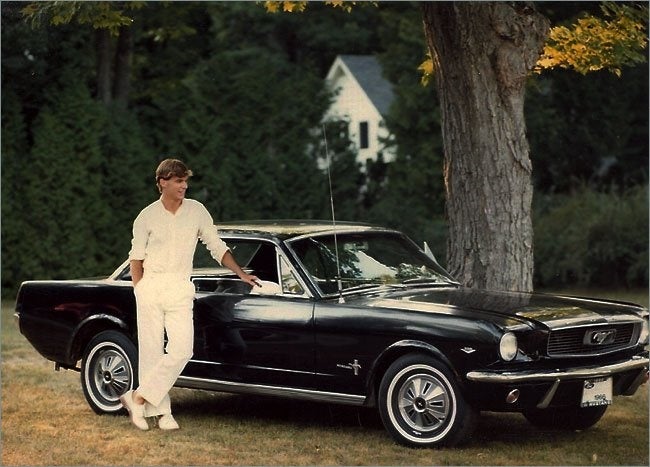
At Georgetown, Farley drove a 1965 Ford Mustang (pictured here), the same car he used to drive across the country when he was a teenager. (Courtesy of Jim Farley)
Farley also loved cars. Most of his friends, he said, didn’t care for them and viewed cars simply as transportation. At Georgetown, Farley drove a 1965 Ford Mustang, the same car he used to drive across the country when he was a teenager. His grandfather, Emmet E. Tracy, started working at Ford in 1913, and Farley would often visit him in Michigan during school breaks, where they bonded over their love of cars.
“I love cars because they’re very complicated consumer products,” Farley said. “They’re an experiential product. You can see the world on your computer, but you experience it in a car.”
At Georgetown, he learned from his professors, many of them Jesuit priests, that curiosity and discernment are essential qualities for problem solving. He marveled that his Jesuit professors taught students about religions outside of Catholicism. His professors, Farley noted, wanted the students to think for themselves, rather than be told what to believe.
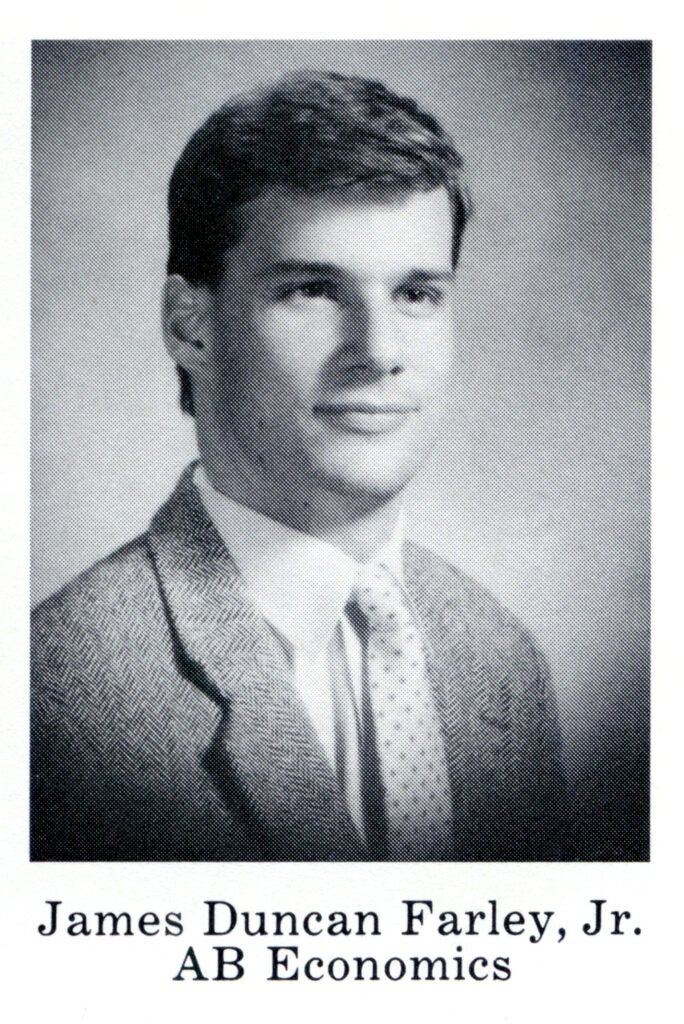
Farley, pictured here in the 1985 Georgetown University yearbook, earned a degree in economics after switching from government.
“Jesuits, to me, are exceptional in their sense of curiosity — around faith, around theology, around philosophies of life,” Farley said. “They don’t want us to be some Catholic robot who goes to church to see other people. They want our faith to be authentic and our connection with our religion to be a conscious choice in the face of other religious choices.”
His time on the Hilltop also reinforced the role of discernment in his life. Having good judgement, Farley said, is often informed by optimism through faith but also mistakes and miscalculations. Discernment, to Farley, requires deeply processing the events in life, and mistakes can often be a gift.
“Often the most valuable inputs to making a decision are the mistakes that you’ve made,” he said. “I think discernment is mission critical, as is being decisive and the other elements of the St. Ignatius framework for solving problems.”
One of Farley’s favorite professors was Jan Karski, a Polish World War II hero, spy and diplomat who served in the Polish resistance against Nazi Germany and provided early reports on Nazi atrocities to the Western Allies. Karski, who died in 2000 and was posthumously awarded the Presidential Medal of Freedom in 2012, taught international relations at Georgetown for more than 40 years.
“I found the intensity of his life and the problem solving to be very refreshing,” Farley said. “He was one of the best problem solvers I’ve ever met.”
Run Toward Problems
Throughout Farley’s career, he’s been drawn to the hardest roles.
“For whatever reason, whenever anyone said to me, career-wise, ‘Don’t go over there, because there’s a very high likelihood that it will not work out,’ I ran to those opportunities,” he said. “It wasn’t like I was taking an unconsidered risk. It’s just that I was always attracted to the gnarliest, most real-world problem.”
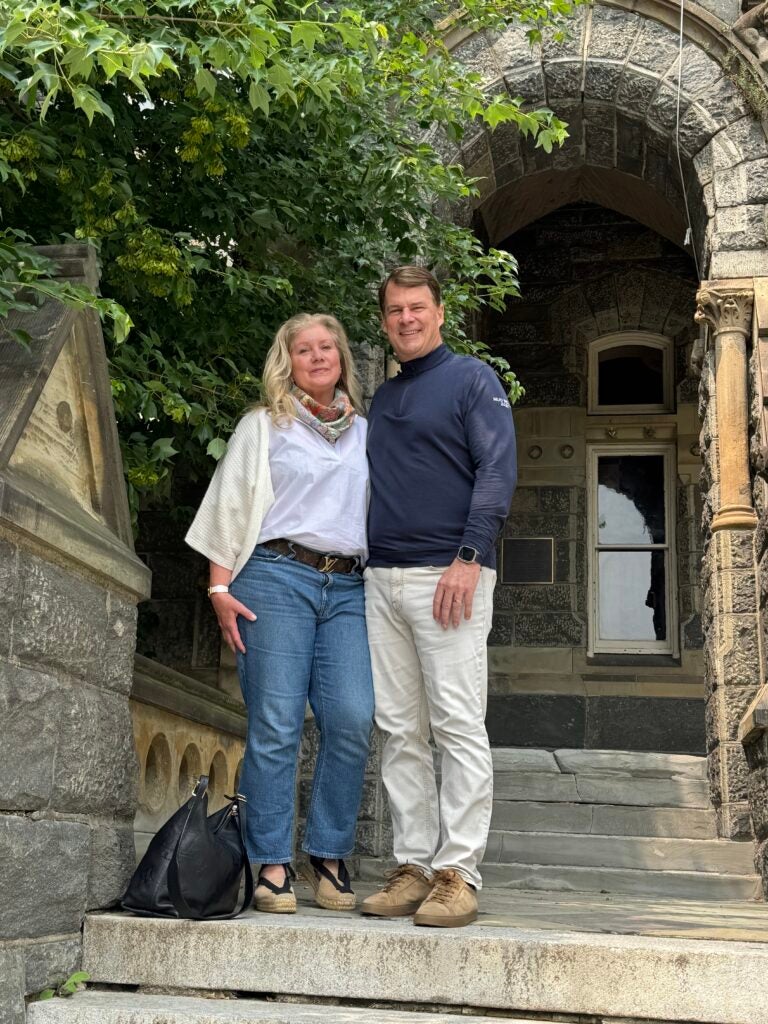
Farley, right, and his wife, Cornelia “Lia” Connor-Farley (C’87), left, met while they were students at Georgetown. (Courtesy of Jim Farley)
That happened at Toyota, where he spent nearly 20 years in product planning, marketing and advertising roles. He served as vice president and general manager of the company’s Lexus group and guided the successful launch of the Scion brand. He was also tapped to be the general manager of product management of Toyota Motor Europe.
“There was no template,” Farley said. “We couldn’t copy anyone, and all those experiences I had to kind of make it up by problem solving.”
Before becoming CEO at Ford, Farley was the company’s chief operating officer and he previously served as Ford’s president of new businesses, technology and strategy and the executive vice president and president of global markets, among several other roles.
“You should run towards hairy, nasty problems and not away from them,” Farley said.
He also looks for ways to volunteer his time in service of others. In Detroit, he raised $30 million as the campaign chair to develop the Pope Francis Center, a transition center for people experiencing homelessness.
In reflecting on his time at Georgetown, Farley said that the greatest gift of being on the Hilltop was meeting his wife, Lia. “She’s been the best partner I could ever have,” he said. “She inspires me and keeps me humble every day.”
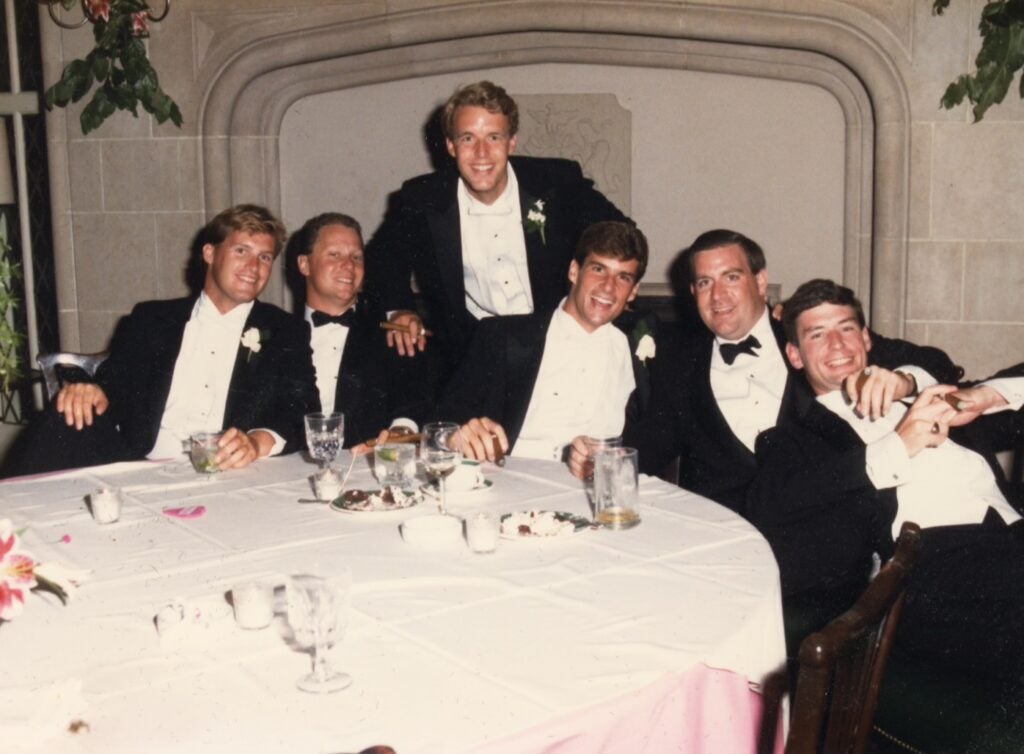
Farley, fourth from the left, attends one of the many Hoya weddings he went to after graduation. (Courtesy of Jim Farley)
Farley still keeps in contact with friends he made at Georgetown — a group of former roommates he affectionately calls “my crew.” Hang on to those relationships, Farley said.
“I imagine that as the graduating seniors look around, I wouldn’t be surprised that many of them have their own crew,” he said. “They will cherish those friendships as much or maybe more than almost any academic experience they’ve had, as they should.”
(Top image courtesy of Ford)