Georgetown’s Journalism Program Marks Press Freedom Week With Global Media Leaders
Georgetown’s Journalism Program in the College of Arts & Sciences marked Press Freedom Week with a pair of events this April that brought together journalists, advocates and media experts to Georgetown’s Hilltop campus for conversations on covering the White House and the state of press freedom around the world.
The high-profile panels took place ahead of the White House Correspondents’ Dinner on April 25 and World Press Freedom Day on May 3. NBC White House correspondent Yamiche Alcindor (C’09) moderated the first event, “The State of White House Journalism,” which was held in Lohrfink Auditorium on April 21 and featured CBS News senior White House and political correspondent Ed O’Keefe, POLITICO White House reporter Sophia Cai and NPR senior political editor and correspondent Domenico Montanaro.
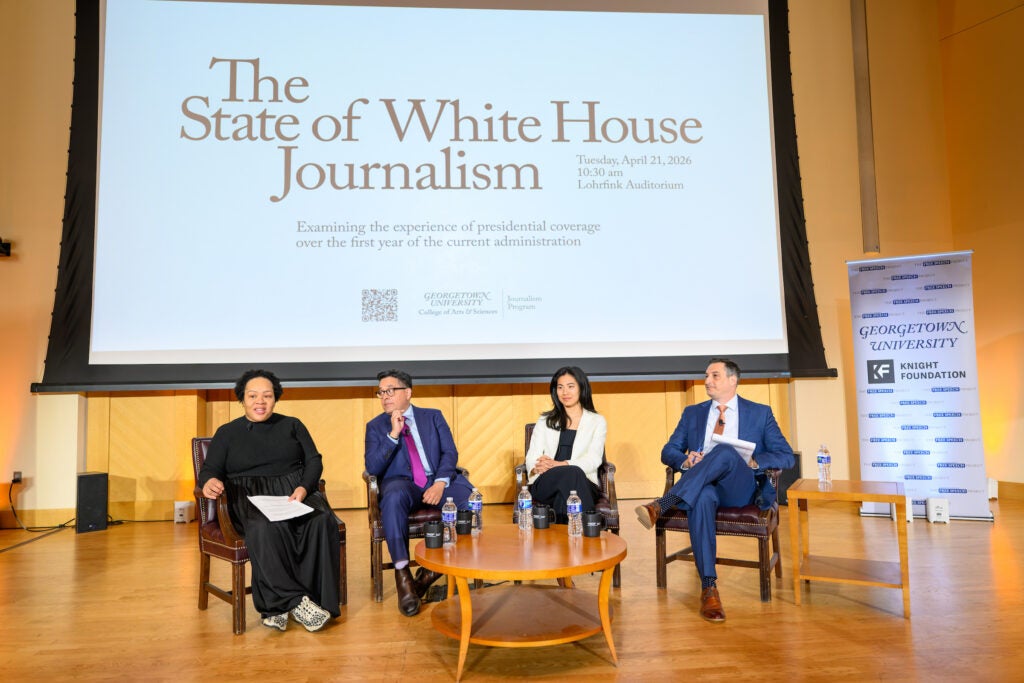
From left: Yamiche Alcindor (C’09), Ed O’Keefe, Sophia Cai and Domenico Montanaro talk about their experiences covering the White House. (Rafael Suanes)
The second panel, “The State of World Press Freedom,” was hosted in Gaston Hall on April 23 and featured an introduction from John Bass, a former U.S. ambassador to Afghanistan, Turkey and Georgia and an instructor for the Institute for the Study of Diplomacy (ISD) within Georgetown’s School of Foreign Service. PBS NewsHour co-anchor Amna Nawaz, a former GU Politics Fellow, moderated the conversation with Jason Rezaian, director of Press Freedom Initiatives at The Washington Post; Yeganeh Rezaian, a special envoy for the Committee to Project Journalists; Fatemeh Jamalpour, an Iranian freelance journalist; and Clayton Weimers, the executive director of Reporters Without Borders (RSF) USA.
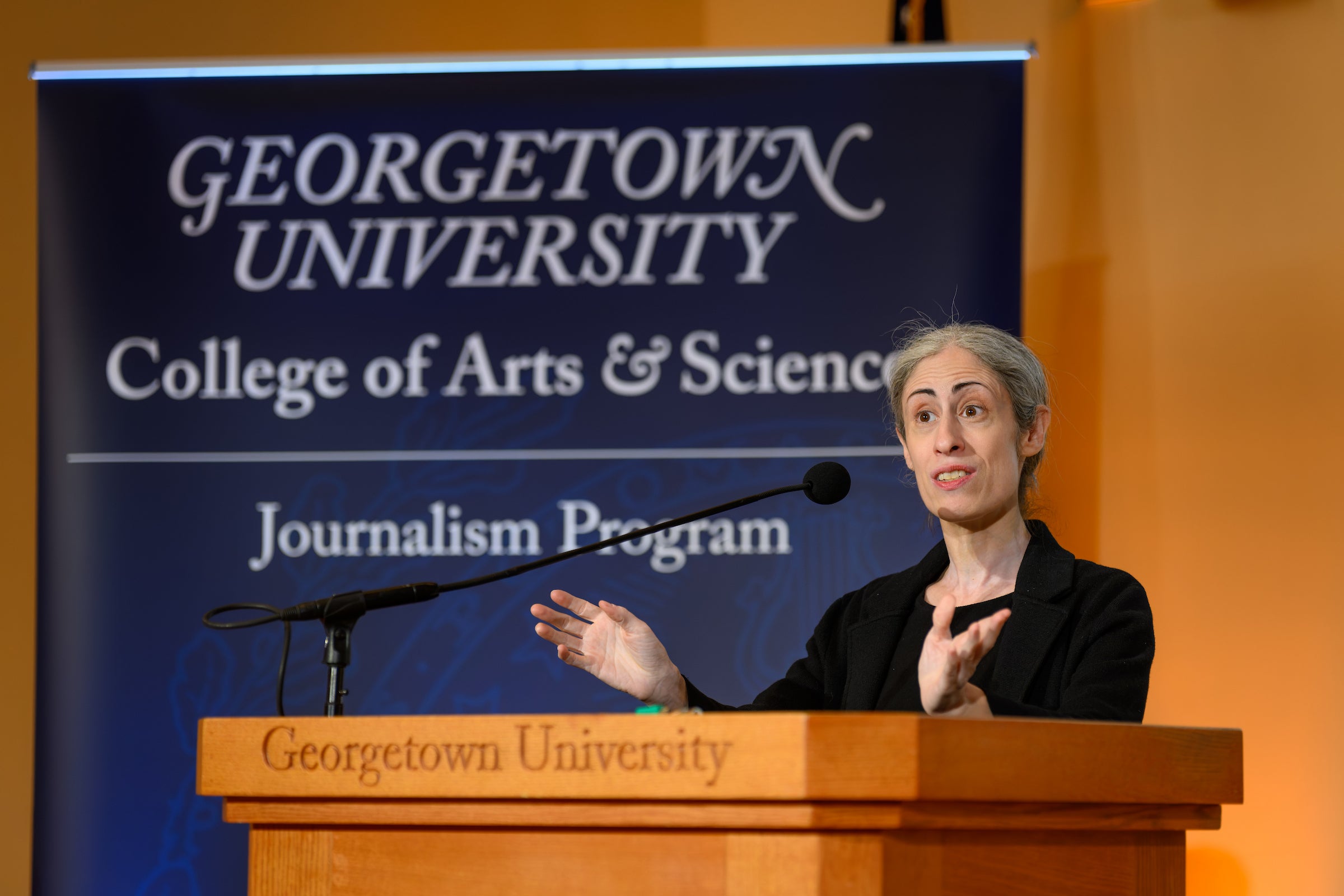
“Our hope is that this week, the conversations that we’ve had are themselves a kind of unfiltered, unrestricted journalism,” Rebecca Sinderbrand (C’99), director of the Journalism Program, said to the audience at Gaston Hall. “We hope all of this will help you better understand the world in which we live and the forces that shape the information that reaches us. This reporting is rooted in hard data and research — and, as with the best journalism, human stories.”
The State of White House Journalism
Instead of a 24-hour news cycle, covering the second Trump administration is more like working in a 24-minute or six-hour news cycle, O’Keefe said.
“What was true at 10 a.m. is not the case at 6 p.m., and that is because Trump himself has molded the conversation in a different way, or thrown a surprise at you that we probably anticipated was coming but did indeed come in some way” he said. “So you just have to be open minded and anticipate anything and really everything and not let yourself be surprised by it.”
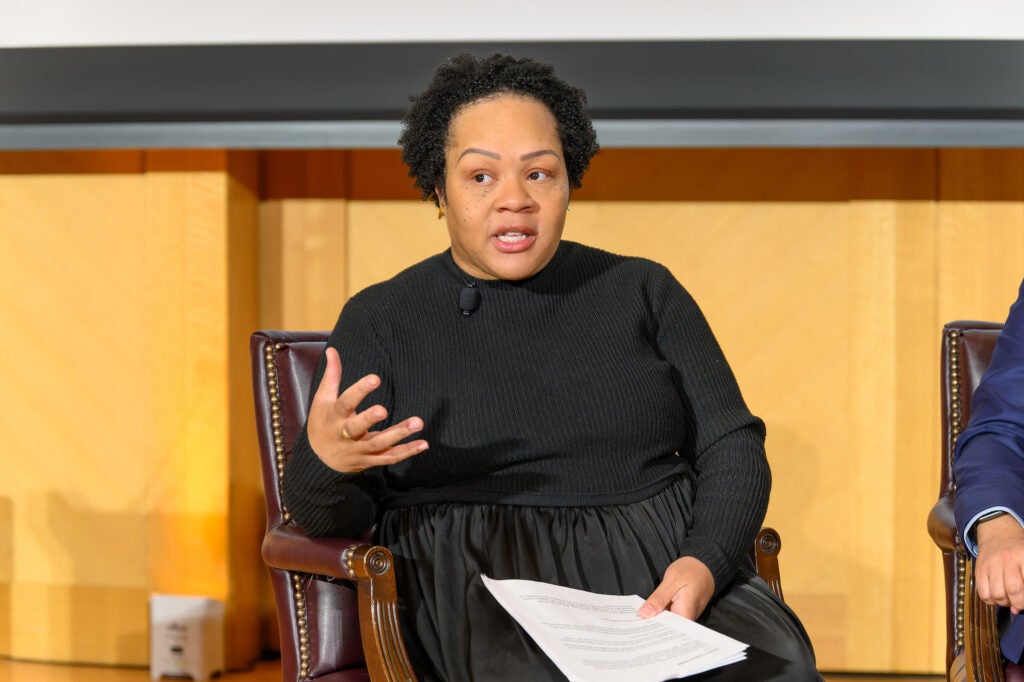
Yamiche Alcindor (C’09) moderated the first event, “The State of White House Journalism,” held in Lohrfink Auditorium. (Rafael Suanes)
In addition to the rapid pace of the news, O’Keefe also said that with the second Trump administration, there are more officials who are combative or restrictive with reporters compared to the first Trump administration. During the spring semester, a team of more than two dozen Georgetown journalism students set out to better understand how access, transparency and coverage of the presidency may be evolving.
They conducted interviews with White House correspondents, editors, academics and other nonpartisan media experts and designed a targeted survey of journalists who actively cover the presidency. Students began this work around the anniversary of the inauguration in January and finished in April.
Montanaro, who worked as an instructor in the course, provided a summary of the findings, which is based on responses from about 90 White House correspondents.
The pool of reporters who travel with the president has expanded to include more partisan, right-leaning outlets, he said, which can make for “watered-down scrutiny.” Transparency in this White House has also gone down, Montanaro said. “Visitor logs, medical reports, tax returns, White House staff salaries, transcripts … there’s less of that that’s being put out to the public,” he said.
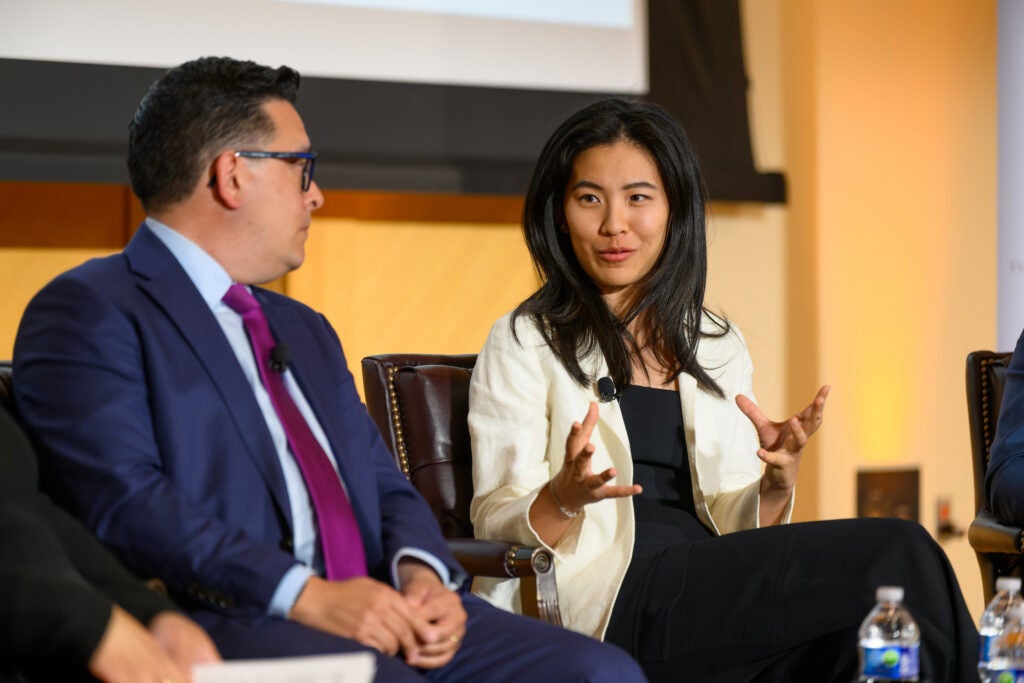
Sophia Cai, right, is a White House reporter and co-author of POLITICO’s West Wing Playbook. Ed O’Keefe, left, covers the White House for CBS News. (Rafael Suanes)
A majority of the journalists who responded said that the job of covering the White House has become more emotionally exhausting, difficult and stressful, but a majority also said that they’re not considering leaving journalism or switching to another beat, Montanaro said.
“Trump is a fascinating person to cover, and I think everyone on the beat realizes that there may never in our lifetime, or our work years, be somebody like that to cover again,” Cai said. “And I think people realize how consequential this president is going to be, how consequential the next two years will be, if potentially the [House of Representatives] flips, and what that looks like with a divided government.”
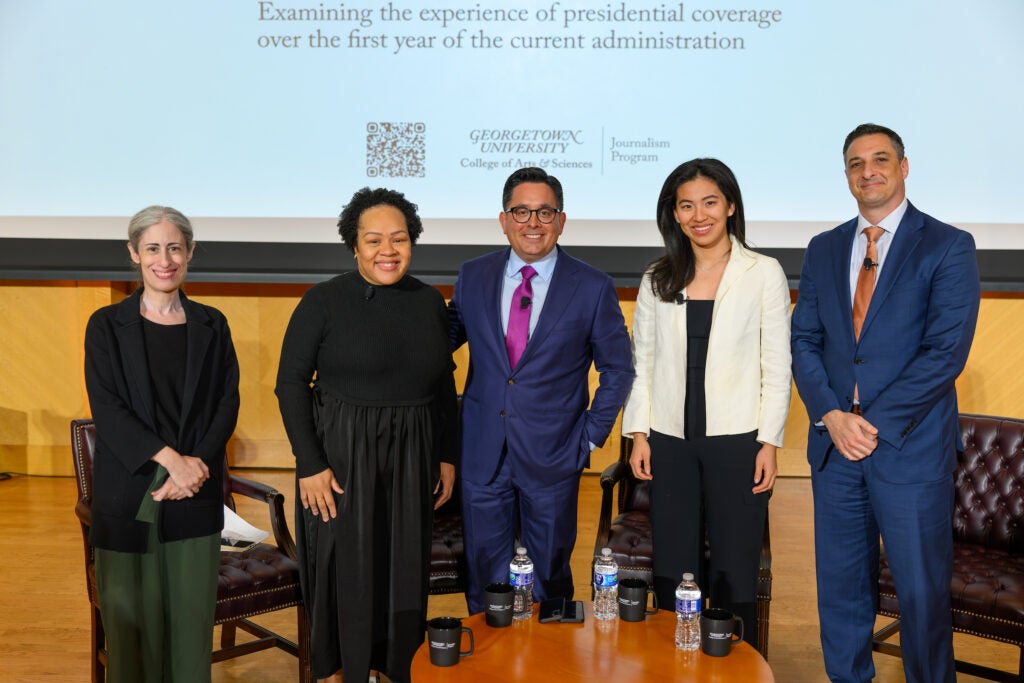
From left: Rebecca Sinderbrand (C’99), Yamiche Alcindor (C’09), Ed O’Keefe, Sophia Cai and Domenico Montanaro appear on stage together for Press Freedom Week. (Rafael Suanes)
From the journalists’ vantage point, the job of a White House reporter is to ask questions and find answers so that the general public can have a better understanding of the decisions being made at the highest levels of government.
“It’s not lost on me that it’s remarkable that I’m working at the White House,” Alcindor said. “And it’s also not lost on me that there are literally, I think, millions of people who are counting on the White House press corps to get information.”
The State of Press Freedom
For Jason Rezaian, the current moment presents the most challenging situation for journalists around the world.
Rezaian was detained in Iran in July of 2014 for 544 days, and this January marked 10 years since his release. He said that restrictions on press freedom in Iran have since become more extreme.
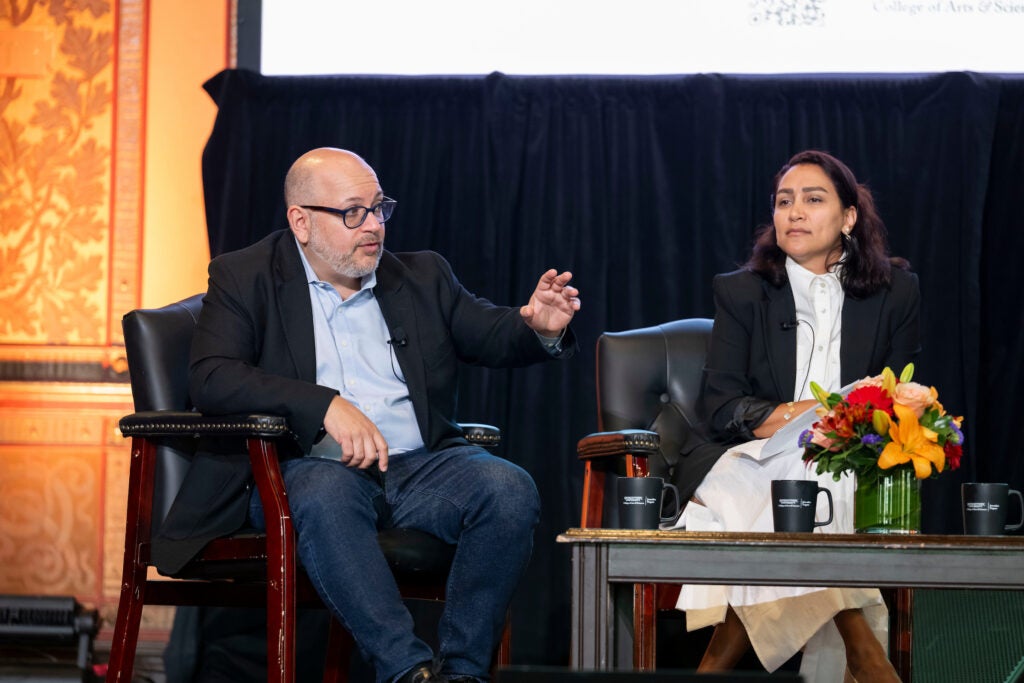
Jason Rezaian, left, and Yeganeh Rezaian, right, were both imprisoned in Iran in 2014 on false espionage charges. (Lisa Helfert)
“The tools of repression go farther,” Rezaian said. “You cut off the internet in 2009, that was very difficult for people, but the internet in 2009 was not what the internet of 2026 is. It’s like oxygen now. It’s part of every aspect of our existence, even in a country like Iran, where there’s massive censorship.”
Yeganeh Rezaian, Jason’s wife who was also imprisoned in Iran in 2014, said press freedom can often feel abstract. “It’s always a battle to make people realize that when a journalist is silenced … you’re being eliminated of your rights,” she said.
Bass, the former U.S. ambassador, had a career in the U.S. Foreign Service for nearly 40 years that spanned the end of the Cold War and the post-Cold War era of the 1990s, Sept. 11 and the global war on terrorism and more recent conflicts around the world. One of the constants throughout his career was the need to defend and advance the work of professional journalists, Bass said.
“That work was vital then, and it’s even more vital today, due to the complexity of the issues that face virtually every society in the world,” he said.
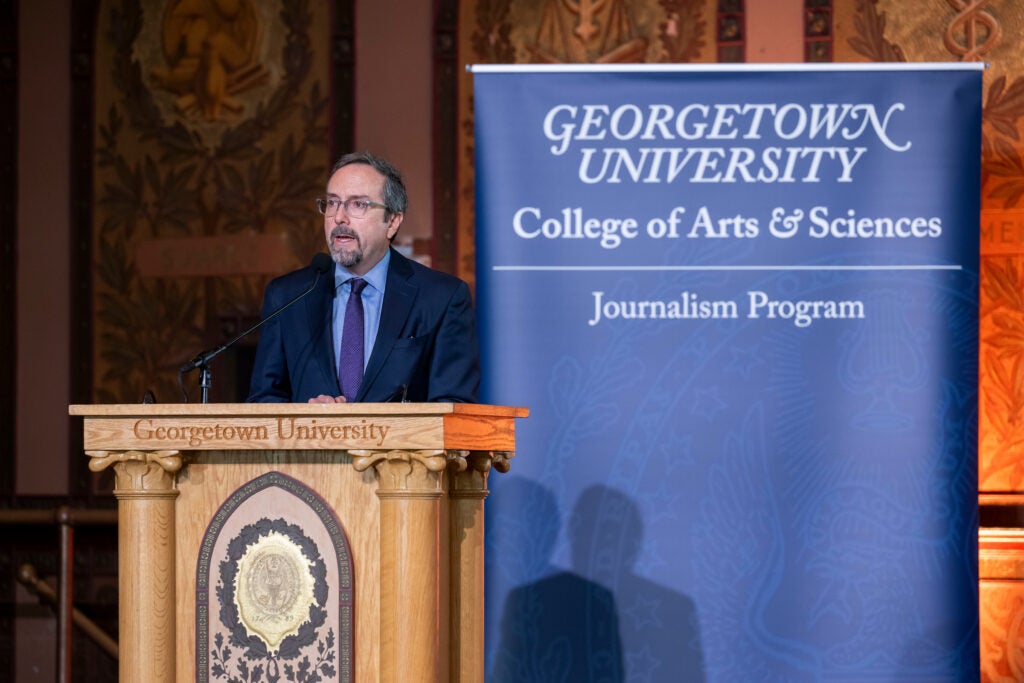
John Bass is a former U.S. ambassador to Afghanistan, Turkey and Georgia and an instructor for the Institute for the Study of Diplomacy (ISD) within Georgetown’s School of Foreign Service. (Lisa Helfert)
Weimers from RSF USA, a nonprofit organization focused on safeguarding press freedom, said that press freedom impacts everyone. Reporters Without Borders releases an annual index on world press freedom, and this year, for the first time since the inaugural index in 2002, over half of the world’s countries fall into the “difficult” or “very serious” categories for press freedom. The United States fell seven spots in the index.
But the panelists believe there is still hope.
“I think that anything we can do to contribute to lessening injustice is a worthy endeavor,” Jason Rezaian said.
Courage is contagious, said Jamalpour, an Iranian freelance journalist who is banned from working in Iran. She is a co-author of For the Sun After Long Nights: The Story of Iran’s Women-Led Uprising. “We are determined to be the voice of our people,” Jamalpour said.
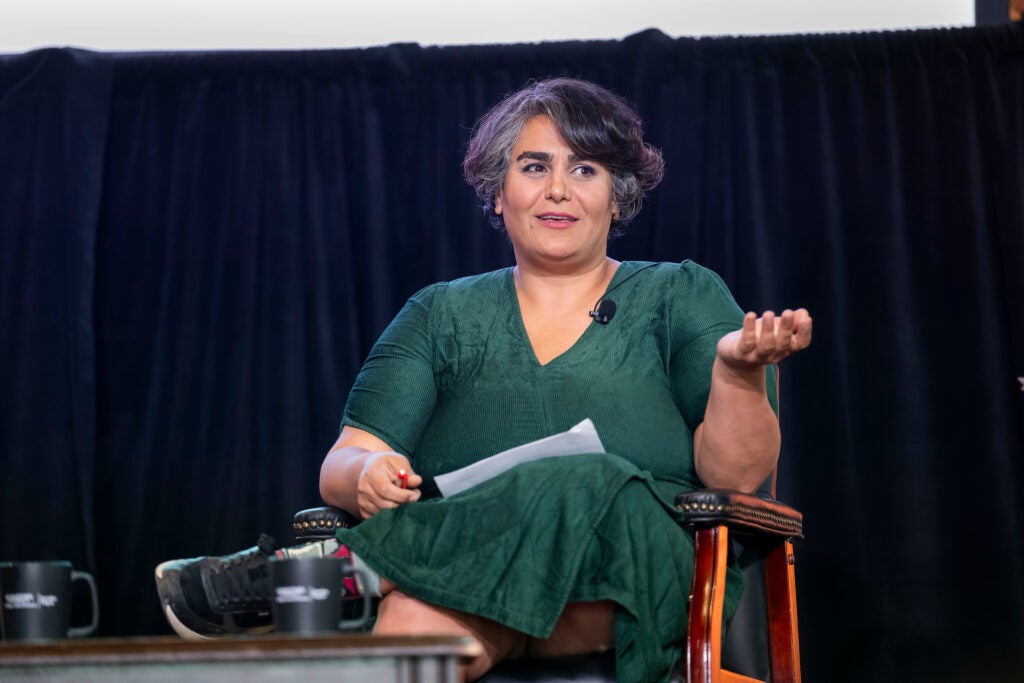
Courage is contagious, said Fatemeh Jamalpour, an Iranian freelance journalist who is banned from working in Iran. (Lisa Helfert)
And there are countries that respect press freedom, and they all share things in common, Weimers said. There is robust public funding for media that is independent of any political control. A legal infrastructure is in place to help ensure crimes against journalists don’t happen, and if they do, there’s accountability. In those countries, Weimers added, there is also a culture where politicians don’t attack the media.
Yeganeh Rezaian finds hope in exiled journalists who continue to report on the news. Jason Rezaian envisions a day where hostage taking is no longer practiced. The tools available to journalists, he said, have never been more developed.
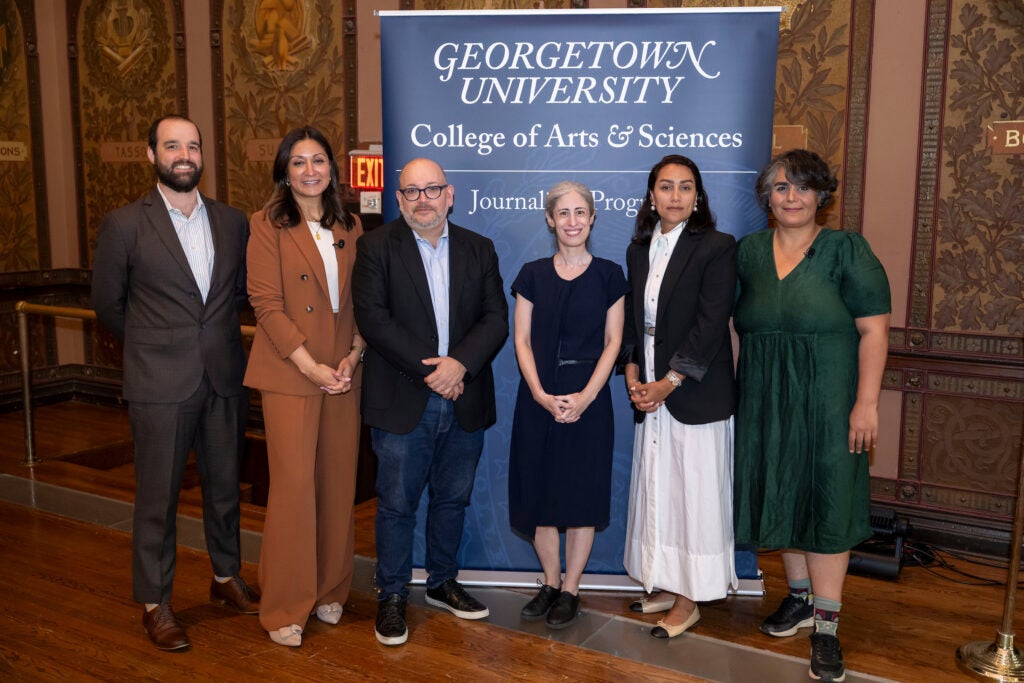
From left: Clayton Weimers, Amna Nawaz, Jason Rezaian, Rebecca Sinderbrand (C’99), Yeganeh Rezaian and Fatemeh Jalampour closed out the Press Freedom Week events at Gaston Hall. (Lisa Helfert)
“Our ability to create more beautiful, data driven, verifiable journalism, has never been more robust than it is right now,” he said. “The core act of making journalism and doing it quickly and efficiently and cost effectively has never been more accessible to more people in the world than it is at this very moment, and that is going to continue.”
(Top photo of Rebecca Sinderbrand by Rafael Suanes)