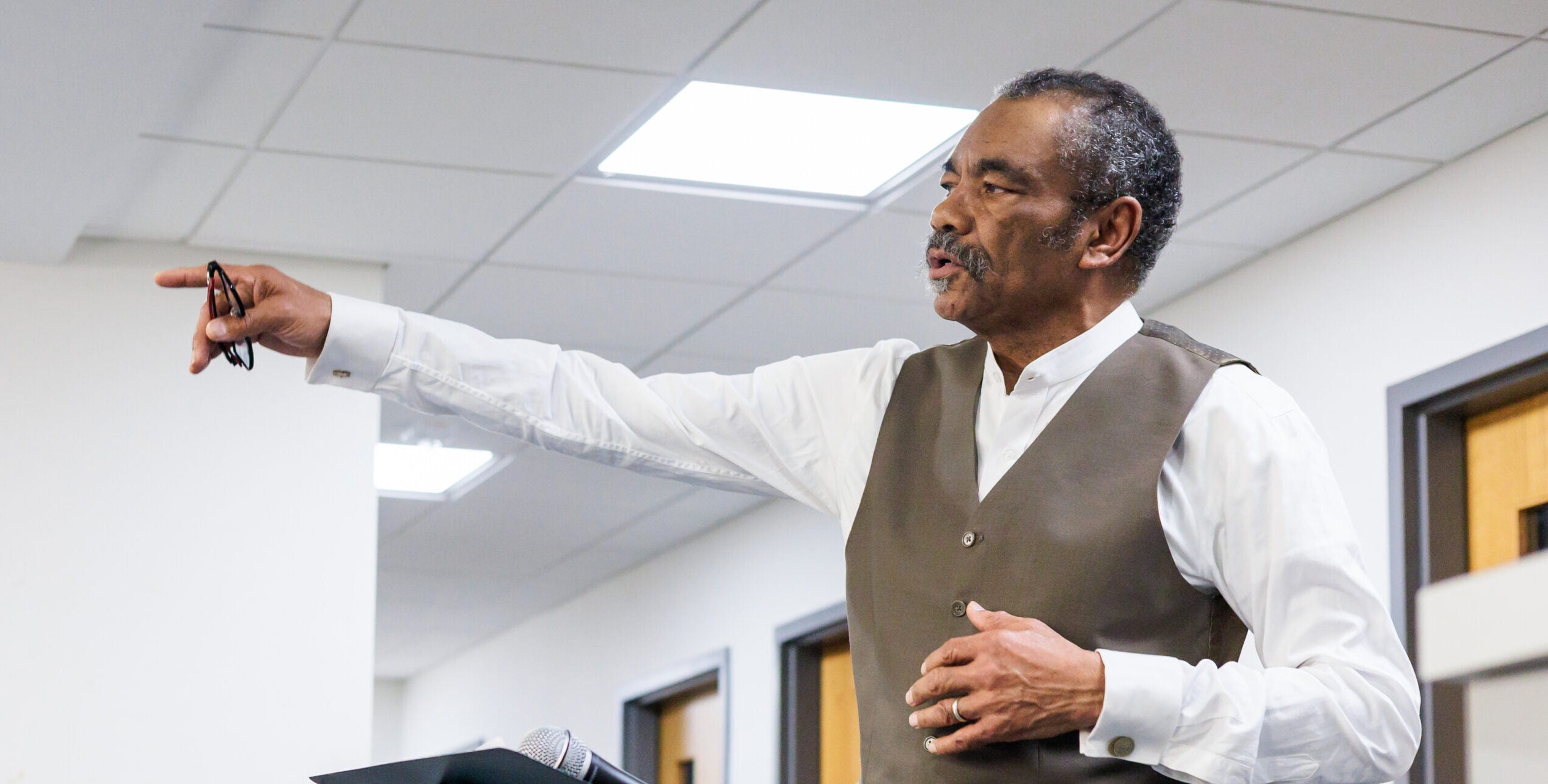
History Professor Maurice Jackson Explores the ‘Rhythms of Resistance and Resilience’ in DC
In order to master something, an athlete or musician must be acutely aware of history, theory and mechanics, said Maurice Jackson (G’95, G’01), an associate professor in the Department of History in the College of Arts & Sciences. The same goes for those working for racial justice.
“You have to understand those things that came before you,” Jackson said. “That’s what the people in the struggle for [equality], they knew.”
In his book Rhythms of Resistance and Resilience: How Black Washingtonians Used Music and Sports in the Fight for Equality, published earlier this year, Jackson tells stories about Black musicians and athletes and the struggle against segregation and inequality in DC. An exhibition of the same title is on display in the Gelardin Center on the first floor of Lauinger Library until Jan 12, 2026.
The athletes and musicians of Rhythms of Resistance and Resilience take complex ideas and apply them in ways that are understandable, and that’s “the most difficult thing to do,” said Jackson. Throughout the book and exhibit, Jackson hopes to do something similar.
Over 160 members of the Georgetown and DC community, including Smithsonian Institution Secretary Lonnie Bunch III, gathered in the Gelardin Center on the first floor of Lauinger Library last month for the opening reception of the exhibition. Photos and stories from Jackson’s book are featured in the exhibition, and both the book and exhibit highlight the significance of music and sports in the life of African Americans living in DC and their fight for equality.
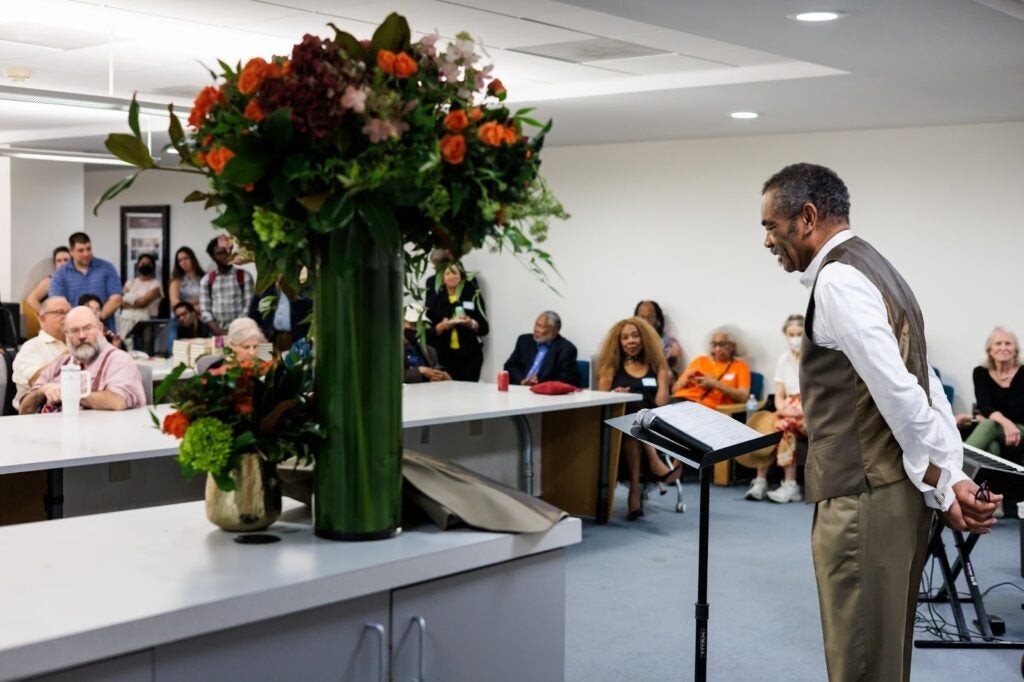
Jackson found his place in DC through attending concerts starting in the mid 1970s as a college student. (Georgetown University Library)
“Music and sports won’t free you, but they can be a balm in Gilead. There is a balm in Gilead to soothe the sin-sick soul,” Jackson said at the reception, referencing a chorus of the African American spiritual, “There Is a Balm in Gilead.”
The reception was co-sponsored by Georgetown University’s Office of the President, Georgetown University Music Program, the Department of History, Georgetown Humanities Initiative and Georgetown Athletics.
Alexia Hudson-Ward, dean of the library, Benjamin Harbert, a professor of music and chair of the Department of Performing Arts and Jackson himself each gave brief remarks. A trio of jazz musicians led by Paul Bratcher, director of jazz studies at Georgetown, on piano and featuring Herman Burney on bass and Kenny Rittenhouse on trumpet played music from DC greats afterward.
The idea for the exhibit came from the relationship between Jackson and library employees Mary Beth Corrigan, who is the librarian for collections on slavery, memory and reconciliation, and Beth Marhanka, the head of library outreach and engagement. Photos in the exhibit are featured in Jackson’s new book, as well as in DC Jazz: Stories of Jazz Music in Washington, DC, a book edited by Jackson and Blair Ruble. Additional photos came from the Library of Congress, Smithsonian Institution and Georgetown University Archives.
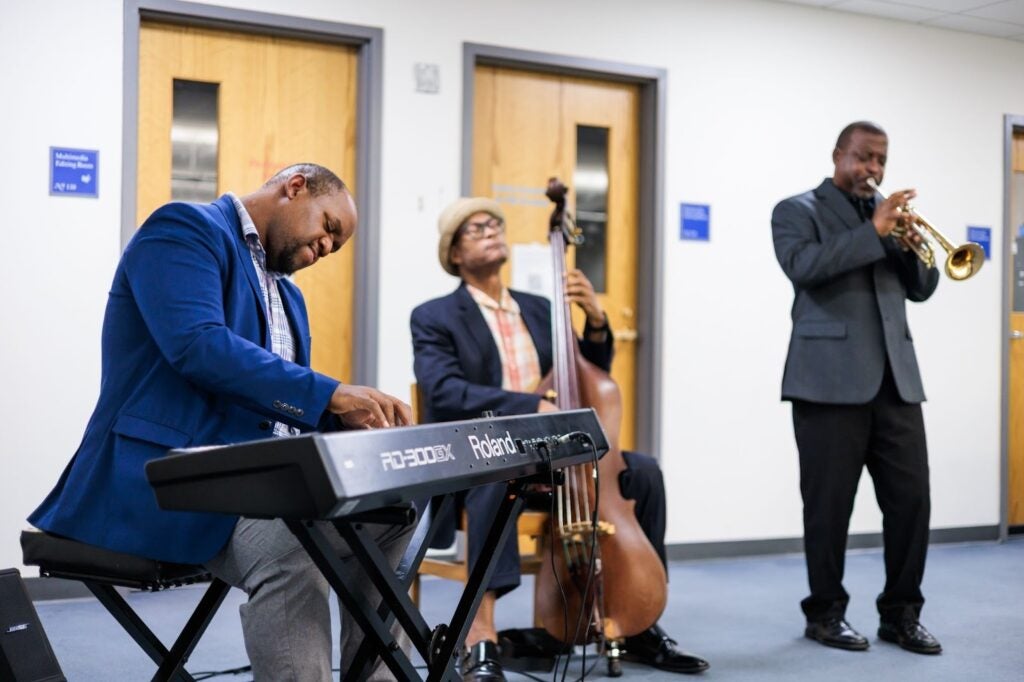
A trio of jazz musicians led by Paul Bratcher, director of jazz studies at Georgetown, on piano and featuring Herman Burney on bass and Kenny Rittenhouse on trumpet played music at the reception. (Georgetown University Library)
Jackson found his place in DC through attending concerts starting in the mid 1970s as a college student. “I didn’t fit in,” he said. “But where I fit in was going to the concerts. I would go to the jazz concerts.”
He would spend hours reading liner notes in DC record stores, and he became infatuated with musicians like John Coltrane, Albert Ayler and Ornette Coleman. Jackson befriended Charlie Haden, Coleman’s celebrated bass player, and the two would talk about politics and the role of music in politics.
Jackson’s newest book is the second of three that he is writing about the city he calls home. The first was DC Jazz and the third is the upcoming book titled, Halfway to Freedom: The Struggles and Strivings of Black Folk in Washington, DC, which is set to be published next year and depicts the struggle of African Americans in the fight for equality and human rights from 1780 to 2020, Jackson said. Jackson uses the history of DC to voice the history of the nation.
He is also beginning work on a biography of Michael Shiner (1805-1880), a Black man who worked at the Washington Navy Yard and is believed to be the earliest known African American in Washington who left a diary.
Jackson took four chapters on sports and music originally featured in Halfway to Freedom and synchronized them to create the book Rhythms of Resistance and Resilience.
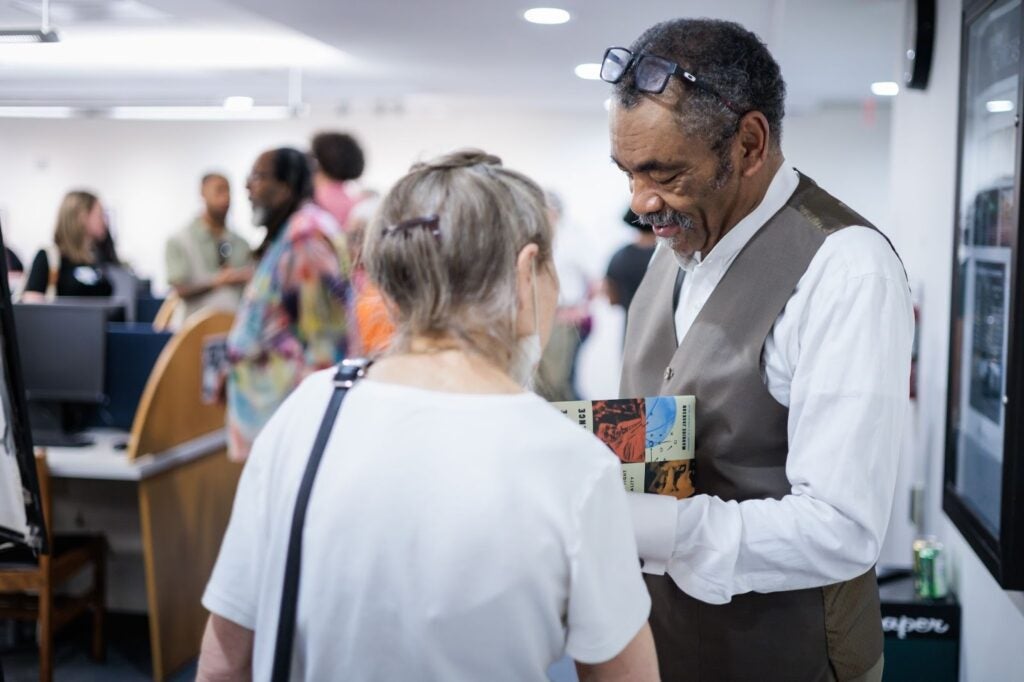
Jackson, an associate professor in the Department of History, signed books for attendees at the opening reception of his exhibit. (Georgetown University Library)
Jackson is a celebrated Washingtonian and member of the Georgetown community. He was inducted into the Washington, D.C. Hall of Fame in 2009 and served as the inaugural chair of the D.C. Commission on African American Affairs. He also served as advisor to former Georgetown University president, John J. DeGioia, on DC affairs and said the book is “in many ways dedicated to Jack DeGioia.” This January, Jackson received the Distinguished Leader Award from the Georgetown University Alumni Association Black Alumni Council. The Council of the District of Columbia passed the “Dr. Maurice Jackson Resolution” for outstanding contributions to scholarship, music and public service in DC and beyond in February of this year.
For Jackson, some of the city’s greatest moments of unity and celebration were the anti-apartheid movement, opera singer Marian Anderson’s 1939 Lincoln Memorial concert and when Washington NFL and Georgetown basketball teams won.
“If we come together through sports and music,” Jackson said during the reception, “we know there will be joy, joy, joy in the morning.”