Physics Professor Daniel Blair Named APS Fellow for Contributions in Soft Matter Research
When you stir a cup of cornstarch and water, the mixture suddenly stiffens under stress – a simple demonstration of a complex physical phenomenon. For Daniel Blair, a professor in the Department of Physics, this behavior is more than a party trick; it’s a window into one of the most fascinating frontiers in modern physics.
This month, the American Physical Society (APS) recognized Blair as one of its 2025 Fellows for “outstanding contributions to the field of soft condensed matter, particularly in understanding the dynamics and mechanics of disordered systems.” The fellowship honors not only his research but also his leadership in building the international soft matter community.
“Dan is highly deserving of this great honor both for excellence in his research and for his service to the soft matter community, with conference organization and leadership roles in the APS,” said Paola Barbara, the chair of the physics department in the College of Arts & Sciences. “This is a new feather in our departmental cap, which already counts six other physics faculty who are APS fellows.”
The Physics of Everyday Materials
Blair studies the materials that sit between solid and liquid such as gels, foams, emulsions and pastes. They are the “materials that we interact with on a daily basis,” he said. His lab probes how these complex materials deform, flow and transition under stress.
He often illustrates this dual nature with a simple example: shaving cream.
“Imagine you take shaving cream and you squirt it out of the container. It’s a liquid, but it also is a solid at the same time,” Blair said. “It has a structure that gives it both the ability to flow … but it also has structure on a scale that’s very small that you can’t see with your eye, that gives it the integrity that allows it to be solid at the same time as being liquid.”
To uncover those mechanisms, Blair’s group designs experiments that capture particle motion in 3D while applying mechanical stress.
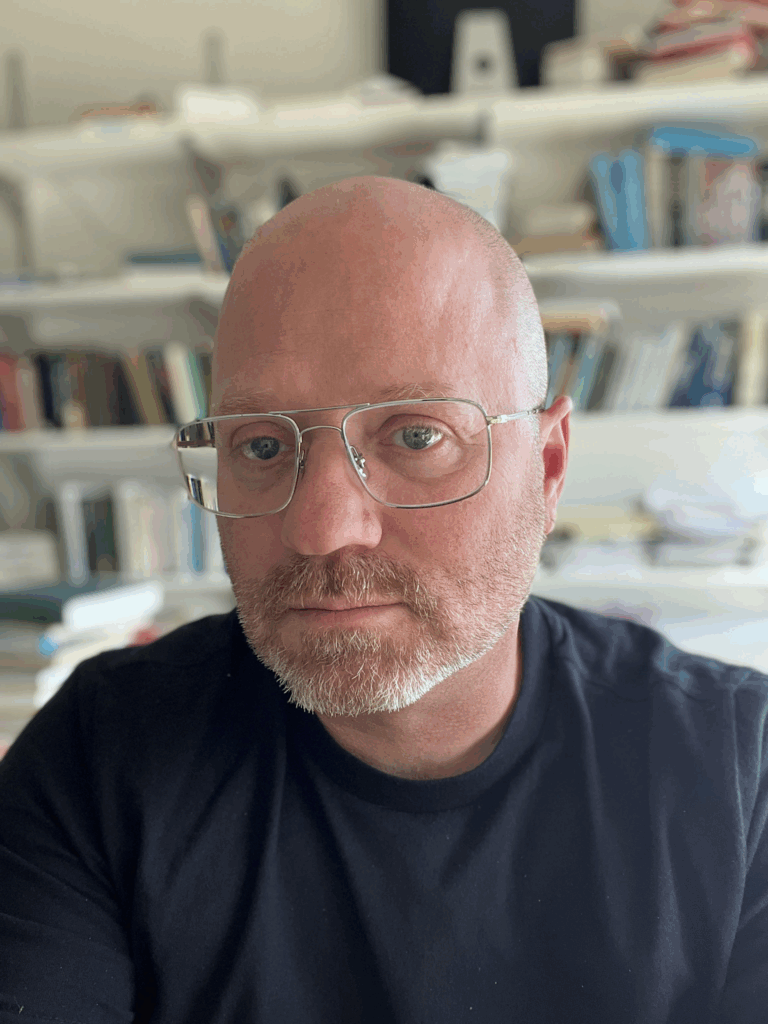
Daniel Blair, a professor and director of graduate studies in the Department of Physics, studies the materials that sit between solid and liquid such as gels, foams, emulsions and pastes.
“In my lab, we have a very powerful microscope where we can make three-dimensional images and then watch things change over time. So it’s almost like a 3D movie of the motions of these little particles while we’re applying a force to make them flow,” he said. “We put them between these two plates, metal plates, and we shear them very hard, and we watch what happens.”
Blair first began this line of inquiry during a sabbatical at the National Institute of Standards and Technology (NIST), where he co-authored a landmark paper describing the transition between liquid and solid states in dense suspensions.
“Since then, we’ve been developing new techniques to more closely view this process under the microscope and under different flow conditions,” he said.
His research has implications for technologies such as impact-resistant clothing and protective gear. “If something hits me quickly, say, a bullet or the road, if I’m on a motorcycle and if I put a very thin amount of this stuff in my protective jacket, the entire material becomes solid instantaneously,” Blair said.
Building a Research Community
Blair thrives on collective inquiry, both within his own lab and across a larger community of physicists.
He continually emphasizes the importance of teamwork in the research process, countering the perception that scientific research is an individual pursuit. At the heart of his research network lies a shared intellectual curiosity. His collaborators range from graduate students to senior colleagues at Georgetown.
“I’ve worked very closely with Jeffrey Urbach, who is the Vice Provost for Research,” he said. “He and I publish most of our papers together because we make a good team and we work very closely on a lot of these topics.”
Blair also highlighted the support he receives from Georgetown faculty, emphasizing that collaboration is central to his success. “I don’t do it alone. Nothing happens by myself,” he said.
Beyond his own research, Blair has devoted significant effort to organizing and strengthening the soft matter physics community, particularly in the Mid-Atlantic region – a commitment that contributed to his recognition as a fellow.
“Part of my mission when I got here at Georgetown was to really provide an environment for people who work in this field to be able to get together and talk to each other on a regular basis,” he said.
Drawing inspiration from his experiences as a student and postdoc in New England, Blair founded Mid-Atlantic Soft Matter Workshop (MASM) that brings together students, faculty and researchers for collaboration and networking.
The next conference, to be held at the University of Pennsylvania, will bring together about 100 students for a day of short research talks and networking, providing them a space for them to connect with one another across institutions.
A Career Defined by Passion
Growing up as a first-generation college student, Blair had the chance to visit NIST’s nuclear reactor at a young age. It helped spark his lifelong interest in science.
“I thought it was really neat that there would be a job where you could do math, work with these cool tools and see all this amazing stuff every day,” he said.
Looking ahead, Blair’s research continues to expand into interdisciplinary frontiers, particularly at the intersection of physics and biology.
For Blair, it all circles back to that early spark of curiosity and to the shared passion of discovery that drives his work today.
“I have a new collaboration that’s being started on looking at how biological materials interact with nonliving materials,” he said. “We can make measurements where we’re taking biological matter and turning it into something where we can manipulate it and measure it in conditions that might be important for applications. And that’s the kind of thing that I find very exciting.”