Vatican-Affiliated Scholars Join Students in Dialogue About the Virgin Mary
In Catholic teaching, the Virgin Mary is understood to bring people together under her “mantle,” guiding them toward Jesus. She is a bridge and a unifier. At the College of Arts & Sciences, Vanessa Corcoran, an advising dean and medieval historian, teaches the course, Mary Through the Ages, which examines the figure of Mary from interreligious and intercultural perspectives.
“It’s under her mantle that she’s able to usher people to Jesus,” Corcoran said. “It’s everyone included.”
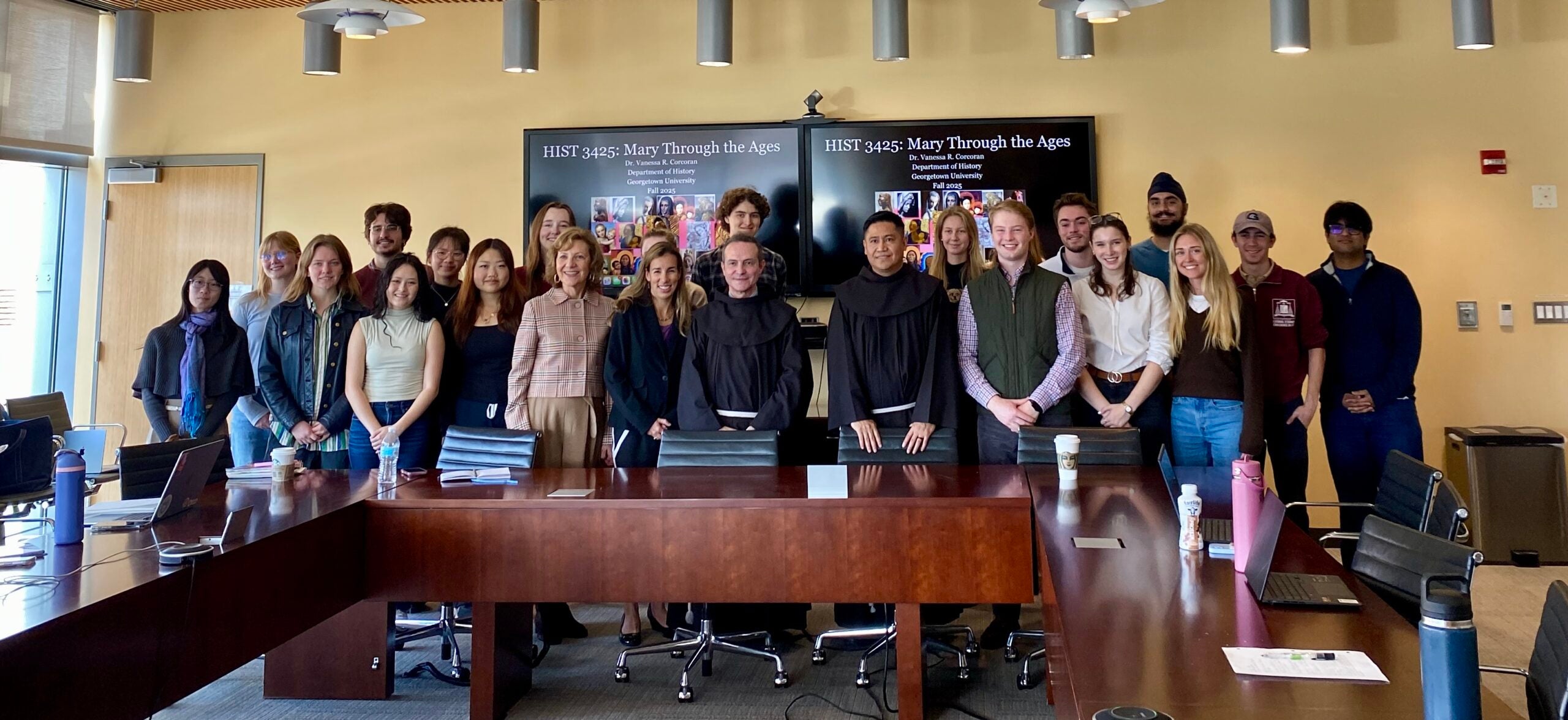
For Fr. Stefano Cecchin, O.F.M. and Brother Marco Antonio Mendoza Martínez, O.F.M., two Vatican-affiliated scholars of the Order of Friars Minor (Franciscans) and distinguished Mariology experts, the idea of Mary as a unifier was central to their recent mission to Washington, DC.
The trip last month, in collaboration with the International Network of Women Catholic Leaders, brought the scholars to the Basilica of the National Shrine of the Immaculate Conception, Catholic University, Mount St. Mary’s University and Georgetown University, where they spoke to Corcoran’s students.
“It’s really important for students to see how scholarship takes place in real time and what real dialogue looks like among academics,” Corcoran said. “I was really grateful that they were willing to come to class.”
Mary as a Unifier
Cecchin and Martínez are the president and secretary, respectively, of the Pontifical International Marian Academy (PAMI), a Vatican-based international organization that promotes Mariology, the theological study of Mary, the mother of Jesus.
During their visit, they met with Corcoran and Kimberly Mazyck (SFS ’90), the associate director for engagement of the Initiative on Catholic Social Thought and Public Life. In Corcoran’s class, the scholars joined in dialogue with students from a variety of religious and academic backgrounds.
The conversation explored the figure of Mary from interreligious and intercultural standpoints. Cecchin and Martínez discussed their work of bringing Mary from history to the people of today, their work in moving Mary away from associations with the mafia, the process of vetting Marian apparitions and how the figure of Mary works to unify people across religions and cultures.
“Mary has always been an opportunity to come into interreligious dialogue,” Martínez said.
He spoke of the significance of Christians and Muslims uniting in prayer. The figure of Mary was central to this collaboration, bringing leaders from both religions together as they joined in prayer and feast.
“It was very nice to see this, the Muslim brothers singing a surah [chapter of the Quran] in front of the cross,” Martínez said. “They started calling us ‘our Franciscan brothers.’ We find that these kinds of events help us get into interreligious dialogues.”
Cultural Understanding
In Corcoran’s course, students study Marian representations in Christianity, as well as in Judaism and Islam. Students from diverse religious, academic and cultural backgrounds come together in conversation about Mary.
“We have students from all faiths, including students that don’t identify with any particular religion, who take this class,” Corcoran said. “It’s also really interesting to learn from students about their cultural understanding of Mary as well.”
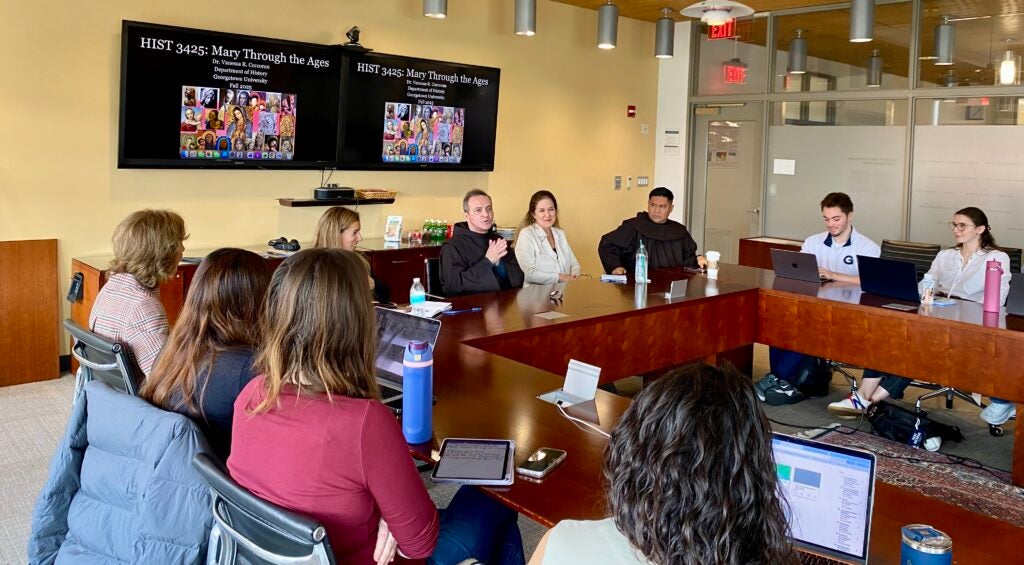
Fr. Stefano Cecchin, O.F.M., center, speaks to Vanessa Corcoran’s Mary Through the Ages course. Third from the right is Brother Marco Antonio Mendoza Martínez, O.F.M. and between them is an interpretator from the International Network of Women Catholic Leaders. (Elizabeth Short)
A highlight of the course is a visit to the The Basilica of the National Shrine of the Immaculate Conception, which contains over 80 chapels and oratories dedicated to Mary, each representing Mary from the perspective of a culture around the world.
“It’s a really culminating moment for the class, because each of these chapels represents different aspects of Mary,” Corcoran said. “[We] see together all of these different representations of Mary and how she really is this global figure, painted to represent how she is imagined by people from each area.”
Overall, Corcoran said the most important aspect of the scholars’ visit was their openness to interpreting Mary in new ways.
“We should embrace the fact that there are still ways to find newness in very old materials,” she said. “I think it’s really exciting when we can bring in real scholars who are talking about the same issues that our students are and showing them what a rich academic discussion looks like.”