In a Small Town in West Virginia, Social Responsibility Network Students See Civic Engagement in Action
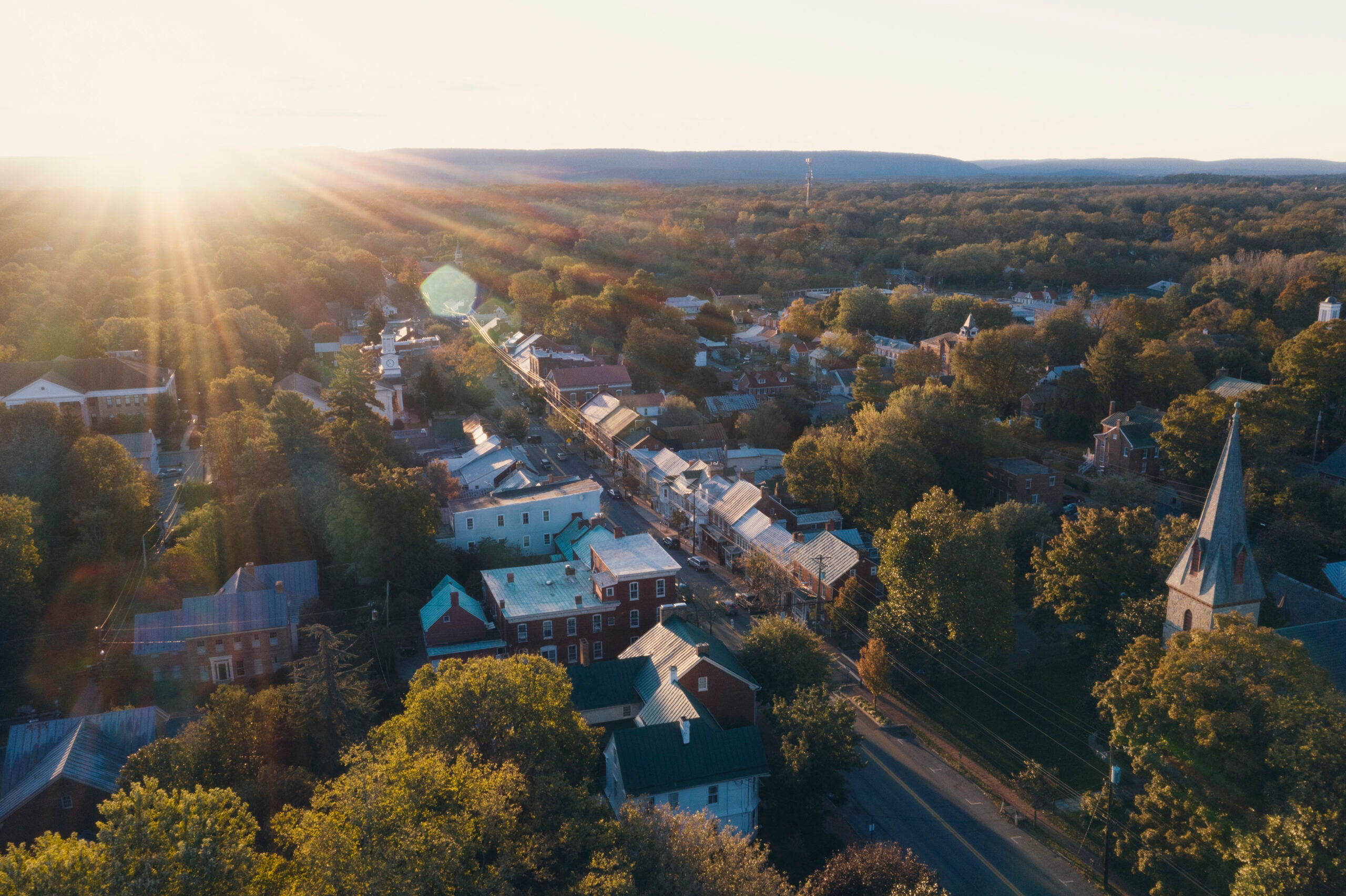
This fall, a dozen students from the College of Arts & Sciences traveled to Shepherdstown, West Virginia, a town of about 1,500 residents nestled along the Potomac River in the lower Shenandoah Valley, for an educational retreat. They were there with the Social Responsibility Network (SRN), a mentorship program for College students interested in pursuing service-based and social impact careers.
During the trip, the group spent a few days at the National Conservation Training Center (NCTC), a U.S. Fish and Wildlife Service conference and training center, met with local politicians, artists, environmentalists and nonprofit leaders and toured the historic homes of local residents.
“The goal of the whole trip and this experience was to provide our students with avenues to learn from different individuals and different sectors of the social impact space directly by visiting with them in their own spaces and to see the work that’s going on in Shepherdstown,” said Thom Chiarolanzio, the senior associate dean in the College who helped launch SRN in 2019.
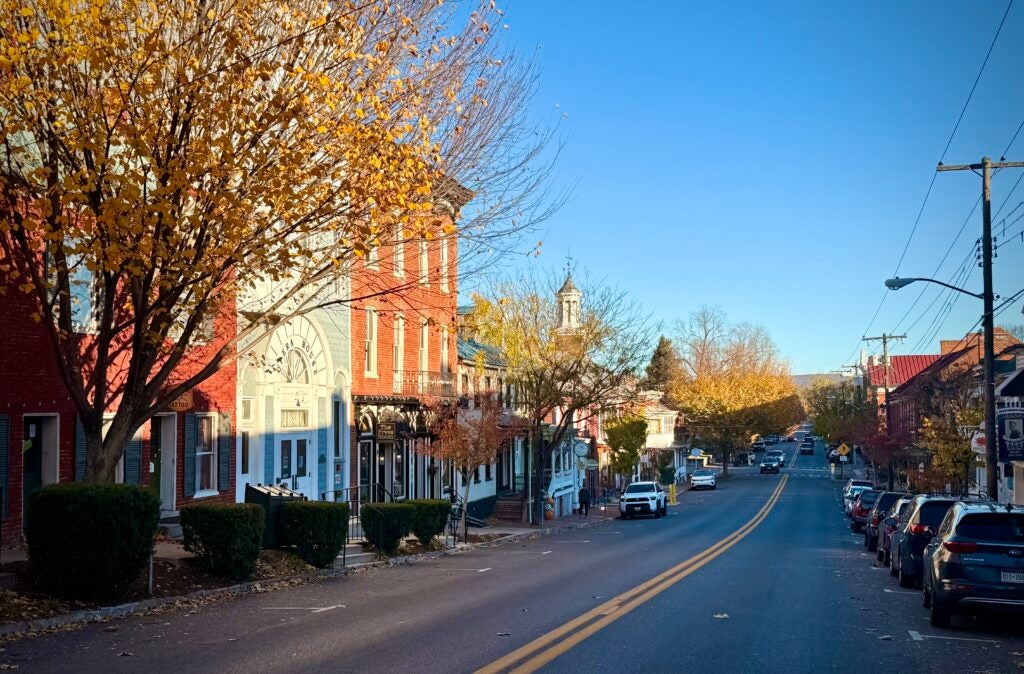
The Shepherdstown Historic District is concentrated along German Street and includes the Opera House, pictured on the left. (Michael Chalmers)
Mary Fortuna (C’89), a member of the SRN Board of Advisors who lives in Shepherdstown, proposed the idea of bringing students to the town last spring, and was instrumental in organizing the trip’s itinerary and lineup of speakers that included the Mayor of Shepherdstown, James Gatz.
Fortuna is an alumna of the College’s George F. Baker Scholars Program, which influenced SRN’s cohort and mentorship-based model. SRN has around 30 total students and is open to rising College sophomores, juniors and seniors. Fortuna wanted to use the trip to introduce students to Shepherdstown and give them opportunities for personal connections with its leaders.
“I wanted the students to learn from their personal anecdotes — what’s been difficult, the pivots they’ve made and their successes and failures,” Fortuna said.
Meaningful Outdoor Experiences
When Daisy Fynewever (C’26) first arrived at Georgetown, she felt she needed to save the world.
But her time on the Hilltop and with SRN has opened her eyes to the possibility of making a difference in smaller communities and at the grassroots level. The trip to Shepherdstown reinforced that in her mind, said Fynewever, who is double majoring in environmental biology and justice and peace studies with a minor in Spanish.
“I think we’re used to hearing about national and international organizations, so seeing the type of changes that can be made in a small community through a tight knit network of people was really interesting and super inspiring,” she said.
One speaker that Fynewever connected with in particular was Kristin Alexander, the executive director of the Potomac Valley Audubon Society.
During her talk, which took place during a morning hike through the Yankauer Nature Preserve, Alexander spoke about how meaningful childhood experiences in the outdoors often leads to people caring about the natural world as an adult. She helps create those opportunities through events like youth day camps.
“I’ve seen so many kids grow up through our programs and they’re now environmental lawyers, they work for Habitat for Humanity, just so many incredible stories of how these campers have grown up to do good work,” she said.
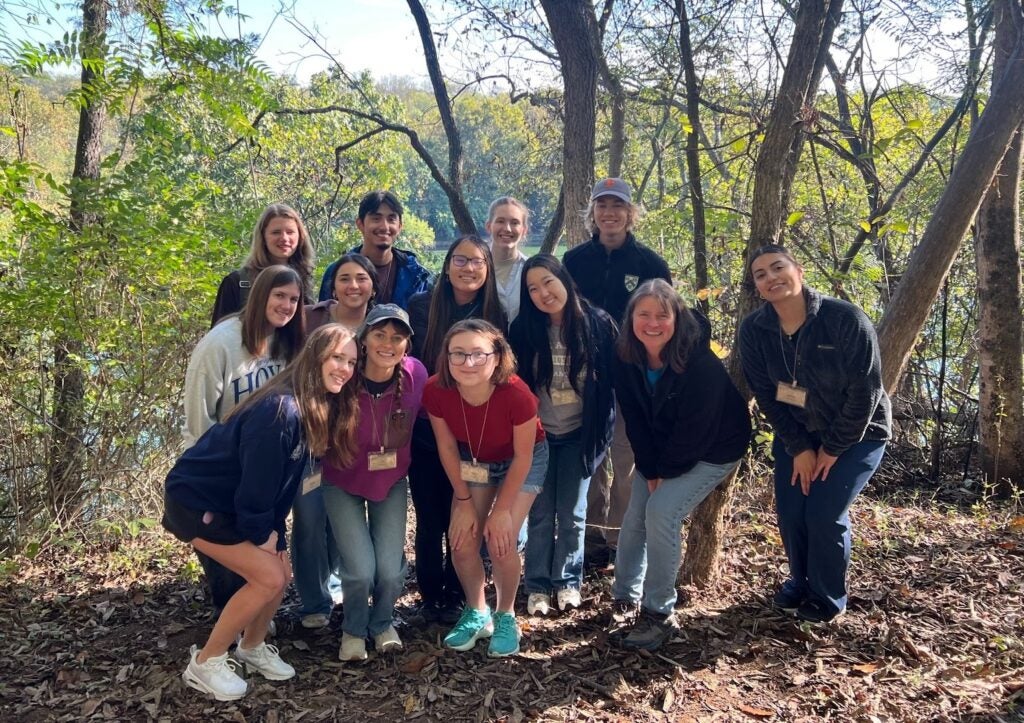
Students from the Social Responsibility Network pose with the executive director of the Potomac Valley Audubon Society, Kristin Alexander, second from the right, at the Yankauer Nature Preserve.
Over the summer, Fynewever worked for Nathaniel “Than” Hitt, the senior scientist for West Virginia Rivers, a nonprofit organization, and speaker for the SRN trip. In her internship, which was supported by an SRN stipend, Fynewever worked on a research project exploring the link between ambient water quality and cancer incidents.
Hitt, a tenth-generation West Virginian and former research fish biologist for the U.S. Geological Survey, shared lessons he learned from his career in the federal government and nonprofit space.
He asked students to think of their future careers by drawing a Venn diagram that includes three circles: 1) What are you good at? 2) What does the world need? 3) What brings you joy?
“What you’re looking for is, where is that overlap? That will guide your next steps,” Hitt said.
The students also heard from Maria Parisi, a Potomac Valley Master Naturalist who recently retired from NCTC.
“It was super interesting to see how each of the speakers had a different perspective on the best way to make a difference and the best way to do social impact work,” Fynewever said. “And I think that we need all of those perspectives to build the future that we want to see.”
Preserving Arts and History
For Cici Sprouse (C’26), the trip spotlighted the importance of the arts and historic preservation for social impact work. Shepherdstown, which was founded in 1762, is known for its historic architecture and vibrant arts scene.
“It was really, really cool to see how arts and culture were huge in creating this sense of identity and also instilling a sense of civic duty,” said Sprouse, a justice and peace studies major who is minoring in Spanish and government.
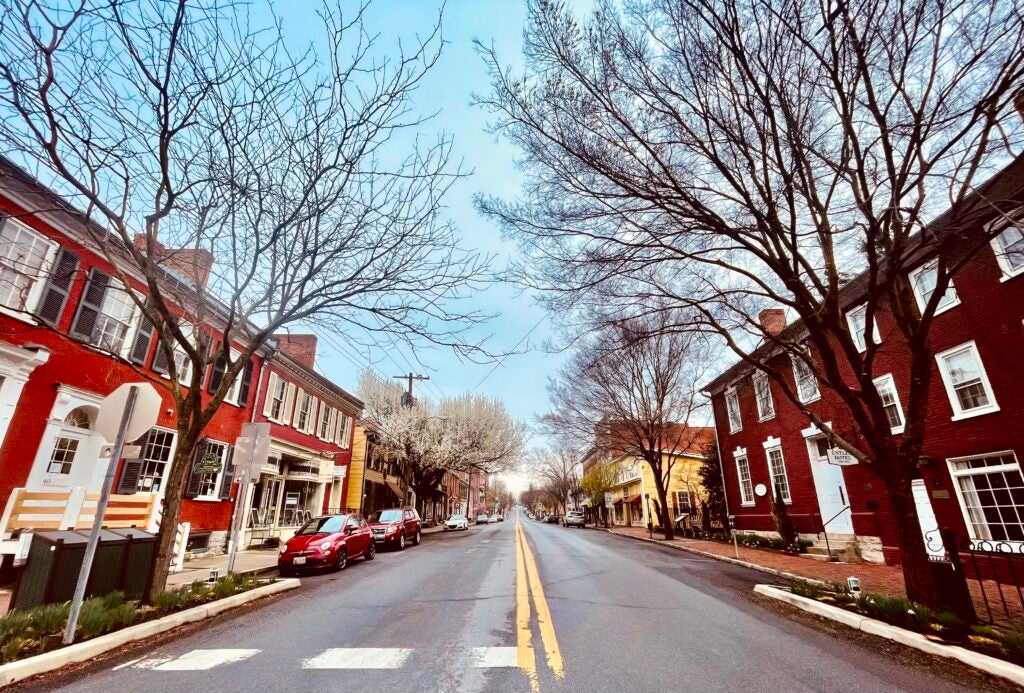
Shepherdstown, which was founded in 1762, is known for its historic architecture and vibrant arts scene. (Michael Chalmers)
Hilary Lo, the festival director of the American Conservation Film Festival, shared with the group that she accepted her job in part because of the ability for “stories to change hearts and minds.” As an example, the students watched a screening of The Grab, one of the films shown at the festival this March. The documentary features Zambian attorney Brigadier “Brig” Siachitema (L’13) and follows journalists as they investigate the dire environmental consequences of foreign governments and private investors seizing food and water resources around the world.
“The Grab was extremely impactful, because it bridged the social impact lens and environmental conservation lens that we were exploring on this trip,” said Madison Ross (C’27), a government major who is minoring in education, inquiry and justice.
Students also met Peggy McKowen, the artistic director for the Contemporary American Theater Festival. The mission of the festival is to produce and develop new American theater with a vision of being the ultimate theater experience for artists and audiences.
In her talk, McKowen highlighted the beneficial impact of arts on someone’s health and wellness and the festival’s commitment to its social values and the local economic impact.
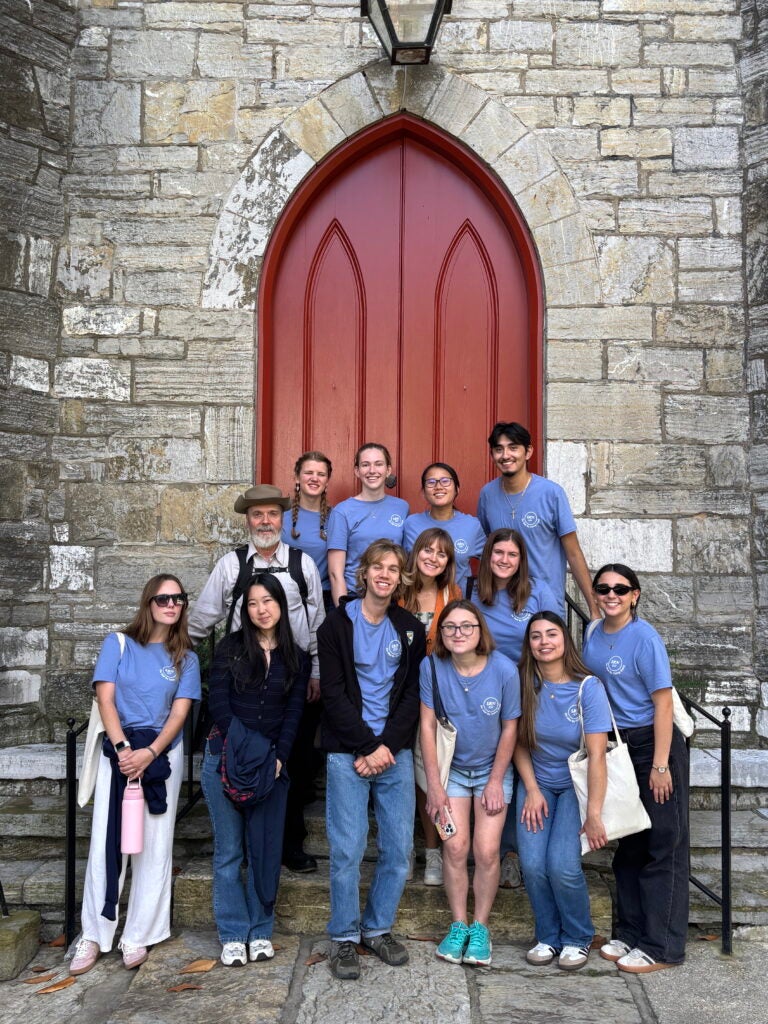
Shepherd University history professor Keith Alexander, top row left, gave a walking tour to the students, including a stop at the historic Trinity Episcopal Church.
Eliana Mlawski (C’26), a government and Spanish double major pursuing a minor in environment and sustainability, found McKowen’s session particularly inspiring for emphasizing the value of the arts in Shepherdstown.
“The importance of local organizing and action is huge, and sometimes can be forgotten, but I think this trip was a really fun way to deep dive to see that impact,” she said.
Social impact can mean preserving history, as well.
When the students arrived at O’Hurley’s General Store, a group of musicians treated them to a bluegrass and folk jam session, held every Thursday night year-round. The musicians sat in a circle and played various instruments, including the guitar, harp, banjo, mandolin and violin. These jam sessions have continued for more than four decades, preserving a piece of Shepherdstown that has been passed down for generations.
“It might not seem like it is directly related to social impact upon first glance,” Ross said. “But I think the preservation of artistic culture is so important to maintain that community. It was so cool to see that they were still doing it.”
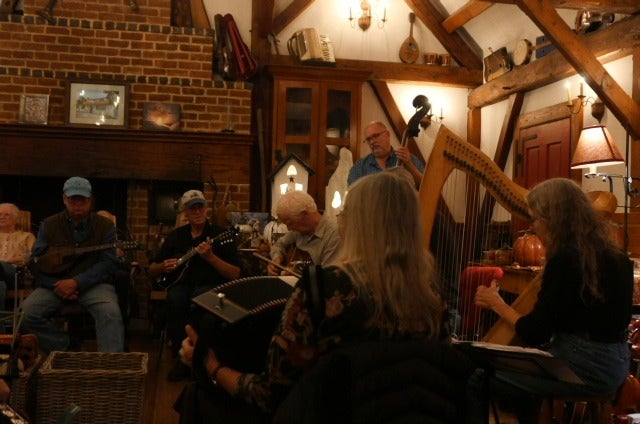
A group of musicians have met up at O’Hurley’s General Store for a bluegrass and folk jam session for more than 40 years.
On the final day, students went on a tour of the Historic Shepherdstown Museum located in the Entler Hotel, led in part by John Kavaliunas (F’68, G’73), visited residents Pia Peltola and Andy Singletary at their re-imagined loft-style home in the former community building and fire hall, explored the Thomas Shepherd Grist Mill with owners Adam Thomas and Shannon Thomas and learned about the restoration of a gothic revival cottage owned by Rod Glover and Tom Mayes.
The group also spoke with the co-owner of the Shepherdstown Opera House, Steve Pearson (MBA’92), who completed a full rehabilitation of the structure in 2023. Local artist and professor of art at Shepherd University, Sonya Evanisko, gave a public art demonstration, and the students wrapped up the weekend with a walking tour of Shepherdstown with Keith Alexander, an associate professor of history at Shepherd University.
“The word that really came to mind for me was civic duty,” Sprouse said. “Every person that we talked to felt this responsibility to improve their community in the way that they saw that they could.”
Socially Responsible Careers
The Shepherdstown trip broadened the perspective on socially responsible careers for the students.
“SRN has kind of taught me that being mission driven in your career doesn’t necessarily mean that you have to work at a nonprofit,” Sprouse said.
“I think that the entire trip as a whole gave me a wider overview of what having a socially impactful life looks like and also the type of people that care about social impact work,” said Ashland Ross (C’28), who is majoring in the joint program in public policy and minoring in environment and sustainability.
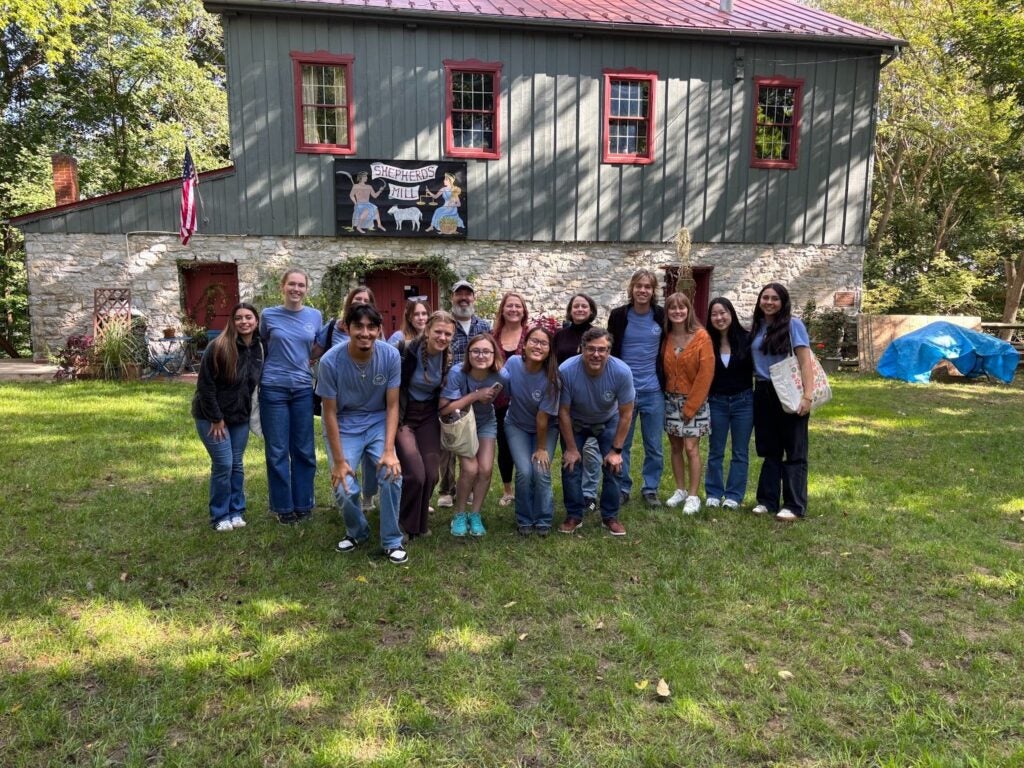
Students pose with Adam Thomas and Shannon Thomas, top row center, who are the owners of the Thomas Shepherd Grist Mill. Senior associate dean Thom Chiarolanzio is on the bottom right, and Mary Fortuna (C’89) is above him.
Ross is interested in doing work in the environmental justice space with the intention of going to law school after graduation. Being on the trip provided her with a sense of community with other people who are passionate about social impact work and related career paths, she said.
Life as a college student can be exceptionally busy, Mlawski said, with students being pulled in multiple directions. The trip, therefore, allowed them to pause and listen to people who found a fulfilling career by following their passions, she said.
“I’m pursuing international environmental work, which can feel really challenging sometimes,” Mlawski said. “So understanding how other people have navigated their own careers to make it work is invaluable.”
(Top photo courtesy of the West Virginia Department of Tourism)