For This Stroke Survivor and Alumna, Obstacles Are Opportunities
Maddi Niebanck (C’17) felt on top of the world.
It was May of 2017, and she had just graduated from Georgetown University with a degree in Spanish and justice and peace studies. Niebanck planned to spend the summer relaxing, traveling and enjoying her time with friends before moving to Boston for a job in technology sales. The post-college life she envisioned for herself was just beginning.
But 10 days after she walked across Healy Lawn as part of the College of Arts & Sciences commencement ceremony, Niebanck had a stroke during a scheduled brain surgery. She woke up paralyzed on the left side of her body and couldn’t speak or swallow. Suddenly, Niebanck’s full-time job became rehabilitation.
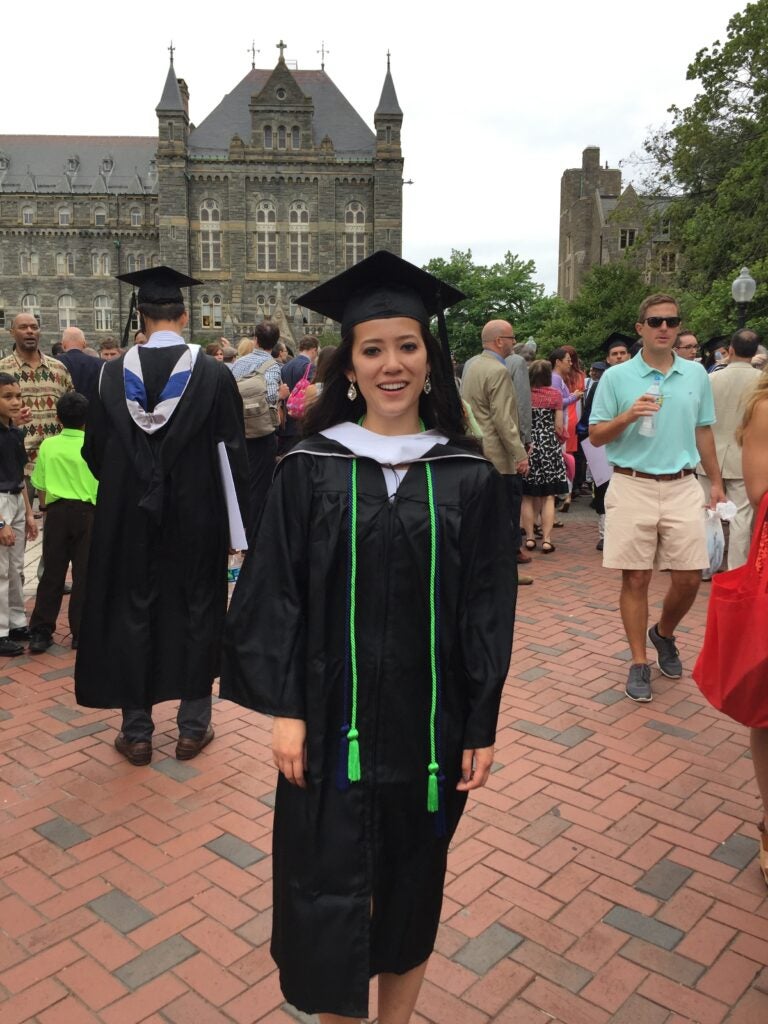
Maddi Niebanck (C’17), attended her College of Arts & Sciences commencement ceremony on May 20, 2017. Ten days later, Niebanck had a stroke during a scheduled brain surgery.
“I had to learn how to walk, how to sit up in a wheelchair, how to speak, how to swallow,” she said. “I had to do everything all over again.”
Niebanck watched her friends move to different cities, launch their careers and live what seemed like glamorous lives in her mind. The sense of being left behind grew. But conversations with her mentors, including a Georgetown professor, shifted her perspective and gave her a new mantra: Obstacles are opportunities.
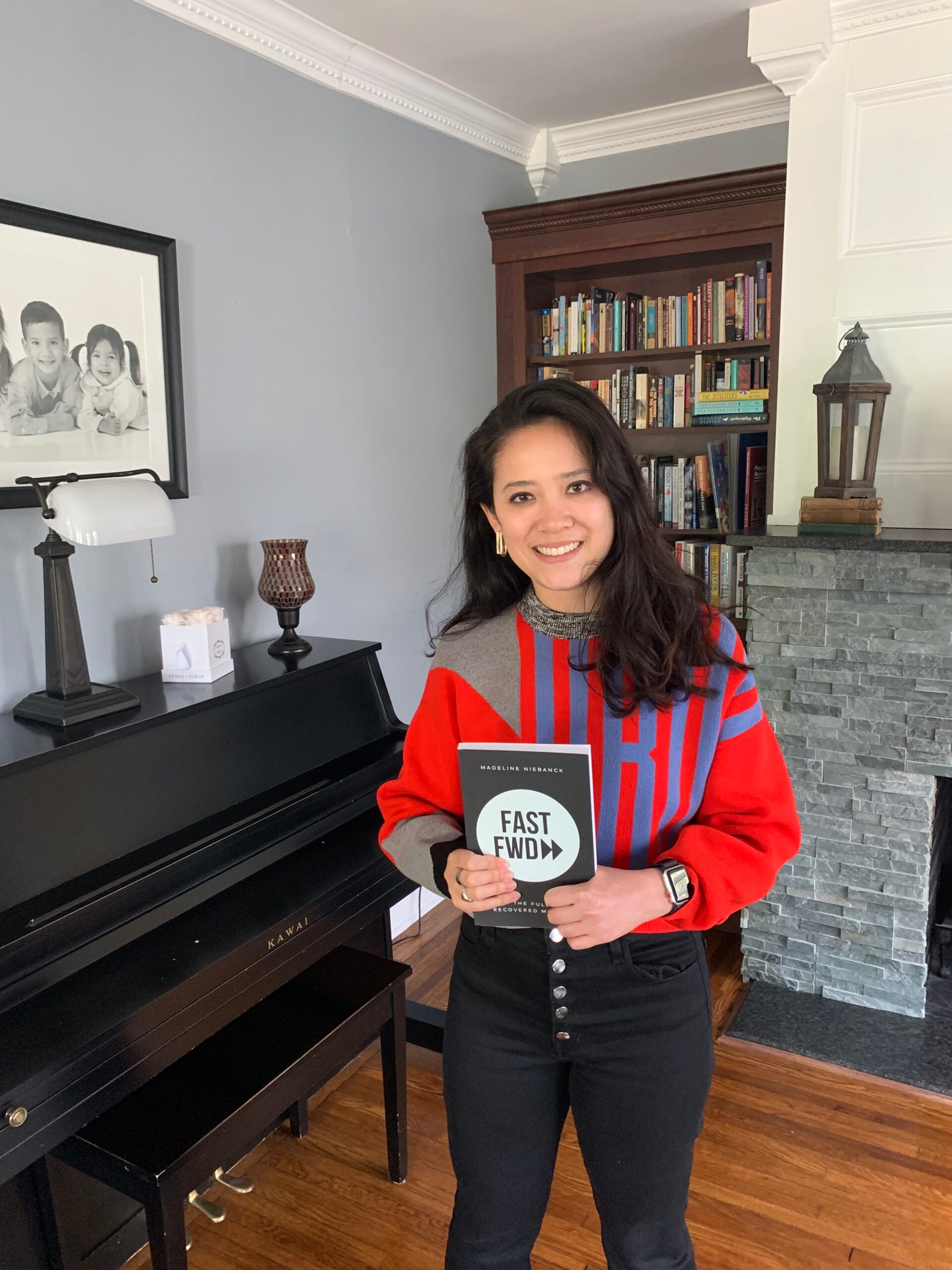
In the years since Niebanck’s stroke, she has published two books — Fashion Fwd: How Today’s Culture Shapes Tomorrow’s Fashion and Fast Fwd: The Fully Recovered Mindset — and has become a public speaker and advocate for stroke survivors. In 2023, the World Health Organization invited Niebanck to speak about her rehab journey at its Global Rehabilitation 2030 meeting in Geneva, Switzerland.
“We all experience obstacles in our lives,” she said. “It’s about how we respond to it and decide how to turn that into something positive for ourselves and for our communities.”
Finding a Place to Thrive
Niebanck grew up in Chatham, New Jersey, a suburb of New York City, as the oldest of three siblings.
She knew from a young age that she wanted to study languages, and came to Georgetown because of its Spanish program and location in Washington, DC.
“It just seemed like a place where I could thrive,” Niebanck said.
At Georgetown, she joined an investment club at Georgetown Collegiate Investors, where she rose to a leadership position. She volunteered as an English language tutor for low-income immigrant families in DC through the DC Schools Project and participated in the Georgetown University Concert Choir and Georgetown Rangila. Niebanck also worked as a front desk clerk for the Center for Latin American Studies (CLAS).
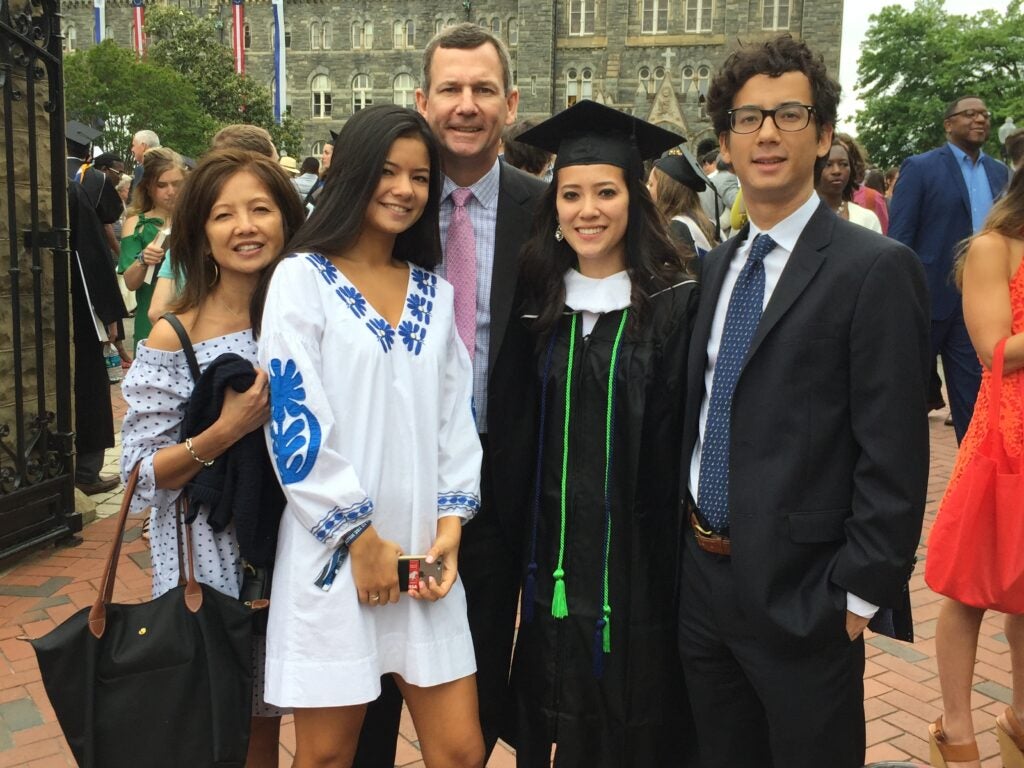
Niebanck, second from the right, poses with her family at graduation. She grew up in Chatham, New Jersey and is the oldest of three siblings.
In her sophomore year, she became an Entrepreneurship Fellow through the McDonough School of Business.
“One of the things that I loved the most about Georgetown was that everyone was so driven and passionate about something,” Niebanck said. “I found it really refreshing that everyone was motivated and hard working and had diverse areas of interest, and we could all collaborate together.”
As a senior, she took the Launching the Venture course with Eric Koester, an adjunct professor in the McDonough School of Business who would become one of her closest and most influential mentors.
Niebanck looked forward to the path she thought lay ahead after graduation. She didn’t even stress or think about her upcoming brain surgery.
Since childhood, Niebanck had dealt with migraines, culminating in a series of migraines that lasted more than 20 days during high school. Doctors eventually diagnosed her with a rare arteriovenous malformation (AVM) in the right occipital lobe of her brain. She elected to have brain surgery after college to remove the risk of a potential rupture.
“In my mind, it was just like, oh, this is just a thing that’s gonna have to happen, and then, you know, I’ll rest for a month, and I’ll be fine,” she said.
‘What Really Matters’
Before surgery, Niebanck had a pre-operative procedure. It caused a blood clot in her brain that burst, leading to a brain hemorrhage. She was rushed into emergency surgery.
After her stroke, Niebanck spent 15 days in the intensive care unit, five weeks as an inpatient and two and half years as an outpatient.
Niebanck stayed in touch with Koester after graduation, and during one of their conversations while Niebanck was struggling with the constant physical and cognitive and speech therapy, Koester encouraged her to view the stroke as an opportunity to explore her interests and dive into her passions.
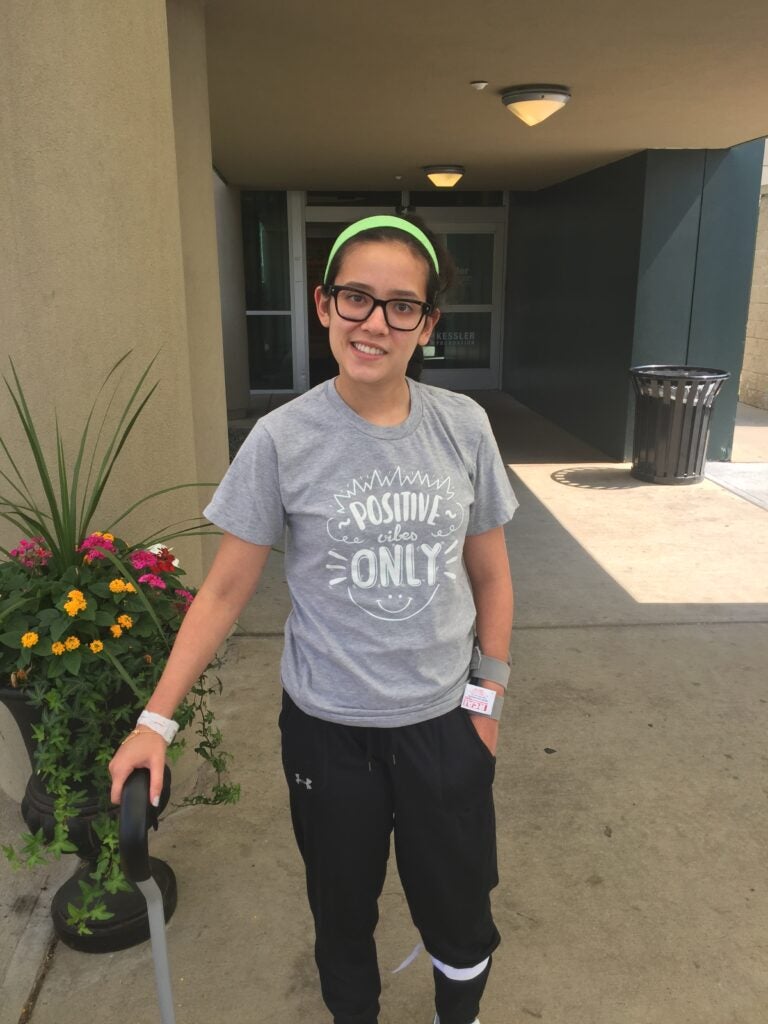
After her stroke, Niebanck woke up paralyzed on the left side of her body and couldn’t speak or swallow.
“He was like, if you could do anything and work any job, what would you do?” Niebanck said.
For Koester, Niebanck embodies the idea of cura personalis, or care of the whole person, through her willingness and ability to inspire others with her story.
“Maddi is one of those people who never sought recognition, but her actions day in and day out brought people hope, joy and lessons for their own journeys,” Koester said. “I think what’s amazing about her is she never once let any limitations she faced as a stroke survivor slow her down. In fact, quite the opposite. She was the one who wouldn’t let others slow her down.”
Niebanck describes Fr. Matthew Carnes, S.J., as another influential figure in her recovery journey. Carnes, the vice president for mission and ministry at Santa Clara University who taught in Georgetown’s Department of Government and School of Foreign Service from 2009 to 2024, met Niebanck through her work for CLAS. Carnes said that Niebanck “points us to what really matters.”
“She kept her eyes on what was possible, and this has allowed her to make such amazing progress, and eventually to succeed in her career, and as an author, and in so many other ways,” he said. “But it’s not the success or the stroke that defines her. It’s the spirit that beats in her heart and has nourished her to this point, and the way she shares that spirit generously with others.”
Building a Supportive Community
When Koester challenged Niebanck to think of her dream job, she thought back to a self-published fashion magazine — Passion for Fashion — she designed in eighth grade.
On the cover is her younger sister, Bridget, striking a model pose. Colorful headlines coat the page: “What’s in Style?”, “A Day in the Life of Model Bridget Niebanck”, “Fashion Advice: Just Be Yourself!”
Niebanck’s first job after her stroke was as a reinsurance underwriter for a Spanish company. But while she was rehabbing, Niebanck reached out to her network and cold emailed people for connections in the fashion industry. This time would eventually lead to her first book, Fashion Fwd, published in 2018, which explored fashion trends and how the fashion landscape was evolving.
“I interviewed everyone from small business owners to fashion executives to the [former] Washington Post fashion editor Robin Givhan,” Niebanck said.
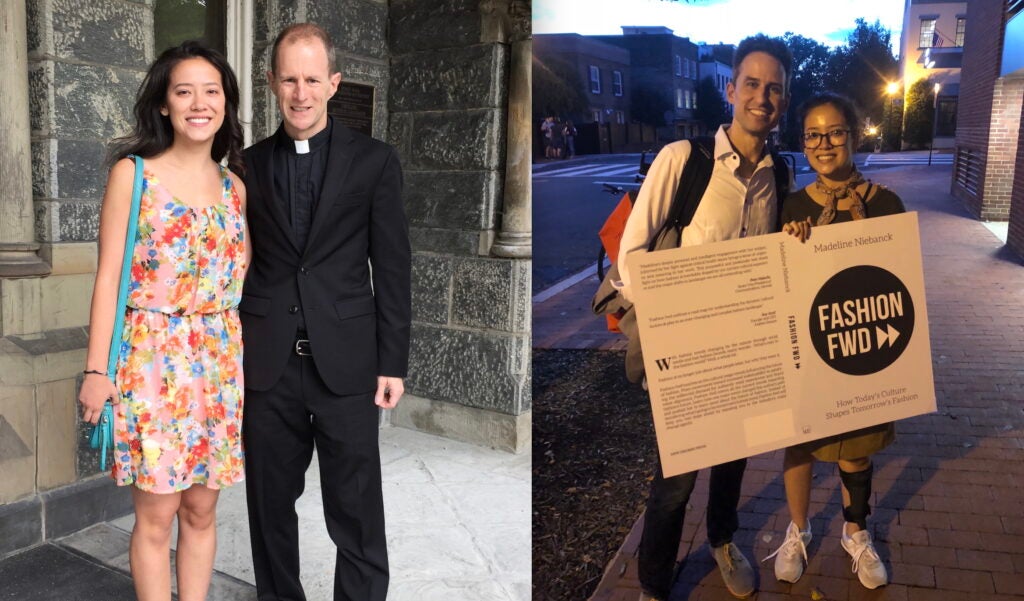
Left: Niebanck with Fr. Matthew Carnes, S.J., who taught in Georgetown’s Department of Government and School of Foreign Service from 2009 to 2024. Right: Niebanck with Eric Koester, an adjunct professor in the McDonough School of Business. Both are Niebanck’s mentors.
She also worked for three years as the client relations coordinator for Hermès, a French luxury goods company, and is now a marketing manager for Cionic, a biotechnology startup that makes clothing to aid mobility.
Today, Niebanck lives independently and works full-time in New York City, but still struggles with her vision. She lost half of her peripheral vision on the left side of both of her eyes. She does not drive.
“When I’m walking down the busy streets of New York City, I have to constantly scan and turn my head to make sure I’m not missing anything,” Niebanck said. “I get bumped into all the time.”
For a while, she said, the challenges of her recovery left her dejected and questioning, “What did I do to deserve this?”
But while writing her second book, Fast Fwd, published in 2020, Niebanck started to build a community of stroke survivors. She decided to share her journey with the public in hopes of meeting others with similar stories.
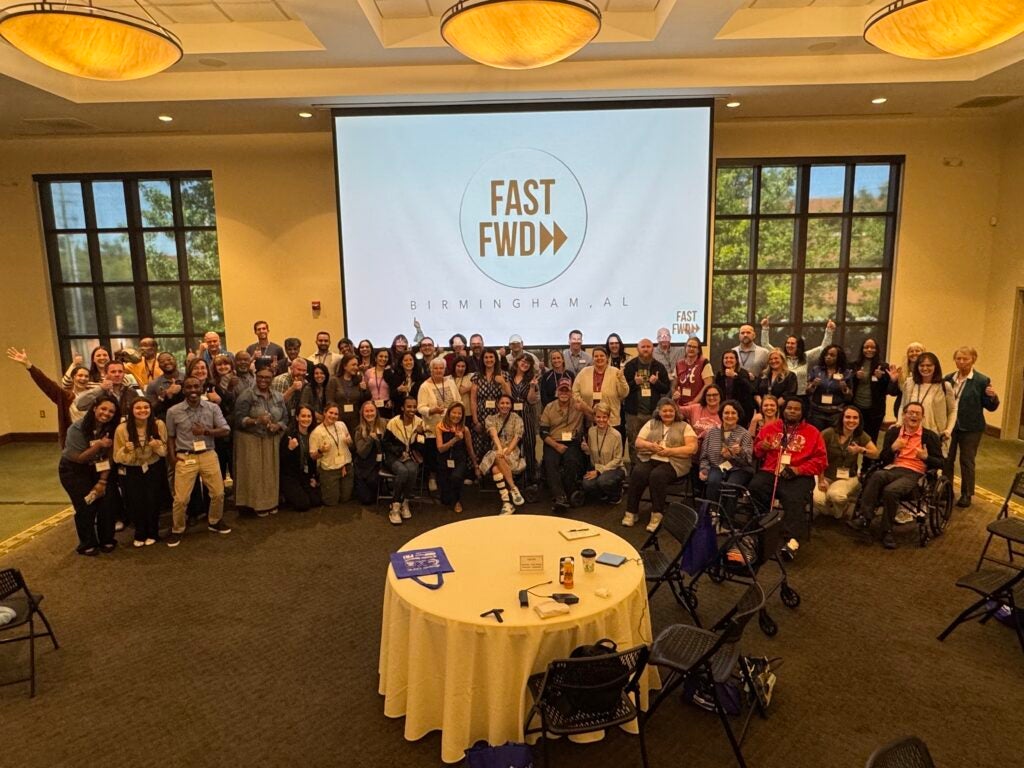
The most recent Fast Fwd Summit for stroke survivors and caregivers took place in Birmingham, Alabama.
Since then, she has written blog posts chronicling her experiences and co-hosted a live video every Sunday with another stroke survivor on Instagram. Niebanck has also given talks about her journey to college students.
More recently started hosting Fast Fwd Summits, where stroke survivors and caregivers get together in person to “connect with others who share similar experiences and build a supportive community.” Niebanck has hosted four so far, with the first summit taking place in New York City in April 2024 and the most recent in Birmingham, Alabama, this October.
“Real life events are super impactful for people to be able to connect with the community and meet other people who are like them,” she said.
Embracing New Opportunities
There is a specific moment that Niebanck remembers as an inpatient.
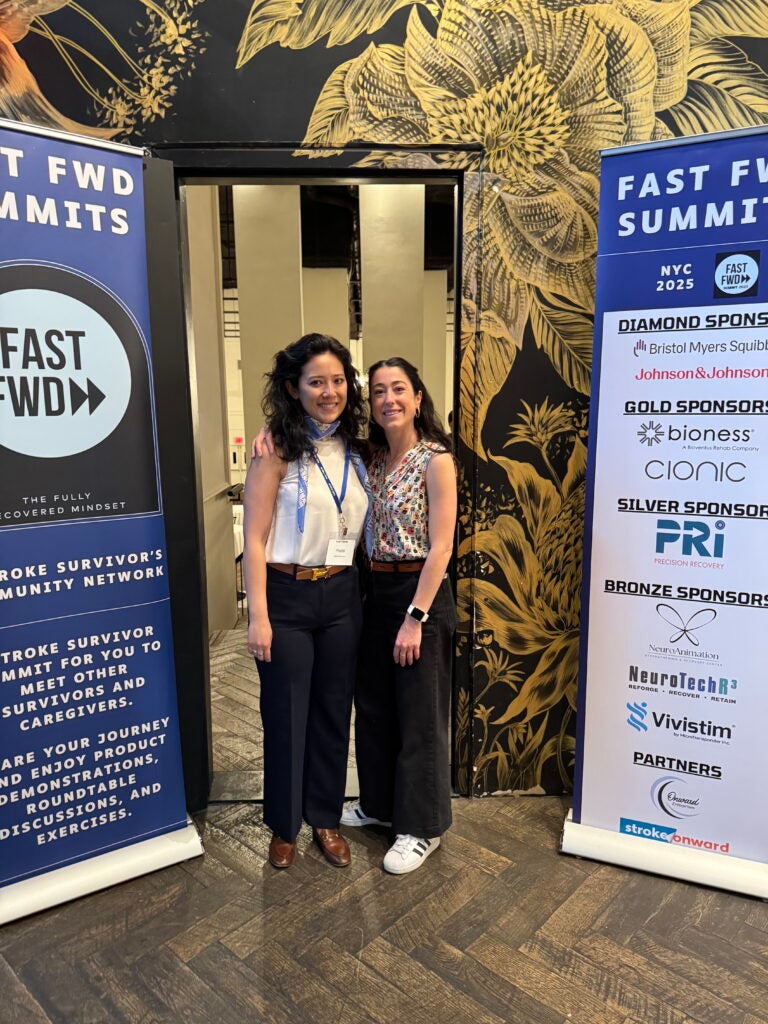
Niebanck has a network of supporters, including friends from Georgetown. One of her college roommates, Meg Wallace (C’17), pictured on the right, visited Niebanck at the Fast Fwd Summit in New York City this year.
She was walking up and down the hall in the hospital with her cane, trailed by her mother pushing her wheelchair. She passed the rooms of other patients and thought to herself, “I am so lucky and fortunate that I have this opportunity to work hard.”
Niebanck credits her family members, friends, New Jersey network, Georgetown community and the people she met in rehab for keeping her motivated. By working on her recovery, she wanted to show herself and her supporters that there is life after a stroke, Niebanck said.
“I don’t let my disability stop me or hold me back from achieving the things that I want to in my life,” she said. “Obviously I had a stroke, but I view it as a testament to my resilience and my ability to adapt and overcome and take a different step — literally and figuratively.”
Niebanck thinks back to when she was on the Hilltop and wants students to remain open minded to opportunities they might not have considered in school. If she hadn’t, Niebanck said, she would never have written one book, let alone two, or become a public speaker and disability advocate. The unexpected things that happen in life aren’t necessarily an ending, she said. They can also be a new beginning.
“Your path can change,” Niebanck said. “It will change, actually, and that’s okay.”