
Music Professor Benjamin Harbert Wins 3 Awards for Book on Incarcerated Musicians
As a professional musician, Benjamin Harbert is accustomed to instant feedback from the audience while performing. But writing a book is different. The response to it takes time.
So, Harbert didn’t truly understand how his book, Instrument of the State: A Century of Music in Louisiana’s Angola Prison, would be received publicly until recently.
This past year, Harbert, a professor of music and chair of the Department of Performing Arts in the College of Arts & Sciences, won three prestigious awards for the book, which was published in 2023: the 2025 Irving Lowens Book Award, the 2024 Music in American Culture Award and the 2024 Portia K. Maultsby Prize.
“Each one has meant something different,” Harbert said of the awards. “It is certainly validating when you get a response from a book.”
Instrument of the State chronicles more than a century of musical history from incarcerated individuals at the Louisiana State Penitentiary, commonly known as “Angola” in reference to the country of origin for many of the enslaved people who lived on the former plantation. The penitentiary still exists today and is the largest maximum-security prison in the U.S. with thousands of inmates.
In the book, Harbert pieces together oral history and archival research to show how incarcerated individuals at the prison have found rare creative expression and a limited experience of freedom through music.
“It gives us an opportunity to think of prison as a disorganized, haphazard, conditional and historical institution,” he said.

The Guts and Glory Band performing at the Angola prison in 2013. (Benjamin Harbert)
The Society for American Music annually gives out the Irving Lowens Book Award for the book it judges as the best in the field of American music. The organization praised Instrument of the State for its “compelling narrative” that centers the voices of incarcerated musicians.
“It opens the door to a musical world long hidden from view and prompts readers to ‘listen longer’ to the message of Angola Prison’s musical presence,” the organization’s awards committee wrote in its announcement.
The recognition meant a lot to Harbert.
“It’s regarded as the biggest prize in the study of American music,” he said. “So that feels good.”
Each year, the American Musicological Society honors a book of “exceptional merit that both illuminates some important aspect of the music of the United States and places that music in a rich cultural context” with the Music in American Culture Award.
The organization’s awards committee wrote that, “By placing familiar stories in new contexts, we come to understand the powerful role(s) music can play in an oppressive system. Instrument of the State matters in ways subtle and profound. It challenges us to rethink old myths about the authenticity of Black music and it brings us face to face with the abomination of justice that is the American prison system.”
For Harbert, that award meant that his book was “approachable and resonant beyond the academic impact.”
“My colleague John Tutino in the History Department gives everybody this advice: write for humans,” Harbert said. “So to get that prize meant that I had followed John’s advice.”
The Portia K. Maultsby Prize, given out by the Society of Ethnomusicology “recognizes the most distinguished English-language monograph in the field of ethnomusicology, with the focus being African American music and/or Black music of the diaspora.”
The organization’s awards committee wrote that Harbert “approaches this project with more care and substance, doing extensive archival research and interviews and giving honor and dignity to his conversation partners, and thereby producing a book that will have reverberations across and beyond the field.”
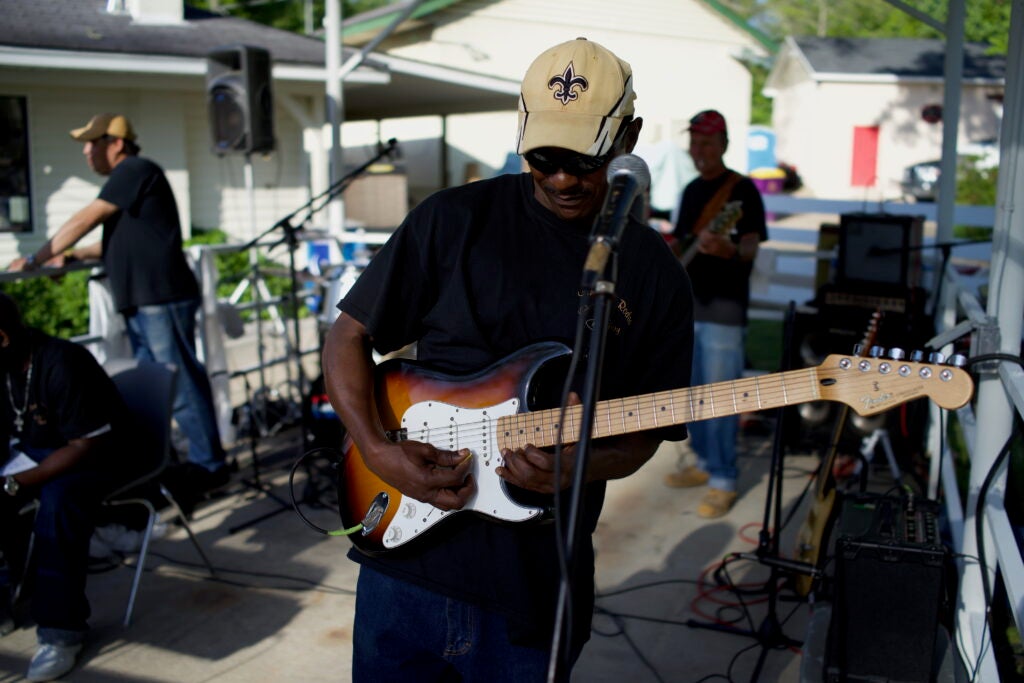
Myron Hodges, guitarist for Angola Big River Band, performing outside the Ranch House at the Angola prison in 2013. (Benjamin Harbert)
Chloe Hornbostel (C’26), a government major and music minor who took Harbert’s American music ethnography and rock history courses, called the book an “eye-opening read.”
“It played a large role in my understanding and appreciation of music’s ability to carry significant historical weight,” she said. “The book taught me more about the ways in which culture and expression persist in spite of social or legal hindrances.”
Harbert said that winning the three awards reinforced to him that the musicians’ stories mattered and that they’re part of the American story. After learning of each award, he would send updates to the incarcerated musicians at Angola.
Myron Hodges, a guitarist for the Angola Big River Band, wrote in one of the book’s foreword that he was “deeply honored” to be a part of Instrument of the State.
“Instrument of the State is like no other book I’ve read about Angola because it doesn’t stereotype its subjects,” Hodges wrote. “Instead, it focuses on the musical history and the endeavors of men serving time, those of us who seek to achieve a sense of purpose, meaning, peace and normalcy in our lives, using our musical abilities to captivate the hearts and minds of our audiences and our keepers.”