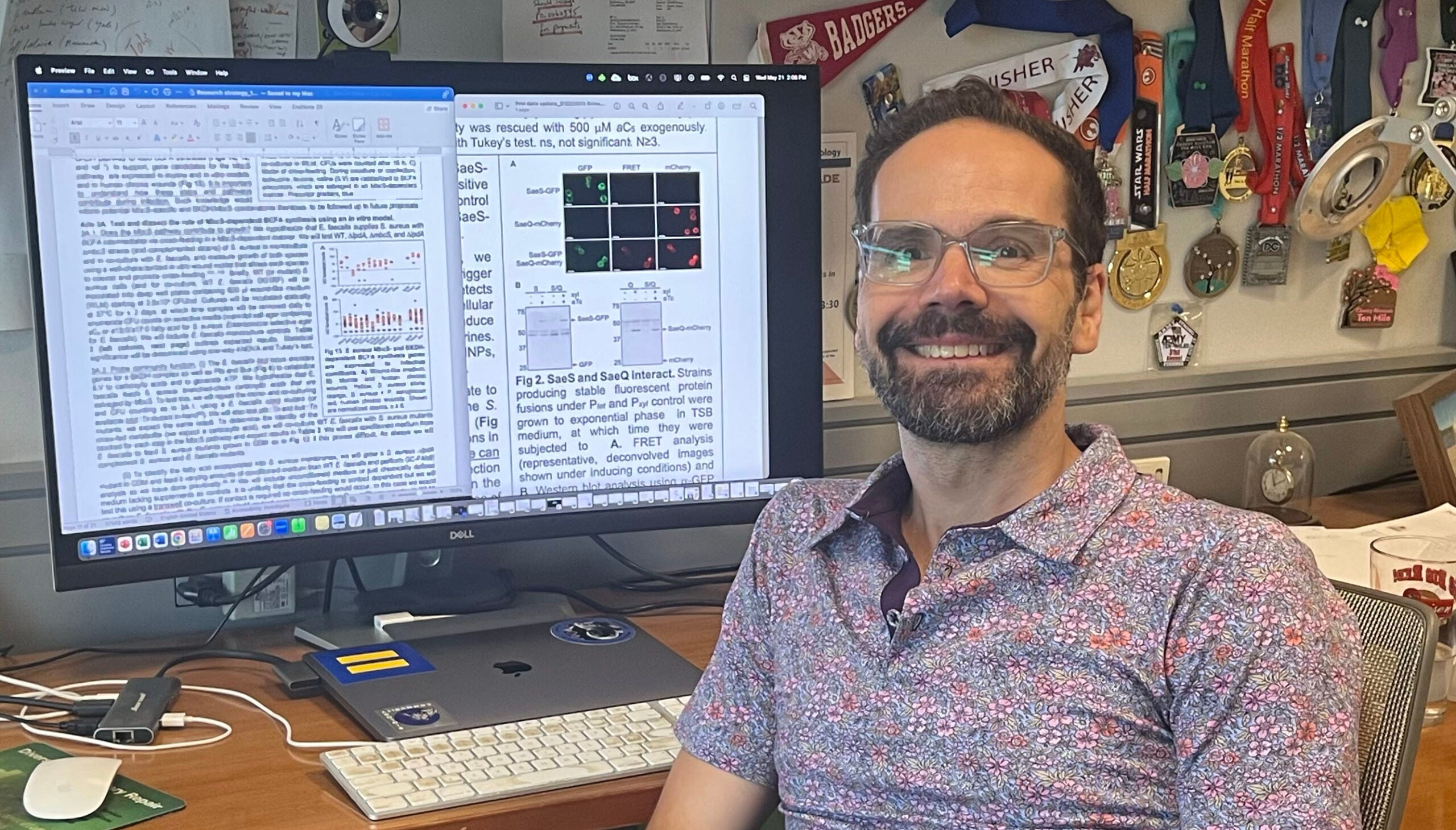
Professor Shaun Brinsmade Named Distinguished Lecturer by the American Society for Microbiology
Professor Shaun Brinsmade of the College of Arts & Sciences’ Department of Biology has been named a 2025-26 Distinguished Lecturer by the American Society for Microbiology (ASM), a recognition that highlights both scientific achievement and dedication to mentoring the next generation of researchers.
For Brinsmade, the honor represents more than an opportunity to present his lab’s discoveries — it is a platform to mentor, connect and inspire. As part of the program, he has been connecting with institutions across the country to share his research and engage directly with students and faculty, offering guidance on research trajectories, professional development and scientific leadership.
Brinsmade has already been active in this role. Last November, he was a keynote speaker at the Theobald Smith Society Fall 2025 Symposium, and in March, he will speak at the Missouri Valley branch of ASM.
“This is an honor, recognizing his commitment to mentoring students and junior faculty members,” said Ronda Rolfes, chair of the Department of Biology. “In Biology, we recognize his talents; this award lets others — inside and outside of the University — know about his mentoring commitments and his strong research.”
How Bacteria Works
The Brinsmade Lab focuses on a fundamental question in microbiology: how bacterial pathogens decide when to produce toxins.
While bacteria are often framed as invaders, Brinsmade offers a different perspective. “We often think of bacteria as ‘out to get us,’ but they’re not,” he said. “Their goal is to multiply, to divide, to grow.”
To do that, bacteria must obtain nutrients inside the human body during infection. His lab studies “how they make the decision to turn on the synthesis of proteins or other molecules to help them forage those nutrients in the host during infection,” Brinsmade said. In short, the group investigates the regulation of toxin production and the broader mechanics of bacterial physiology.
Another focus of the lab is antibiotic resistance. “We use antibiotics to treat bacterial infections, and they’re becoming increasingly ineffective because of antibacterial resistance,” Brinsmade said. Many antibiotics target the bacterial cell membrane, which is the structure that separates the inside of the cell from the outside and is essential for survival.
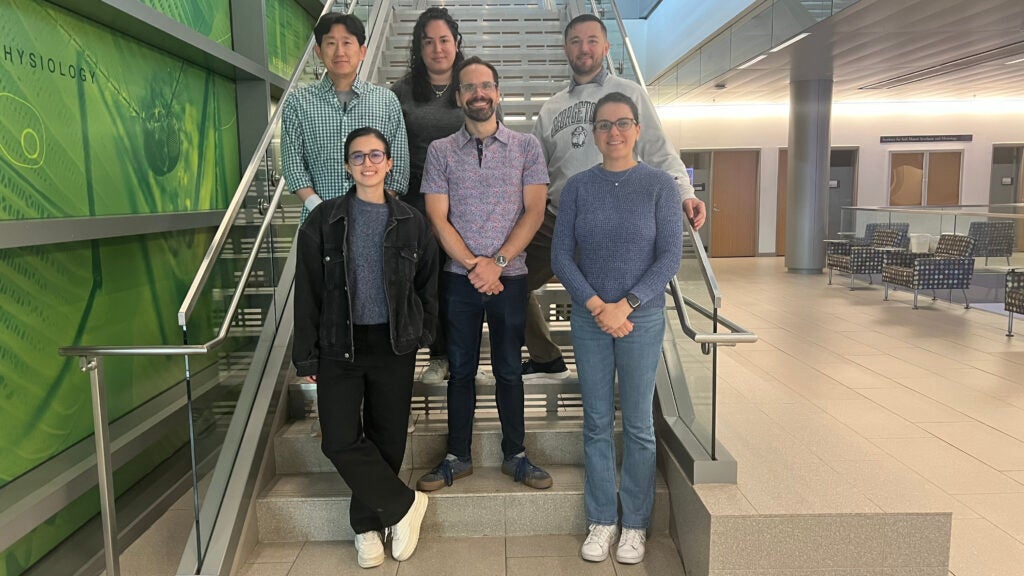
Members of Shaun Brinsmade’s lab, from top left to right, WonSik Yeo, Fabiana Málaga Gadea and Dennis DiMaggio; from bottom left to right: Danna Camelo, Brinsmade and Marcelle Ferreira.
Brinsmade’s team has made a recent discovery in their bacterium of interest, Staphylococcus aureus. The team found that this dangerous bacterium has a hidden backup system for building its membrane, and that discovery could help scientists design better antibiotics.
Still, Brinsmade emphasizes that his lab is fundamentally driven by curiosity and basic biology. “We try to unravel the fundamental mechanics of bacterial physiology,” he said. While new therapies would be welcome, that’s not their goal. Their main goal is to understand the biology of the organism.
Teaching Beyond the Textbook
Brinsmade is deeply committed to undergraduate and graduate education.
“I always put the students first,” he said, whether in the classroom or the research lab.
He has taught courses including biochemistry, microbiology and mechanisms of bacterial pathogenesis. While foundational knowledge is essential, he believes undergraduate science is more than memorizing facts.
“In all these courses, you have to start somewhere … but we also expand on what we read in a textbook and look into the primary literature,” Brinsmade said.
Students analyze journal articles written by scientists, learning not only new discoveries but “the process by which those data are obtained,” he said. As Brinsmade puts it, “you actually learn about doing science at the same time that you’re learning about the science.”
He finds that excitement in the classroom can be infectious.
Students often “get excited about learning a new technique, or learning about a new discovery… and they become curious,” Brinsmade said.
The Importance of Mentorship
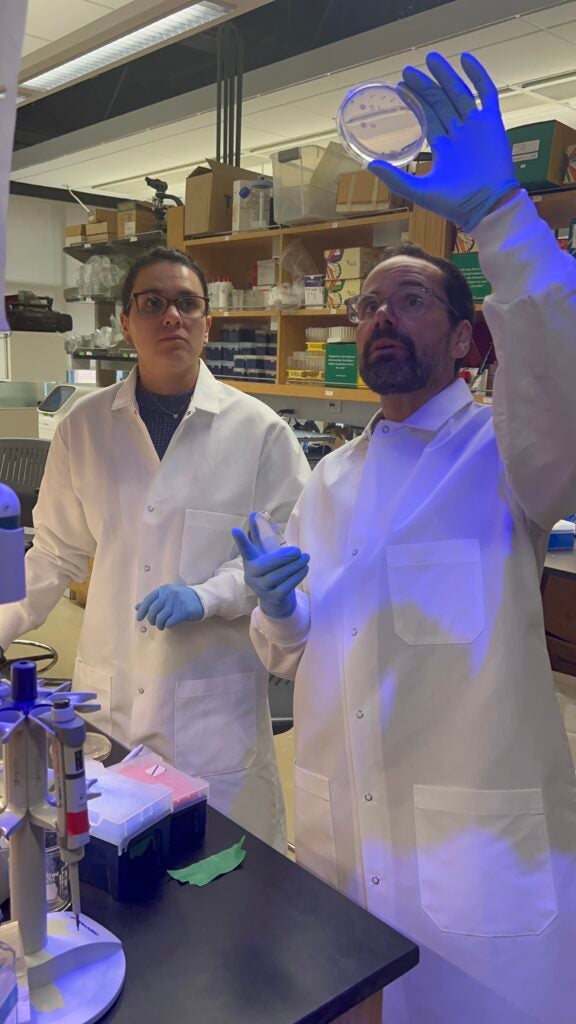
Brinsmade, right, and Marcelle Ferreira, a Ph.D. candidate at Georgetown, in the Brinsmade Lab.
Mentorship, for Brinsmade, is central to both his career and his identity as a scientist. His lab includes trainees from the United States but also from countries all over the world, including Brazil, Colombia, Peru and Korea.
He approaches mentoring as individualized work.
“Everybody is different,” Brinsmade said. “There’s not a one-size-fits-all.” Each trainee requires “a bespoke experience,” he added, shaped by their goals, background and aspirations.
He acknowledges that becoming a good mentor is an ongoing process. “I’ve learned by making mistakes. Nobody’s perfect,” he said. Mentoring, he believes, is more of a practice, because “you’re always learning something new.”
His commitment to holistic evaluation stems from his own experience. As a student, he described himself as “not a very good standardized test taker,” and his standardized testing scores were “average at best.”
“There’s more to a person than a test score,” he said. Because others gave him a chance, he strives to do the same for his students.
Finding Your Advocates
Brinsmade also sees the Distinguished Lecturer role as a platform for representation. “Anybody can be a scientist,” he said. As someone who identifies as LGBTQ, he hopes that visibility matters. By traveling, giving lectures and sharing his story, he hopes others will see themselves in science.
“We don’t hear much about those scientists who identify as LGBTQ,” he said. “If someone sees me and says, ‘I can also be just like Professor Brinsmade,’ then that’s important.”
When asked what message he would share with Georgetown students, his advice was direct: “Take advantage of the opportunities that are available to you. You never know where they’ll lead you.”
He also encourages students to seek mentors, even multiple ones. “There’s not one person that can be a mentor for every aspect of your life,” he said. Instead, “surround yourselves with mentors and people that are going to support you and advocate for you, and they will help you achieve your dreams.”
Through the ASM Distinguished Lecturer program, Brinsmade will share his lab’s discoveries with audiences nationwide. Just as importantly, he will continue modeling the inclusive, curiosity-driven science that defines his work and demonstrate that excellence in research and dedication to mentorship go hand in hand.