Learning How to Make a Decision Through an Ignatius Seminar
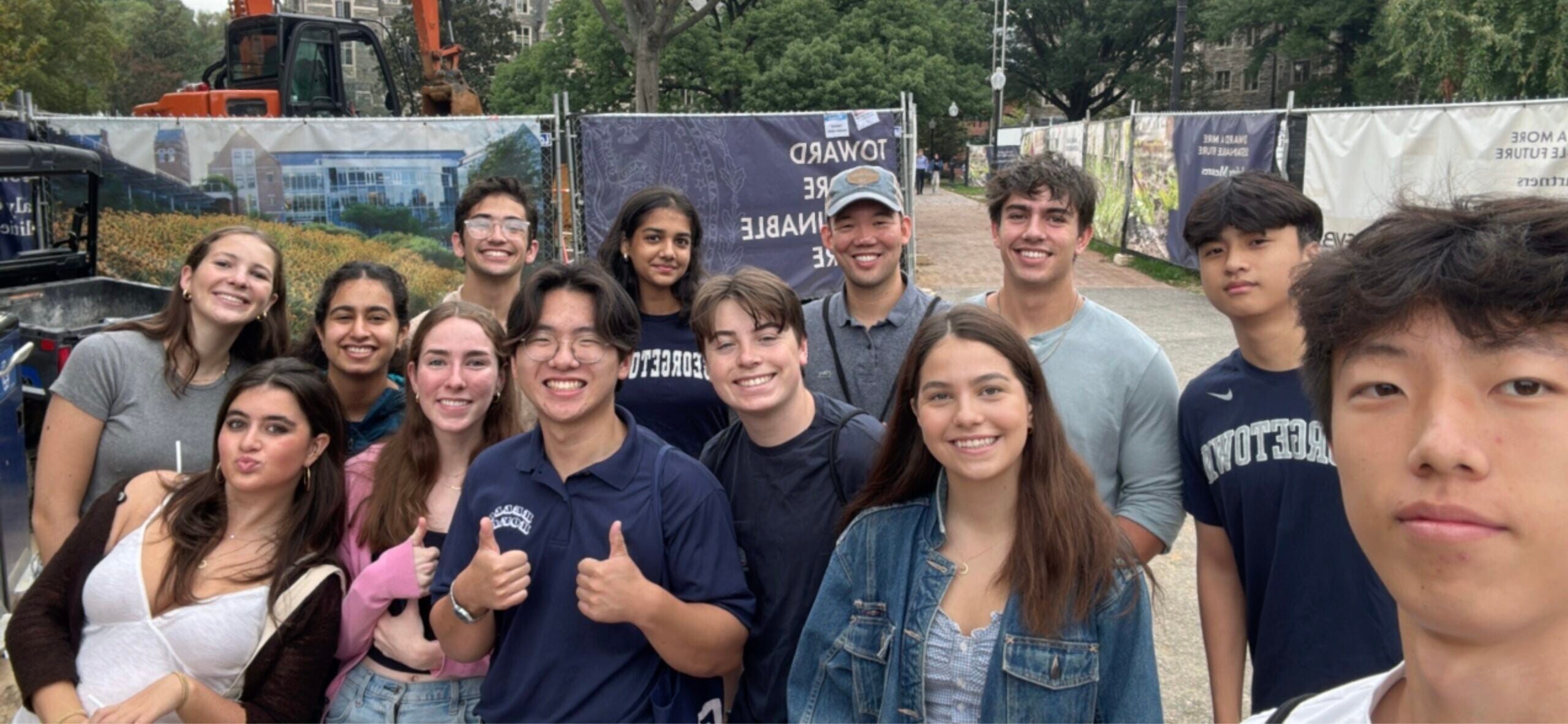
As the clock ticks closer to 9 a.m. on a sleepy Saturday morning in late September, the students standing near Georgetown University’s main gates anxiously await the next steps of their mystery assignment.
Their professor, Fr. Peter Folan, S.J., has provided them with a meeting time and location but has otherwise kept details vague. Today is the first out-of-the-classroom “Decision Lab” assignment as part of Folan’s first-year Ignatius Seminar, How to Make a Decision.
At 9:02 a.m., the students’ phones buzz with a GroupMe notification from Folan.
You didn’t think I would be meeting you in person, did you?
But I did tell you that I would see you at 9 am. Help me make that statement true by taking a selfie of the whole group and sending it to me.
I’m here with the students, both as a participant and observer, to learn what goes into the decision-making process. My first and only decision of the day comes as every student except one has made it to the starting point. I have to choose a photographer.
I pick Sophie Erlinger (C’29), who has already started to round up her classmates. But as she attempts to get everyone in the shot, another student, Sam Baghdadchi (C’29), suggests that Randy Fu (C’29) take the photo instead. “Randy has longer arms,” Baghdadchi says.
I’ve wasted no time, it seems, in making the wrong decision.
After the selfie is sent, Folan divides the class into three groups. Thirteen of 16 students in the cohort are here for the assignment. I’m sorted with Lily Carroll (C’29), Yulian Dlaboha (C’29), Manavi Gupta (C’29) and Brandon Hsu (C’29).
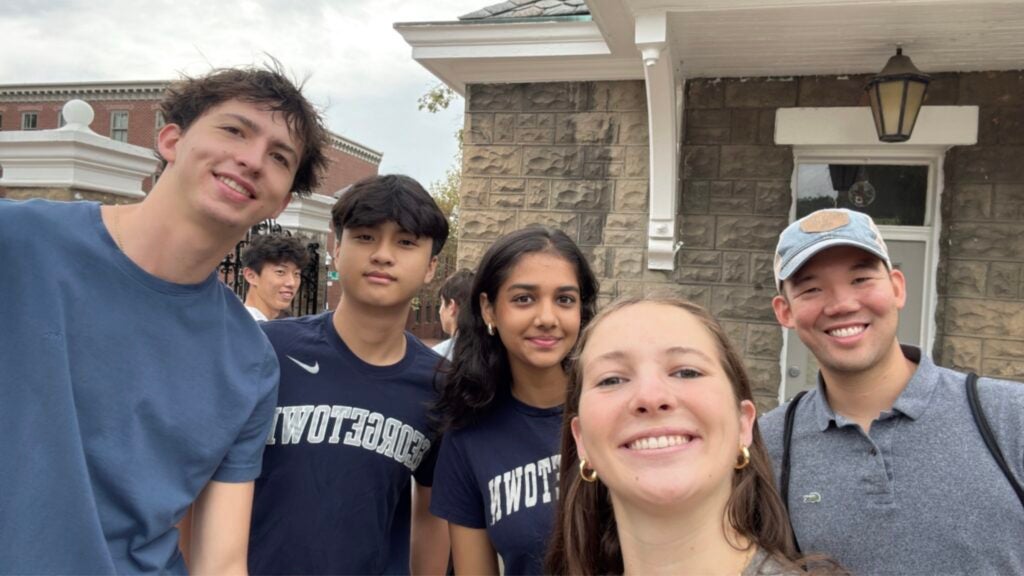
From left to right: First-year students Yulian Dlaboha (C’29), Brandon Hsu (C’29), Manavi Gupta (C’29), Lily Carroll (C’29) and the author get ready for the “Decision Lab” assignment.
Our team’s first task is to walk to Tatte Bakery & Café in Georgetown. Gupta has been directed by Folan to lead the way, and at one point, Carroll wonders out loud: “Is this supposed to be a race?”
We don’t know the answer, but we pick up our speed just in case.
Our group arrives at Tatte, and Carroll asks the barista for an envelope marked “Georgetown Decision Lab – Group 2.” It’s starting to feel like we’re in Folan’s version of the reality competition show, Amazing Race. Inside the envelope are five SmartTrip Metro cards.
Folan, meanwhile, is in an undisclosed location with his colleague, Erin Cline, a professor in the Department of Theology and Religious Studies, and co-conspirator in today’s assignment. We select our next destination: the headquarters of the Association of Jesuit Colleges and Universities in Dupont Circle, and start heading toward the door.
Not so fast, Folan responds. “I’ve asked twice now for a group name…and none has come!”
There will be a small penalty, he tells us, as we each slump back down in our seats. Carroll offers to buy Folan a croissant, but he declines. If this is a race, we’re not off to a good start.
Time to make better decisions.
Reflective Decision Makers
One of Folan’s inspirations for the course is St. Ignatius of Loyola, founder of the Jesuits.
“Obviously, I don’t know Ignatius personally, but it is the Jesuit tradition of being very serious about discernment and decision making that is part of the deep bass background music of what I’m doing in class,” Folan tells me between sips from a cup of espresso.
It’s a few days before the “Decision Lab,” and we’re sitting in Folan’s office in the New North building on campus. He has just finished teaching his seminar course for the week and is curious how the class will react to the lab assignment. Students must attend at least one of the three out-of-the-classroom labs during the semester.
First-Year Seminars like the one Folan is teaching are small, unique courses designed exclusively for first-year students in the College of Arts & Sciences, and this is the first time his Ignatius Seminar is being offered.
“I hope they don’t just give it a whole shoulder shrug,” Folan says of the lab. “I figure, worst-case scenario, the College is treating them to lunch at the end of the day.”
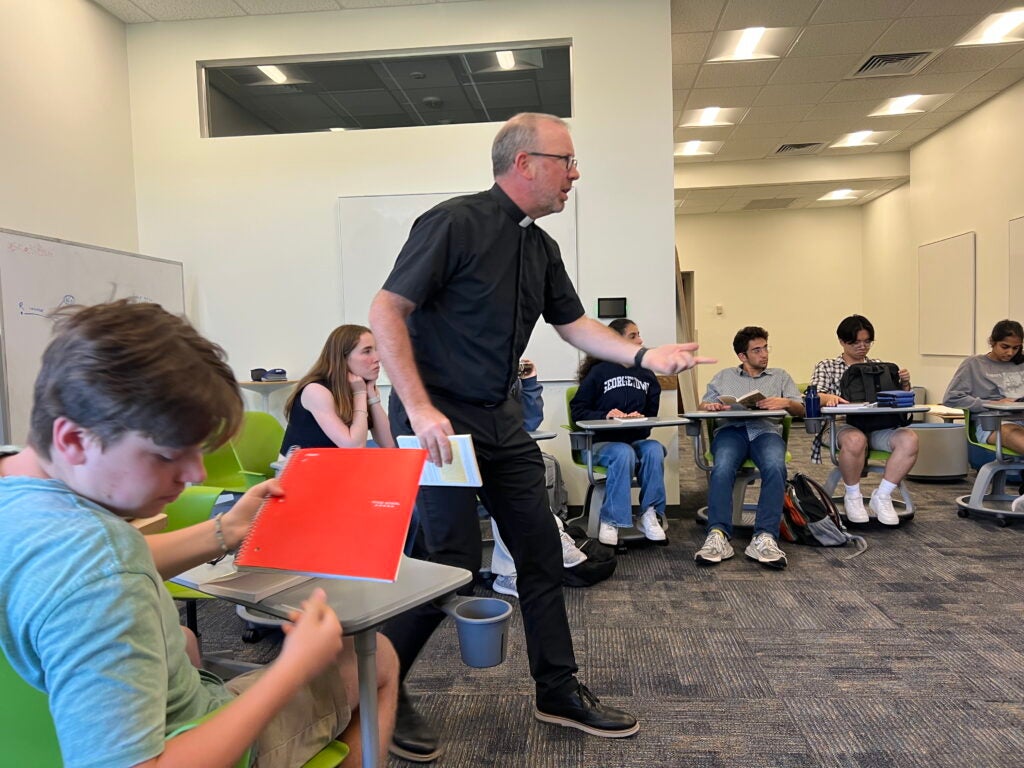
Folan joined Georgetown in the fall of 2019 as a faculty member in the Department of Theology and Religious Studies.
Folan radiates coffee-fueled energy and his eyes widen behind his dark-rimmed glasses as he’s explaining his inspiration for the class.
“I want them to be able to do more than simply choose from a field of options,” Folan says. “I want them to be reflective about the decisions they make and to know why they are making those decisions.”
The idea for the seminar developed over time as Folan reflected on his own significant life decisions and conversations he’s had with alumni of the George F. Baker Scholars Program, where he serves on the Board of Trustees.
He hopes that instead of being “decision-making machines,” the undergraduates he teaches become people who feel comfortable with decision making. “I want them to feel,” Folan says, moving his hands for emphasis, “that when the record skips in their lives, they can still move to the music, and hopefully I’m giving them some tools to do that.”
Folan grew up in Massapequa Park on Long Island, as the oldest of three siblings. All four of his grandparents are immigrants from Ireland, and Folan describes his family as a “pretty typical middle-class home.” Neither of his parents had a college degree; his father worked for the Federal Aviation Administration, and his mother was a secretary at a law firm. They went to Mass every Sunday.
“I was always close to God,” Folan says. “Church, God, things like that were always important to me, as were playing baseball and soccer, doing well in school and being a Cub Scout. But for me, even as a child, the priest was a very interesting figure.”
He applied and was accepted to Chaminade High School, a private Catholic school on Long Island. Attending that school is a decision Folan calls one of the top three most important he’s made in his life. Seeing the schools that graduates of Chaminade attended – University of Notre Dame, Boston College, the University of Chicago, Stanford University, Georgetown University – opened his eyes to what was possible.
Folan would go on to Notre Dame and faced another major decision after graduating: follow his friends and a familiar path to Notre Dame’s Alliance for Catholic Education (ACE) or take a leap into the unknown and accept a job offer with the United States Conference of Catholic Bishops in DC.
“There was just a sense of adventure of going to Washington, DC,” Folan says.
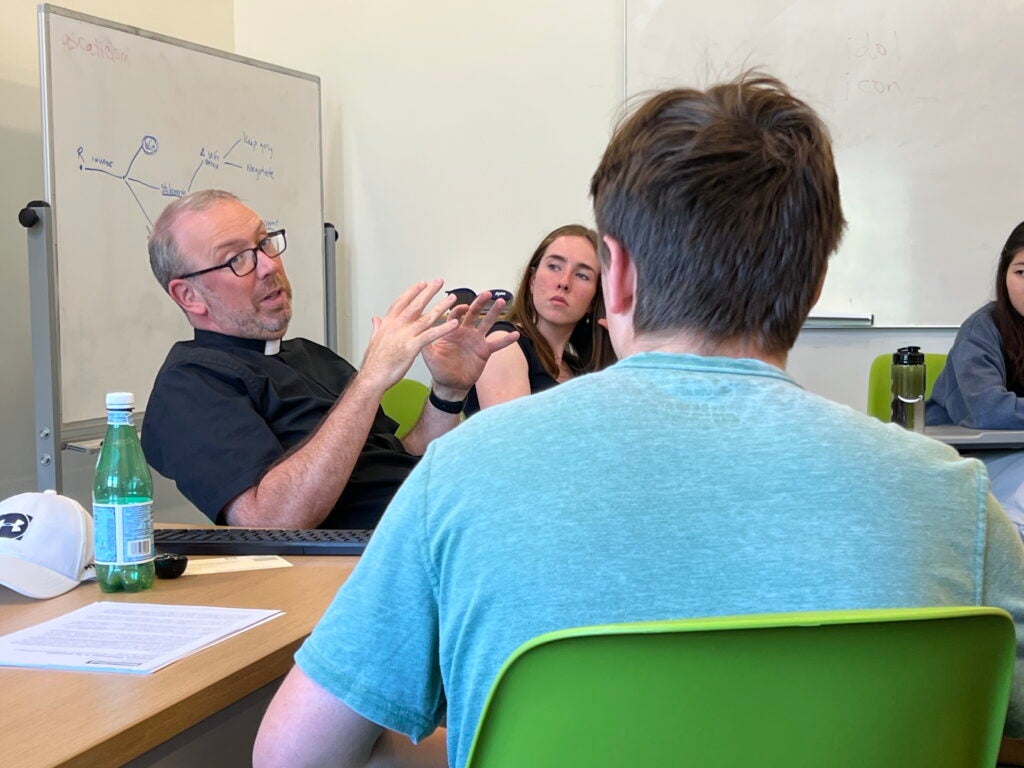
The idea for the Ignatius Seminar was inspired by Folan’s own significant life decisions and conversations he’s had with alumni of the George F. Baker Scholars Program, where he serves on the Board of Trustees.
Afterward, he taught at Bishop McNamara High School in Maryland for two years before applying to become a Jesuit priest – another major life decision.
“Probably the best piece of discernment data I could have ever gotten was that I was in love with teaching at that high school, and still, I wanted to apply to become a Jesuit,” Folan says.
Folan became a priest in 2013 and spent his first year after ordination at Holy Trinity Catholic Church, right outside the gates of Georgetown University. He earned a Ph.D. in theology from Boston College in 2019. Later that fall, Folan joined Georgetown as a faculty member in the Department of Theology and Religious Studies. He thought it would be the best fit.
“I talk a lot in class about options,” Folan says. “What are the options before you when you have to make a decision? Are there options you do not see? Are there options that you can create? Luckily for me, when it came to Georgetown, my best option was right in front of my eyes.”
Time, Value and Options
In his Ignatius Seminar, Folan has three overarching goals for students:
- To get under the hood of decision making.
- To identify their strengths and their yet-to-be strengths in decision making, honoring the former and developing the latter.
- To build a foundation in theology and religious studies for further learning.
Students are taught that in order to make a decision, one should identify the conditions, carry out the act of that decision and embrace the results or re-think the decision.
The conditions surrounding a decision include time, values and options, Folan says. Making decisions often means choosing between options; the Latin roots of the word decision mean to cut off, Folan explains.
An evaluation process follows.
“After making the decision, one has to live into the decision and hopefully confirm that it was a good decision,” Folan says. “Maybe it wasn’t a perfect outcome, but it might have been a good decision.”
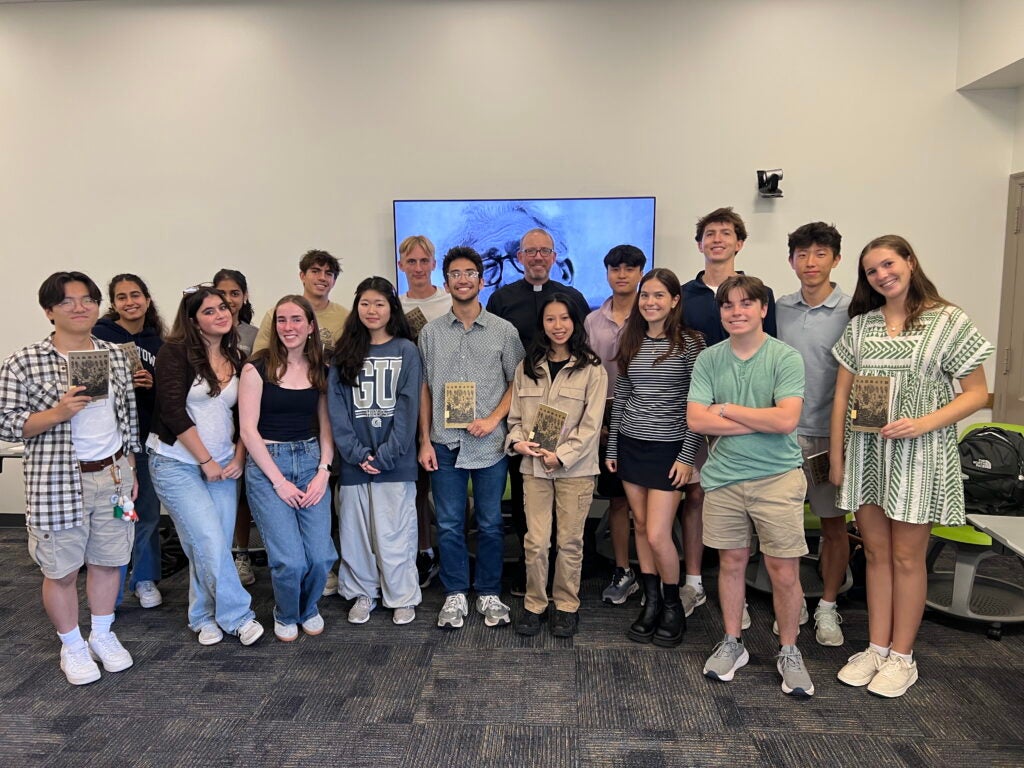
The small cohort of 16 students learn from religious texts like Abraham Joshua Heschel’s The Sabbath.
In class, students learn from religious texts like Abraham Joshua Heschel’s The Sabbath. In the book originally published in 1951, Heschel, a Polish-American rabbi, describes the Sabbath as a sanctuary of time and emphasizes the value of choosing time over space.
“It is not a thing that lends significance to a moment; it is the moment that lends significance to things,” Heschel writes.
“Oftentimes, when we think about time, especially in decision making, it’s kind of like an hourglass – how much of it do I have left?” Folan says. “I hope The Sabbath can give us a different perspective on time: how I measure it, what it is, how it can form me, how it can be a gift.”
Working Together
Our team – which finally has a name, Aesthetic Instagram – is lost.
We race through the hallways of the sixth floor of 111 Massachusetts Avenue NW, the new interdisciplinary hub on Georgetown’s Capitol Campus, and homestretch of the “Decision Lab,” but can’t find the right room.
“Are we sure it’s on this floor?” Gupta asks. “Should we split up and message each other?”
We make an unspoken decision to stick together and round another funhouse mirror corridor. Finally, at 11:48 a.m., nearly three hours after we started our journey, we spot Folan and Cline sitting inside a conference room, with wide grins on their faces.
“Welcome!” Folan shouts, as we push open the doors. “Did we have fun? Did we learn something?”
Aesthetic Instagram is the first team to arrive. Nine minutes later, another group – HTMADness (a pun on the course name) – makes its way through the doors, and seven minutes after that, the third group – Deciding Factors – arrives.
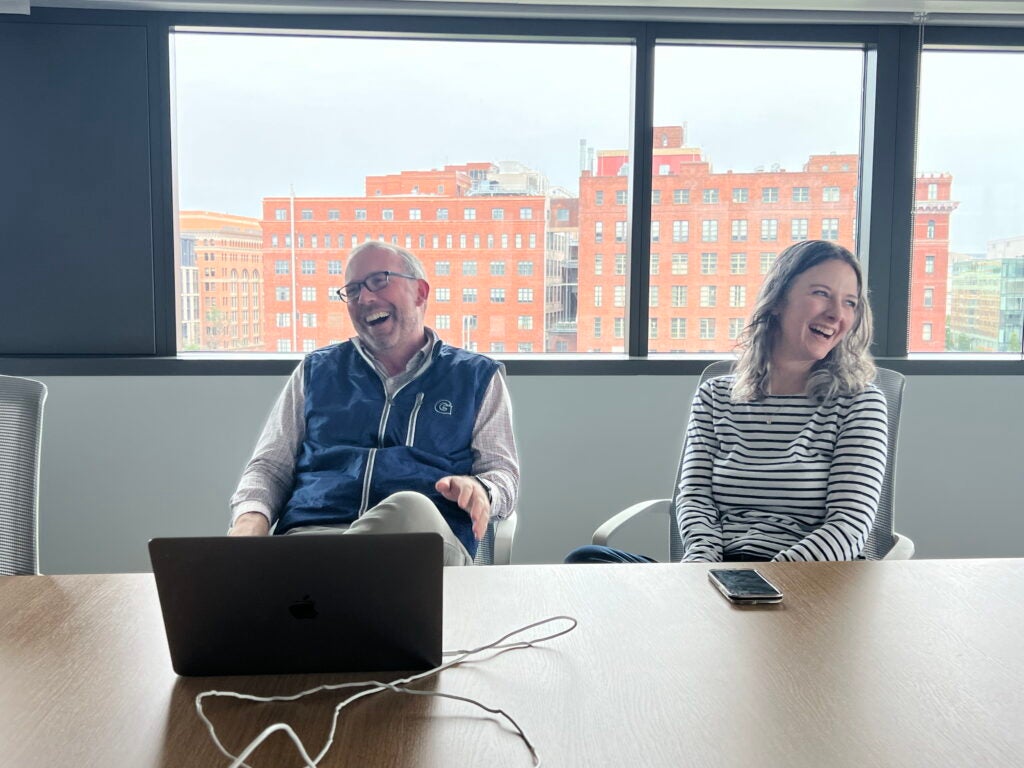
Folan, left, recruited Erin Cline, a professor in the Department of Theology and Religious Studies, to help with the “Decision Lab.”
On the digital board, Folan and Cline have been taking notes of the teams. In addition to finishing first, we learn that we are the only group to have walked to the first three locations. My watch has recorded more than 14,000 steps. We receive points for our decisiveness, creativity and negotiation skills. (Folan declined Carroll’s croissant offer earlier because he had already gone to Tatte.)
But the race isn’t the point of the exercise. “Punctuality is a value, but there are other values too,” Folan says.
Throughout the lab, Folan has included prompts in his instructions to help group members learn about each other. After a rocky start, our team now resembles one that worked together each step of the way. Even our team name, Aesthetic Instagram, comes from a shared joke of the quintessential fall morning in Georgetown.
We learn that Carroll is in an improv group on campus and had never ridden the DC Metro before today. Dlaboha plays club volleyball and is thinking of becoming a Georgetown basketball manager. Gupta’s goal is to visit every cafe on M Street before graduating. Hsu wants to join an investment club.
The purpose of the lab, Folan tells the group gathered around the table, was more than just to test our navigation skills and attention to detail. It was an opportunity for students to spend time together and have meaningful conversations to get to know each other better, all while exploring the city and Georgetown’s newest campus. In a sense, Folan wanted us to slow down time.
As we leave the building and walk toward The Dubliner for lunch, the students continue chatting and sharing laughs. Folan looks on and smiles. No one is in a rush to leave.